
A strong operating model gives AI something worth accelerating. Without clear decision rights, incentives, and data, the mess spreads faster.
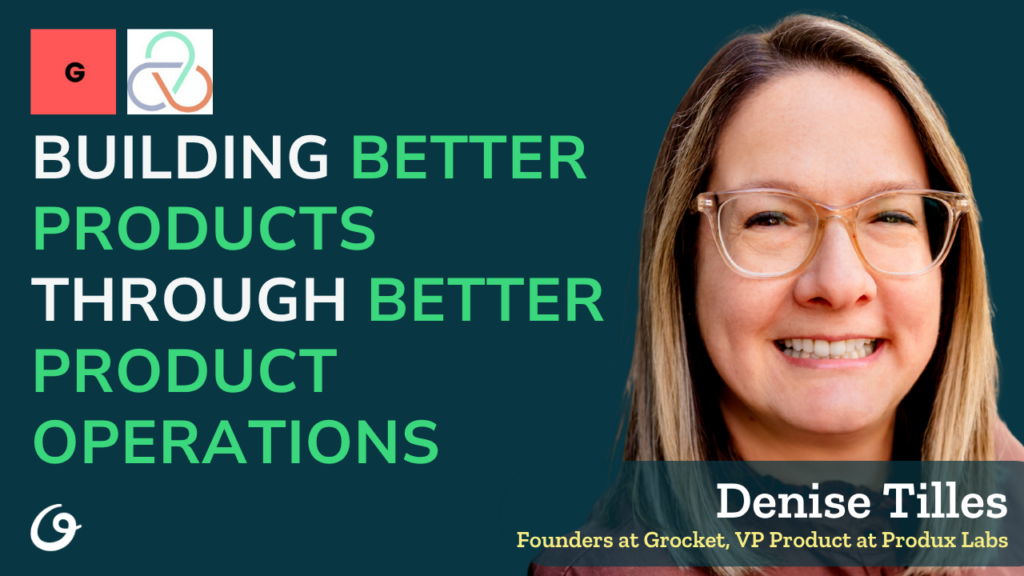
In this episode, I sit down with Denise Tilles, a leading voice in product operations, to unpack how her career moved from editorial work at Condé Nast into product management, commercial leadership, and eventually product operations. Denise shares how learning to work with revenue data, product analysts, and operating models changed the way she thought about product leadership and led to her work helping enterprise organizations make faster, better-quality decisions.
We explore what product operations actually does, why an operating model needs to define how decisions get made, and where incentives can quietly undermine even a well-designed process. We also dig into what happens when AI makes producing documents, specifications, and analysis nearly effortless: generating more output doesn’t remove the work of judgment. In many cases, it makes clarity about inputs, outputs, ownership, and what “good” looks like even more important.
Subscribe


Key Takeaways
- Product ops should improve decision-making: Denise defines it around business and data insights, customer and market insights, and the operating model.
- Commercial context changes product thinking: At Cision, learning P&L, ACV, and recognized revenue helped Denise connect product decisions directly to business outcomes.
- Good analysis reveals hidden opportunities: A product analyst uncovered an add-on opportunity that generated roughly $1 million within a year.
- Operating models need clear decision rights: Teams need to know what gets worked on, who decides, and how work actually gets done.
- AI amplifies the system already in place: If ownership, data, or processes are unclear, AI can make those weaknesses spread faster.
Additional Insights
- Informal decisions can override formal processes: Denise learned that hallway conversations and executive requests often mattered more than the documented workflow.
- Proof does not create authority: Better analysis can earn credibility, but changing a system still requires ownership, sponsorship, and permission.
- Incentives shape behavior: Product and sales can both act rationally while optimizing toward conflicting measures of success.
- AI can shift work downstream: Faster artifact creation still leaves someone responsible for checking the reasoning, evidence, and assumptions.
- Operations may become more connected: Denise sees product ops, design ops, sales ops, and other functions moving toward a more unified “Omni Ops” model.
Episode Highlights
00:00 – Episode Recap
Denise explains why operating-model and AI work should begin with the pain a company is experiencing, from PRD structure to data quality, rather than adopting AI simply because the technology is available.
02:01 – Guest Introduction: Denise Tilles
I introduce Denise Tilles and her work in product operations and operating models, setting up our discussion about data, decision-making, incentives, and how product organizations can operate more effectively.
03:13 – From Editor to Product Leader
Denise traces her move from editorial work at Condé Nast into product management and commercial leadership, where access to revenue data changed how she understood products and business outcomes.
08:41 – The Analyst Who Changed the Team
Denise explains how hiring a product analyst gave her team more objective insight into customer and product data, including an overlooked opportunity that generated roughly $1 million in its first year.
15:14 – The Three Pillars of Product Ops
Denise defines product operations through business and data insights, customer and market insights, and the operating model, all designed to help product managers make faster and better-quality decisions.
17:01 – How Decisions Really Get Made
Denise describes how documented processes compete with informal conversations and executive requests, revealing why operating models must clarify what gets worked on, who decides, and how decisions happen in practice.
24:41 – Ownership, Incentives, and Accountability
Denise explains why operating models need clear owners and how conflicting incentives can cause teams to optimize for different outcomes, even when everyone is acting rationally within the system.
29:09 – When AI Makes Weak Ideas Look Stronger
Denise explains how a senior leader’s opinion can arrive with an AI-generated specification, data, and outcomes attached, making an untested idea appear more rigorous without improving the underlying thinking.
33:22 – Define What Good Looks Like
As AI increases the volume of work teams can produce, Denise argues that operating models need clearer standards for what should be created, what evidence belongs in it, and how colleagues should consume it.
35:33 – Your Output Is Someone Else’s Input
We explore the value of looking at work end to end, because one team’s output often becomes another team’s input and localized optimization can create problems elsewhere in the system.
38:56 – Use AI Where the Pain Justifies It
Denise is advising companies to begin with the problem, the value AI might add, and the human judgment and context that must remain, rather than introducing AI simply because it is available.
41:10 – Closing Reflections: From Product Ops to Omni Ops
Denise looks ahead to a more connected model where operational disciplines work across functional boundaries, allowing companies to design operations as one system rather than a collection of independent silos.
FAQs
Q1: What is product operations?
Denise describes product operations as helping product managers make faster and better-quality decisions. Her model has three pillars: business and data insights, customer and market insights, and the operating model or ways of working that support product teams.
Q2: What is a product operating model?
At its simplest, Denise says an operating model determines what a company decides to work on, who gets to decide, and how the work gets done. Every organization has one in practice, but many have accumulated theirs informally rather than designing and communicating it intentionally.
Q3: How does AI affect product operations?
AI can accelerate activities across product operations, but Denise argues that judgment and context remain essential. When organizations apply AI to an unclear operating model, poor data, or unresolved decision rights, the technology can amplify those existing weaknesses rather than solve them.
Q4: Why do incentives matter when designing an operating model?
People tend to optimize around what they are measured on. Denise experienced this when product was focused on recognized revenue while sales celebrated closed contracts, creating different definitions of success even though both teams were acting rationally according to their incentives.
Q5: How should a company decide where to use AI in its operating model?
Denise starts with the pain points rather than the technology. She looks at issues such as PRD structure, data analysis, source quality, ownership, and decision-making first, then asks whether AI genuinely improves that part of the system and where human judgment still needs to remain.