
A lot of the conversation around AI is still focused on the wrong question: Will AI replace people?
It is an understandable fear, but it is also too narrow.
The better question is: How is AI changing the work people actually do?
That is where the real shift is happening.
In many cases, your role does not disappear. Your title may not change. Your place in the organization may look exactly the same from the outside. But underneath, the work is being reassembled.
A role is the responsibility you hold.
A job to be done is the work required to fulfill that responsibility.
A task is the specific unit of work inside that job.
AI changes the tasks first.
Some tasks disappear because they no longer need to exist. Some get automated because machines can now handle them reliably. Some get accelerated because AI helps people move faster. Some get augmented because human judgment and machine intelligence produce better outcomes together. And entirely new tasks emerge because the system of work itself has changed.
That is why the “AI will take your job” narrative misses the point.
Your role may remain. The jobs to be done may still matter. But the tasks inside those jobs are changing fast. And when the tasks change, the way people create value changes too.
The change rarely arrives in the dramatic “your role disappears overnight” way headlines suggest. It happens gradually, task by task, workflow by workflow, decision by decision.
Administrative work that once consumed hours can now happen in minutes. Routine synthesis can be automated. Research can be accelerated. Preparation can be improved. Work that depends on judgment, communication, creativity, customer understanding, and strategic thinking becomes more valuable.
That creates opportunity. It also creates discomfort.
Because if your identity has been built around being exceptional at tasks AI can now perform faster, cheaper, or more consistently, this moment can feel personal.
For years, organizations rewarded people for navigating friction better than everyone else. The Excel wizard. The person who could pull together the board deck under pressure. The operator who knew how to reconcile the numbers, track the updates, and keep complicated systems moving.
Those capabilities mattered. Some still do. But many are no longer the differentiator they once were.
The value is not disappearing, it is moving.
The Data Is Starting To Tell The Real Story
In my latest blog, I wrote about why the “human vs AI” framing is failing us too.
So far, the labor market is not showing the simple replacement story many people expected.
The Yale Budget Lab studied the labor-market impact following the release of ChatGPT and found no measurable disruption at the aggregate level between late 2022 and early 2026.
At the same time, Burning Glass Institute analyzed millions of job postings before and after the release of ChatGPT, and found something more nuanced happening underneath the surface:
- Skills most vulnerable to automation are 16% more likely to decline in demand
- AI-augmented skills are 7% more likely to increase
- Automation exposure and augmentation exposure are strongly positively correlated, at r = 0.87
In short, skills most exposed to automation are declining in demand, while AI-augmented skills are increasing. That distinction matters.
The labor market is not being reorganized cleanly by job title. It is being reorganized by task exposure and skill leverage.
That means leaders who manage AI adoption only through roles, headcount plans, or org charts are looking at the wrong level of the system.
The same roles being disrupted are often the same roles expanding at the same time. The financial analyst whose model-building tasks are automated may now spend more time interpreting patterns, challenging assumptions, and helping leaders make better capital allocation decisions. The project manager whose status reporting is automated may now spend more time identifying delivery risks, resolving constraints, and improving team flow.
The job may still exist, but the task mix inside it is changing.
That is why the more useful leadership question is no longer: Will AI take this job?
It is: How is AI reshaping the tasks, decisions, and responsibilities inside this job?
Work Is Being Reassembled
Here is the model I use with leaders:
Role → Jobs to Be Done → Tasks
A role is the responsibility someone holds in the organization.
A job to be done is a container for the work required to fulfill that responsibility.
A task is a specific unit of work inside that job.
This distinction matters because AI does not usually transform work by deleting whole roles overnight. It changes the tasks inside the jobs people perform.

Understanding Work_ Role, Job, Tasks
Take a CFO.
I will be speaking to finance leaders at the Gartner CFO Symposium next week on Turning AI Spend into CFO Decision Advantage, and this is exactly the shift many of them are facing.
The role of the CFO is still to help the company allocate capital wisely, manage risk, improve business performance, and support better enterprise decisions. But the jobs to be done inside that role are changing fast.
One job to be done inside the CFO role might be preparing a monthly business review.
That job contains many tasks: collecting data, cleaning spreadsheets, identifying trends, preparing charts, writing commentary, surfacing risks, framing trade-offs, recommending decisions, and aligning stakeholders.
AI will not affect all of those tasks equally.
It may automate data collection. It may accelerate analysis. It may draft the first version of the commentary. It may surface anomalies faster than a human can. But the judgment still matters.
- What do the numbers mean?
- What trade-off should we make?
- What decision should the leadership team take?
- What risk are we ignoring?
That is the shift.
The job is not fixed. It is a bundle of tasks, decisions, workflows, responsibilities, and expected outcomes. AI changes the bundle.
Once leaders see that, the conversation becomes much more practical.
Instead of asking: Which jobs will disappear?
They can start asking:
- Which tasks no longer need to exist?
- Which tasks can be automated?
- Which tasks can be accelerated?
- Which tasks require better human judgment?
- Which new tasks are being created?
That is where redesign starts. Not with org charts, not with job titles, not with another enterprise AI tool rollout—with the work itself.
AI does not change work evenly at the role level. It changes work unevenly at the task level. As tasks change, jobs are reassembled, and roles must evolve.
The New Task Map
AI is already reshaping work. The impact is just unevenly distributed.
Inside every job, the task mix is changing. That is the real disruption. Not the title. Not the org chart. The task mix.
The best financial analysts are no longer impressing people with spreadsheet gymnastics. They are showing up with sharper insights, better questions, and stronger recommendations.
The best project managers are not simply tracking tickets and presenting beautiful dashboards. They are seeing problems earlier, resolving constraints faster, and helping the team make better trade-offs before delivery is at risk.
The best leaders are not asking how to use AI to increase output inside old systems of work. They are redesigning work around judgment, adaptability, and decision-making.
That is where the advantage compounds.
So how do you start? By looking at the task mix inside the jobs people already do.
1. Eliminate: Tasks That No Longer Deserve To Exist
A surprising amount of organizational activity only exists because systems are fragmented and information moves slowly.
Examples include:
- manual status reporting
- copying updates between systems
- meetings held purely to relay information
- administrative checking between disconnected teams
- creating decks that repeat what everyone should already know
One of the biggest mistakes companies make with AI is accelerating low-value work instead of questioning whether the work should exist at all.
If unnecessary work stays in the system, AI simply helps organizations waste time more efficiently. That is not transformation. That is bureaucracy with better tooling.
Before automating a task, leaders should ask: Does this work still deserve to exist?
If the answer is no, the goal is not automation. The goal is elimination.
2. Automate: Tasks Machines Can Handle Reliably
There is another category of work that still matters, but no longer requires significant human effort.
Examples include:
- summarizing meetings and transcripts
- drafting recurring updates
- organizing notes and research
- extracting themes from customer conversations
- turning raw information into usable material
- generating first drafts of routine communication
This is where many teams first experience practical leverage from AI.
The important question is what organizations do with the capacity created. Some reinvest it into better thinking and stronger decisions. Others absorb it back into more meetings, more reporting, and more internal overhead.
That difference compounds quickly over time.
AI can create capacity but leadership decides whether that capacity becomes leverage or just more busyness.
3. Accelerate: Tasks That Still Need Humans, But Move Faster
Some tasks still require deep human involvement, yet AI dramatically shortens the time needed to explore, analyze, and prepare.
This includes work such as:
- research and market analysis
- scenario planning
- strategic preparation
- evaluating alternatives before making decisions
- pressure-testing ideas before important conversations
- preparing for board, customer, or investor discussions
The human role does not disappear in these situations. Judgment, context, and accountability still matter deeply. What changes is the ability to move through ambiguity with greater speed and range.
A leader who can evaluate five approaches before a high-stakes discussion usually arrives far better prepared than someone relying entirely on instinct and memory.
A team that can test assumptions before committing resources will learn faster than a team that waits for the quarterly review to discover it was wrong.
A CFO who can explore multiple investment scenarios before the executive meeting will make a better call than one who only sees the deck the night before.
This is not about moving faster for its own sake. It is about increasing the quality of preparation before judgment is required.
4. Augment: Tasks That Improve Through Human + AI Collaboration
This is where some of the most meaningful gains are emerging.
AI is often most effective when paired with experienced operators who know how to interpret nuance, challenge assumptions, and decide what deserves attention.
For example:
- an executive can reconstruct months of context before a board discussion in minutes
- a product team can synthesize patterns across thousands of customer interactions
- a CEO can explore strategic scenarios before making a high-stakes decision
- a finance team can pressure-test assumptions before recommending capital allocation
- a customer success leader can identify early signals of churn before the account escalates
In each case, the machine expands visibility and recall. The human still determines meaning, judgment, and direction. Organizations that treat AI purely as automation often miss this entirely. The larger opportunity is improving how decisions get made across the company.
Human judgment plus machine intelligence does not just make work faster. It can make work better but only if people know what judgment they are responsible for.
5. Create: New Tasks Leaders Must Now Own
AI is also creating responsibilities that barely existed before.
- how AI-generated work gets reviewed
- where accountability must remain human
- how trust is built around machine-supported decisions
- which workflows should be redesigned entirely
- how organizational knowledge gets captured and reused over time
- how teams learn from AI-supported work without blindly trusting it
- how to measure whether AI is improving decisions, not just increasing output
These are not isolated technical problems. They are leadership and organizational design challenges. And they will increasingly shape how companies operate and compete.
It is true that the work of leadership is expanding. Not because leaders need to become AI experts, but because they must become better designers of work, judgment, and decision systems.
Same Job To Be Done. Different Task Mix.
Take the monthly business review.
The old version rewarded the person who could gather numbers, clean spreadsheets, build slides, chase inputs, and survive the late-night scramble before the meeting.
The new version rewards something different.
It rewards the person who can spot the signal, explain the trade-off, challenge the assumption, and help the leadership team make a better decision.
Same job to be done. Different task mix. Higher standard for judgment.
That is what is happening across knowledge work. The visible job may stay the same, but the task mix underneath it is being rewritten. And when the task mix changes, value moves.
The Identity Trap
For many people, the hardest part of AI adoption is not learning a new tool.
It is confronting the possibility that the work they became known for may no longer carry the same value it once did.
Organizations have historically rewarded people for managing complexity, navigating friction, and building deep domain knowledge over years in their field.
- The person who could pull together the board deck at the last minute
- The operator who knew where every dependency lived
- The manager who carried institutional knowledge entirely in their head
Those capabilities mattered because the judgment systems and infrastructure in their companies were manual, fragmented, or missing altogether.
For years, knowledge was power. In many organizations, the person who knew where the answer lived had influence. Yet as knowledge becomes easier to retrieve, the value shifts.
The advantage is no longer having information in your head. It is knowing how to interpret it, challenge it, apply it, and turn it into better decisions.
AI is changing those dynamics quickly.
Information becomes easier to retrieve. Coordination becomes easier to automate. Work that once required enormous manual effort can now happen far more efficiently.
That shift can feel threatening, especially for experienced operators whose identity has been tied to being exceptional at those activities.
Remember, the value itself is not disappearing, it is moving.
In many organizations, the differentiator is becoming less about managing friction and more about building better judgment, adaptability, and decision-making under pressure.
The leaders who unlearn the outdated lessons first are usually the ones willing to rethink where they create value, instead of defending the tasks that made them successful in the past.
What Eric Ries Reminded Me About Organizations
This month, I also spoke with Eric Ries about his new book, Incorruptible, and what creates organizational health.
One idea from the conversation stayed with me: Mary Parker Follett’s concept of the “invisible leader.”
She argued that strong organizations are shaped less by hierarchy or personality and more by the quality of the system of work itself: how information flows, how decisions get made, and how people coordinate around shared goals.
That feels increasingly relevant in the age of AI.

Barry O’Reilly with Eric Ries
AI does not automatically create better organizations. In many cases, it amplifies the operating model and systems of work that already exist.
Companies with fragmented communication, slow decision-making, and excessive coordination overhead often accelerate the noise along with the productivity.
Organizations with strong context-sharing and clear decision ownership tend to benefit much faster because AI is augmenting a healthier system of work.
That is why task redesign cannot be left to individual employees experimenting alone.
If the system rewards activity, AI will create more activity.
If the system rewards judgment, AI can help create better judgment.
The operating model decides whether AI becomes leverage or noise.
That is why this shift is not only about adopting new tools. It is about redesigning how organizations operate.
AI may dramatically change the speed of work, but the quality of the underlying system still shapes the outcome.
The Redesign Challenge for Leaders
For leadership teams, this shift creates a different set of questions than most organizations are used to asking.
1. Where Does Human Value Actually Sit?
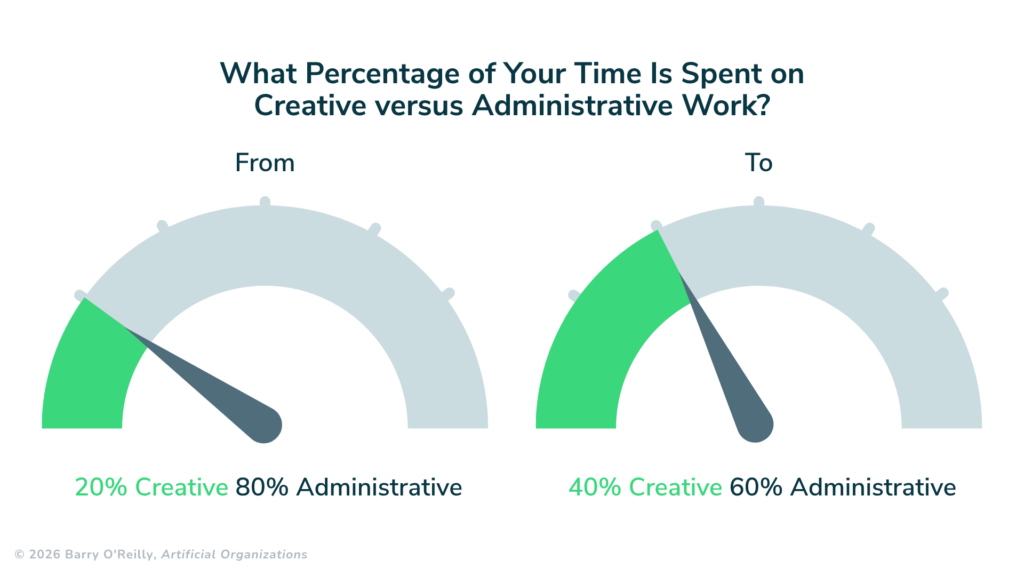
If AI reduces large amounts of administrative and coordination work, what becomes the highest-value contribution of your people?
Not generically, by role, by job to be done, by workflow or by decision.
Where do you need more:
- judgment
- creativity
- customer understanding
- communication
- strategic thinking
And where are people still being rewarded primarily for managing friction inside outdated systems?
Creative vs Administrative Work
This question matters because many organizations still confuse activity with value.
The person producing the report may not be creating the value. The value may be in framing the decision the report enables.
The person managing the meeting may not be creating the value. The value may be in resolving the trade-off the meeting exists to address.
The person creating the dashboard may not be creating the value. The value may be in noticing the signal everyone else missed.
AI makes this distinction much harder to ignore.
2. What Work Should No Longer Exist?
This is one of the hardest questions for organizations to confront honestly. Many companies approach AI by trying to make existing workflows faster without questioning whether those workflows still deserve to exist in the first place.
But automating unnecessary work does not create leverage. It preserves inefficiency at greater speed.
Before redesigning the system, leaders need to identify:
- which activities no longer create value
- where coordination overhead has become excessive
- what consumes attention without improving decisions
- which meetings exist only because context is not shared well
- which reports exist only because trust in the system is low
- which approvals exist only because decision rights are unclear
This is where courage is required.
Because eliminating work often challenges habits, status, control, and identity. If leaders do not remove low-value work, AI will simply make the old system faster. And a faster broken system is still broken.
3. How Will Capacity Be Reinvested?
One of readers’ favorite case studies in Artificial Organizations is with Pete Anevski, CEO of Progyny.
Pete stated their AI strategy clearly:
“We’re not using AI to reduce headcount. We’re using it to amplify your human skills. To elevate, not eliminate you and your work.”
That statement unlocked psychological safety. People leaned in. Experimentation exploded.
Then Pete asked the uncomfortable but transformative question: What will you do with the capacity this creates?
That is the leadership question. AI creates capacity very quickly. The problem is that organizations often absorb that capacity back into more meetings, more reporting, and more internal work.
Without intentional redesign, the calendar simply expands to fill the available space again.
The companies seeing the strongest results are usually deliberate about where that reclaimed attention goes:
- deeper customer understanding
- faster learning cycles
- better preparation
- stronger decisions
- more strategic focus
- more creative problem solving
- more coaching and development
- more time spent on the work only humans can do
That is where the long-term advantage compounds, by reinvesting the capacity AI creates into better work.
A Practical Exercise: Reassemble Your Own Job
Here is a simple exercise to try this month.
Start with your own role. Write down the responsibility you hold. Then list the jobs to be done inside that role.
For each job to be done, list the recurring tasks that fill your week: meetings, reporting, preparation, approvals, analysis, communication, decision-making, customer conversations, follow-ups, or administrative work.
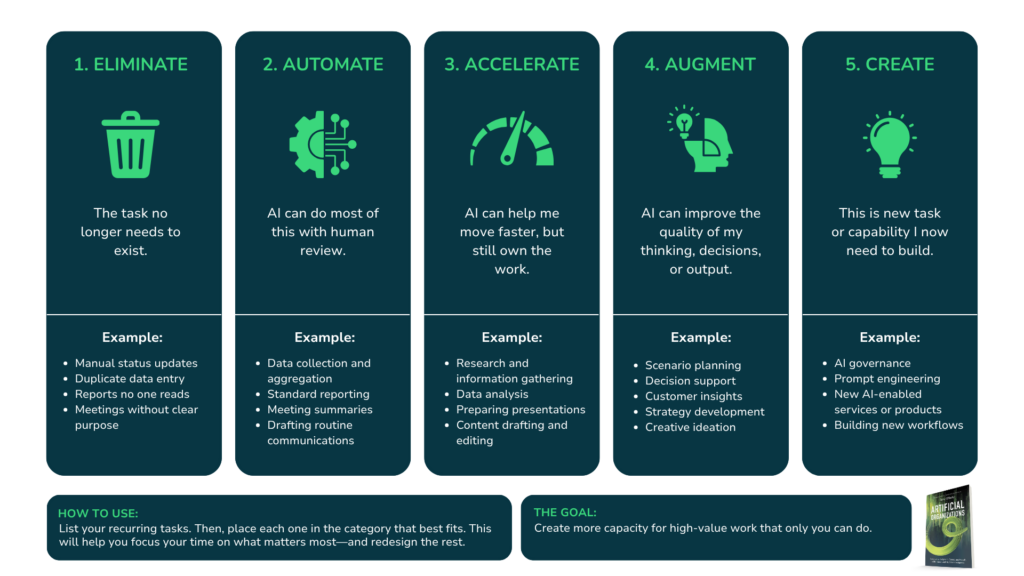
Then put each task into one of five categories:
- Eliminate This task no longer needs to exist.
- Automate AI can do most of this with human review.
- Accelerate AI can help me move faster, but I still own the work.
- Augment AI can improve the quality of my thinking, decisions, or output.
- Create This is a new task or capability I now need to build.
Reassemble Your Own Job
Then ask the harder question: If these tasks change, how does my value need to change?
That is the real work.
Not: How do I use AI?
But: How do I redesign my contribution?
The leaders who do this exercise honestly will start to see their work differently. They will notice tasks they should stop protecting. They will see where their judgment matters most. They will find capacity they did not realize was trapped in the system.
And they will begin to understand that AI adoption is not about tools. It is about redesigning work.
The Future Is Not Fewer Humans
The future of work is not about removing people. It is about redesigning work around better judgment, faster learning, and clearer decisions.
AI will reduce much of the repetitive coordination, manual synthesis, and administrative friction that consume modern organizations today but as those activities shrink, the value of human leadership increases.
The leaders pulling ahead are not replacing humans with machines.
They are combining Human Instinct + Machine Insight = Better Outcomes
That is the shift.
Your job is not being taken away. The work inside it is being broken apart, redistributed, and redesigned.
The leaders who thrive will not be the ones defending old tasks. They will be the ones brave enough to unlearn, ask what work still matters, what work no longer deserves to exist, and where human judgment becomes more valuable because machines are now in the system.
Not fewer humans. Better-designed work.
Not AI instead of people. Human instinct plus machine intelligence.
That is how jobs are reassembled.
And that is the foundation of Artificial Organizations.
FAQ
1. Is AI really taking people’s jobs?
Not in the simple way most headlines suggest. The more immediate shift is happening at the task level. Roles may remain, but the tasks inside those roles are being automated, accelerated, augmented, eliminated, or newly created. The better question is not “Will AI take my job?” It is “How is AI changing the work inside my job?”
2. What is the difference between a role, a job to be done, and a task?
A role is the responsibility someone holds. A job to be done is the work required to fulfill that responsibility. A task is a specific unit of work inside that job. AI changes tasks first. As tasks change, jobs are reassembled, and roles evolve.
3. What should leaders look at first when redesigning work with AI?
Start with the task mix. Look at the work people actually do each week. Which tasks no longer need to exist? Which can be automated? Which can be accelerated? Which require better human judgment? Which new tasks are emerging? That is where meaningful redesign starts.
4. Why does AI feel threatening to experienced people?
Because many people built their value around tasks that were hard, slow, or painful in the old system. The person who knew the spreadsheet, the process, the dependencies, or the institutional memory had influence. As AI makes information easier to retrieve and routine work easier to complete, value shifts toward judgment, interpretation, decision-making, and adaptability.
5. What should organizations do with the capacity AI creates?
They need to reinvest it deliberately. If leaders do not decide where freed-up time goes, the organization will absorb it back into more meetings, more reporting, and more internal work. The real opportunity is to reinvest that capacity into better customer understanding, stronger decisions, faster learning, creative problem solving, and the work only humans can do.
References
- O’Reilly, Barry. “Human vs AI vs Human + AI: The Leadership Shift No One Is Explaining Properly.” Barry O’Reilly, May 5, 2026.
- The Budget Lab at Yale. “Tracking the Impact of AI on the Labor Market.” April 16, 2026. Updated April 16, 2026.
- DiMarzio, Melissa. “Beyond the Binary: How Automation and Augmentation Are Combining to Reshape Work.” The Burning Glass Institute, January 28, 2026.
- Gartner. “Sessions | Gartner Finance Symposium/Xpo™ 2026 in National Harbor, MD.” Gartner, 2026.
- O’Reilly, Barry. “Incorruptible with Eric Ries.” Unlearn Podcast, episode 181, May 12, 2026.
- O’Reilly, Barry. Artificial Organizations: Build Better Judgment, Speed, and Results with Human and Machine Intelligence. United States: Barry O’Reilly, 2026.