
A lot of the conversation around AI is still stuck in the same, wrong place: Will AI replace people?
It’s a flawed framing. Not because displacement won’t happen, it will, but because it misses what’s already happening underneath the doom-scroll headlines, and the data is starting to show it clearly.
The Yale Budget Lab looked at labor market impact from November 2022 (ChatGPT release) through early 2026 (~33 months). The headline is clear: nearly three years into generative AI, the labor market still shows no measurable disruption, yet.
At the same time, the Burning Glass Institute analyzed millions of job postings before and after the release of ChatGPT. Their findings offer some of the first empirical evidence—not projections, but measurable shifts—of how AI is reshaping work:
- Skills most vulnerable to automation are 16% more likely to decline in demand
- AI-augmented skills are 7% more likely to increase
- Automation exposure and augmentation exposure are strongly positively correlated (r = 0.87)
That means the roles most vulnerable to automation are the same roles being augmented the most. In short, the same roles being disrupted are also being expanded.
We’re at the beginning of a redesign, not a replacement.
This shift isn’t centered on manual labor. It’s concentrated in knowledge work.
Work Is Being Reassembled
Most people still think in terms of jobs being nicely sorted into “safe” or “at risk” of AI. But jobs are just containers. What’s actually changing is the tasks inside the job.
- Some tasks get automated
- Some get accelerated
- Some get redefined
- New tasks appear
If you zoom out, the pattern becomes clear. AI doesn’t remove work. It changes what counts as valuable work.
That’s where most organizations get stuck. They assume AI can replace workers and reduce headcount without first proving new capabilities are in place.
It’s where employees get stuck too, fearful they are training their replacements. You’re not. The truth is, you have the chance to give “your replacement” the administrative work you’ve always hated while you focus on higher-value work.
The biggest mistake, however, is trying to layer AI into existing ways of working. Same roles, same structure, same decision flow. It’s the same way you’ve always done the work, faster.
That has worse effects. Existing processes weren’t designed for AI, so you’re simply amplifying the problem more productively.
From Roles to Systems
The shift most people haven’t internalized is this: we’re moving from roles to systems.
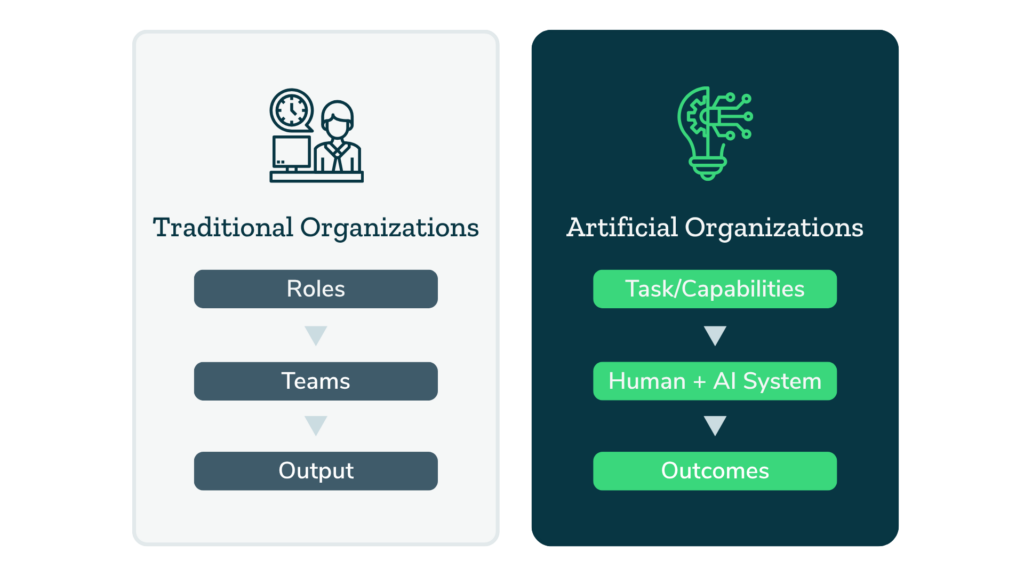
Traditional Organizations vs Artificial Organizations
In the old model, work is organized around roles. Hire teams, execute jobs, and create output.
In the new model, work is organized around capability, delivered through a combination of human judgment and machine intelligence to drive outcomes.
The implication is practical and profound.
You don’t ask, “Who owns this?”
You ask, “What combination of human judgment and machine capability produces the best outcome?”
That’s a different way of designing work, and the foundation of a Judgment System.
A True Comparison: Human vs AI vs Human + AI
Most of the debate still sits around Human vs AI, but it’s not where the leverage is.
Executives are struggling with this, especially in terms of their own identity, judgment, and allocation. The three deeper questions they are asking themselves are often surface concern:
- Identity → Where do I add value now?
- Judgment → What decisions stay human?
- Allocation → What do we do with the capacity created?
If a leader can’t answer those with confidence, they default to defensive choices:
- Identity → protecting roles
- Judgment → experimenting at the edges
- Allocation → automating low-level tasks
And they never reach the actual upside.
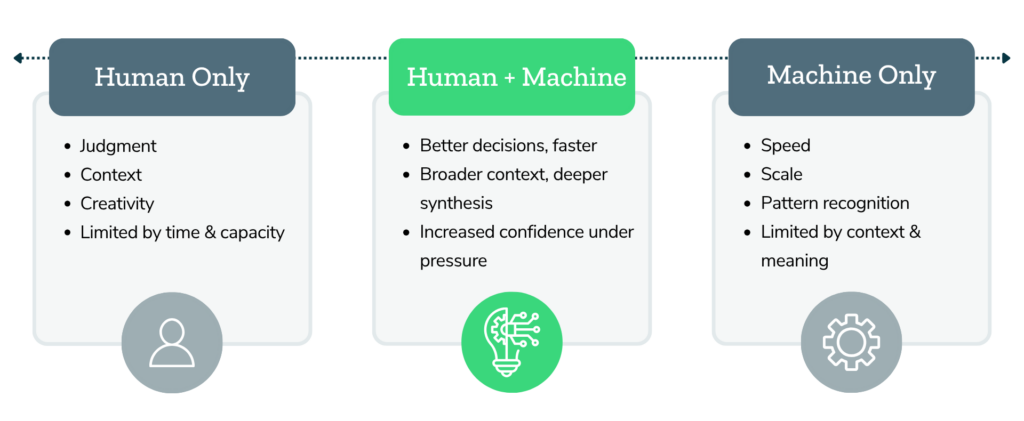
Human vs AI vs Human + AI
Better outcomes don’t come from humans alone. They don’t come from machines alone. They come from human judgment deliberately paired with machine intelligence.
Individually, human-only and machine-only modes are limited.
Together, they create something different: a judgment system and infrastructure to drive business outcomes—the focus of Artificial Organizations.
The Constraint Isn’t Productivity. It’s Judgment
Across conversations and coaching sessions with CEOs, C-suites, and senior leaders over the past five years, one pattern keeps coming up:
Leaders are overloaded with work—and more importantly, overloaded with decisions.
“The constraint in AI-augmented leadership is no longer information. It is judgment under pressure.”
More tools haven’t made decisions easier. They’ve made the environment more complex—more inputs, more noise, more second-guessing when the stakes are high.
Leaders respond by trying to move faster with tools.
That’s the trap.
The 80/20 Mismatch
In our Artificial Organizations AI Executive Study in 2025, where we surveyed 5,000+ CEOs, C-suites, and VPs, a clear pattern emerged:
Roughly 80% of leadership time is consumed by:
- meetings
- updates
- coordination
- administration
- reconstructing context
Yet 80% of leadership value is created by:
- framing the right problems
- evaluating trade-offs
- being fully present in critical moments
- making high-quality decisions
This isn’t a time management issue. It’s an allocation problem, and until you redesign how judgment flows through your Judgment System, no AI tool will save you.
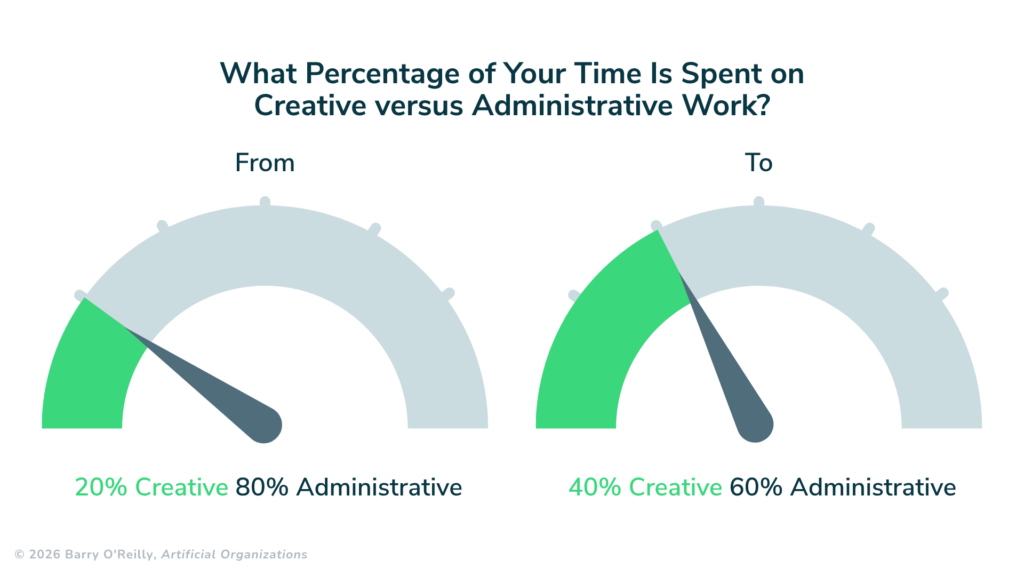
Creative vs Administrative Work
Yet it’s also where human and machine intelligence working together really starts to matter. Not because it saves time, but because it changes where your attention goes.
I challenge leaders with a few simple questions:
- What percentage of your time is spent solving hard problems—doing high-value work that only you can do?
- What percentage of your time is being eaten away by low-leverage, yet necessary, time-sucking tasks?
- What would happen if you could shift those ratios by 5%, 10%, even 50%—and spend more time focused on creative problem-solving?
Do this thought experiment right now. Your answers may shock you.
Legacy leadership rewards responsiveness. Today (and in the future), leadership demands human judgment augmented by AI to drive better outcomes.
The Radiologist Paradox
A decade ago, the world was full of future fears. AI was supposed to replace jobs, and radiologists were the first target. Today, radiologists earn over $500,000 per year, and demand continues to grow.
Reading scans is a task, not a job. When the task gets cheaper, faster, and more accurate, demand for the job increases.
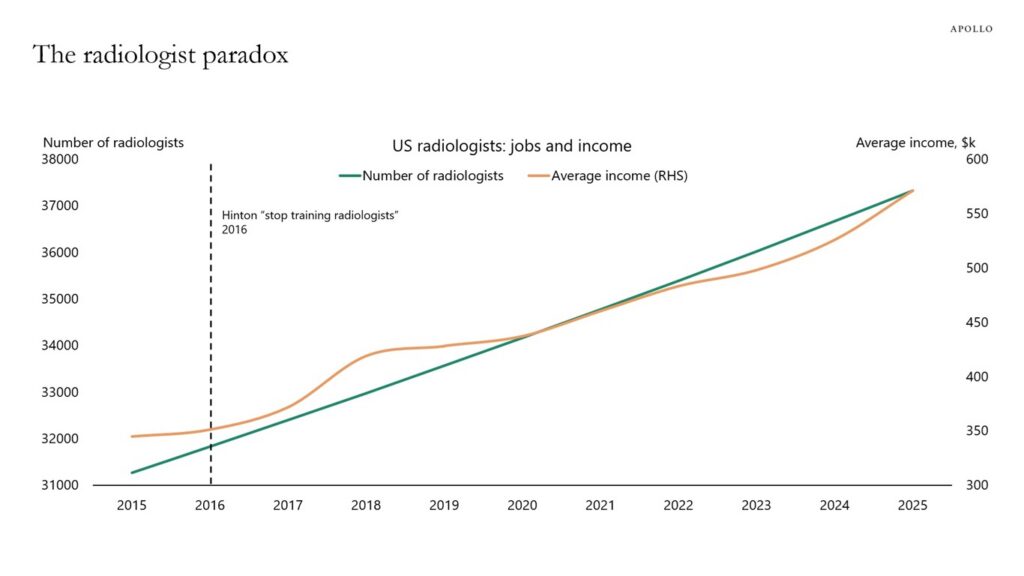
The Radiologist Paradox
This is when work shifts from administrative to judgment and high-value creative problem-solving.
We’re now making the same mistake with software engineers. “Vibe coding means we won’t need engineers.” We will.
We’ll need better ones, more focused on creative problem solving and quality human judgment.
The Shift Most Leaders Feel But Don’t Name
When AI is introduced properly—as a behavior change, not just tool adoption—something subtle happens.
You don’t just get faster. You get clearer, calmer, and more confident.
From working with executives and founders applying the leadership systems in Artificial Organizations, we’ve seen:
- prep time collapses
- context stops leaking
- follow-ups get tighter
- conversations improve
But the real shift is harder to describe.
You show up differently—more present, less reactive, and more confident under pressure.
That’s authority. Well beyond productivity.
Case Study: Pete Anevski, CEO of Progyny
Pete Anevski is the CEO of Progyny, a NASDAQ-listed leader in fertility and family building benefits, and former CFO of WebMD.
When Progyny started their AI initiative, Pete didn’t launch a massive transformation program. He started with one visible behavior change—and one bold statement:
“We’re not using AI to reduce headcount. We’re using it to amplify your human skills. To elevate, not eliminate you and your work.”
That created psychological safety. People leaned in, and experimentation accelerated across the company.
Then Pete asked the harder—but transformative—question: What will you do with the capacity this creates?
Most assume capacity means “more work,” that management will try to squeeze more out of them, or increase workloads. It doesn’t.
It’s an opportunity to think more deeply, act more strategically, and make better decisions.
Most organizations miss that. It’s what fearful employees can’t see. It’s how AI transformations die in silent protest, 95% of them, based on MIT research.
This is where organizations stall.
A lack of safety. A failure to recognize that AI isn’t about productivity—it’s about creating space for creative problem solving, better judgment, speed, and results.
That’s playing it safe—and it doesn’t drive better business outcomes.
The Uncomfortable Truth About AI Adoption
McKinsey’s latest numbers are clear:
- 90% of organizations use AI
- 88% say it’s a priority
- Less than 40% see a meaningful financial impact
- Most improvements are under 5% of EBIT
AI is everywhere. Results are not.
Why?
Because most companies are optimizing tasks, not redesigning how decisions get made. Or worse, bolting AI onto existing jobs, workflows, and processes.
You need to redesign the work.
You’re already seeing the split in performance, and it’s accelerating. Leaders (especially CEOs and C-suite teams) experimenting with AI directly in their work are moving ahead. Others are delegating it, waiting, or watching.
AI transformation can’t be handed over to the CTO or CIO like digital transformation. It needs to be led, role-modeled, and demonstrated publicly by the entire C-suite.
Over time, that gap compounds—and plays out in a way no company wants.
- Leaders who integrate AI into thinking → faster, clearer decisions
- Leaders who don’t → increasing decision latency
And that latency is the real cost.
Not missed automation. Missed opportunities.
Why Most Leaders Stall
Early use of AI feels awkward. Slower, even.
You’re learning new behaviors. Changing how you work. Unlearning old habits.
But then something shifts.

From Linear Leadership to Exponential Innovation
“If AI doesn’t change behavior, it’s decoration.”
The dip matters because most leaders never push through it. They treat AI as a tool—not as a behavior change in how they operate.
You can deploy tools across the organization. It won’t move the needle.
Unless leaders:
- change how they make decisions
- change how they use information
- change how they show up
The Way Forward
This isn’t about replacing people.
It’s about redesigning how you work through a stronger Judgment System.
The leaders getting the most out of this shift aren’t doing more.
They’re doing fewer things better:
- using AI to think through problems
- pressure-testing decisions
- preparing before conversations
- focusing on judgment, not output
If you strip it back, there’s one practical move:
Don’t start with the organization. Start with yourself.
Pick one part of your work:
- meetings
- decision prep
- synthesis
- communication
Redesign it using AI.
Not to go faster—but to think better.
Where We Are Heading
Not fewer humans.
More capable humans.
Operating inside better systems.
Building better judgment, speed, and results with human and machine intelligence at the core.
High-performing Artificial Organizations.
FAQ
1. If AI isn’t replacing jobs yet, what should I actually be preparing for?
Prepare for your role to change from the inside.
The data shows stability at the job level, but movement at the task level. That means the work you do—and what you’re expected to be good at—will shift.
The leaders who adapt fastest aren’t waiting for job descriptions to change. They’re already redesigning how they work, especially around decision-making.
2. Where should I trust AI in my work—and where shouldn’t I?
Use AI where scale and synthesis matter. Keep ownership where judgment matters.
AI is effective at:
- organizing information
- generating options
- identifying patterns
It breaks down when context, accountability, or trade-offs are involved.
The mistake is treating it as either fully reliable or completely unsafe. It’s neither. It’s a tool that improves how you think—if you stay actively involved.
3. How do I know if we’re actually getting value from AI?
Look at decisions, not activity.
Most organizations track:
- usage
- automation
- time saved
Those don’t tell you much.
Instead, ask:
- Are decisions being made faster?
- Is rework going down?
- Are teams clearer on direction?
If those aren’t improving, AI is likely being used at the edges, not where it matters.
4. What should I do with the time AI frees up?
If you don’t decide, the system will decide for you.
In most companies, freed-up time gets pulled back into:
- more meetings
- more coordination
- more internal work
Very little goes into better thinking.
The opportunity is to reinvest that time into:
- problem framing
- decision preparation
- strategic thinking
That requires deliberate choices. It won’t happen automatically.
5. Where do I start without turning this into a full transformation program?
Start with one part of your own workflow.
Pick something you do every week:
- preparing for meetings
- summarizing information
- making decisions with incomplete data
Then redesign it using AI.
Not to go faster—but to arrive better prepared.
That’s how this scales. Not through rollout plans, but through leaders changing how they work in practice.
References
- The Budget Lab at Yale, “Tracking the Impact of AI on the Labor Market,” accessed April 30, 2026.
- Burning Glass Institute, Beyond the Binary: How Automation and Augmentation Are Combining to Reshape Work (January 2026).
- Barry O’Reilly, “AI Decision Making for Leaders,” April 30, 2026.
- Apollo Global Management, “The Radiologist Paradox,” accessed April 30, 2026.
- O’Reilly, Barry. Artificial Organizations: Build Better Judgment, Speed, and Results with Human and Machine Intelligence. United States: Barry O’Reilly, 2026.
- O’Reilly, Barry. Artificial Organizations AI Executive Study 2025.
- Massachusetts Institute of Technology, The GenAI Divide: State of AI in Business 2025, NANDA Initiative report, July 2025.
- McKinsey & Company. The State of AI: How Organizations Are Rewiring to Capture Value. McKinsey Global Survey. March 12, 2025.