
For decades, organizations have leaned on maturity models to guide their adoption of new technologies. In software and cloud transformations, these models promised a structured path from beginner to advanced, with stages carefully defined by consultants.
Yet history has shown us that maturity models rarely deliver the outcomes leaders need. They create the appearance of progress without guaranteeing impact. In reality, they often reinforce bureaucracy, delay experimentation, and limit innovation.
As enterprises rush to adopt AI, many are once again turning to maturity models. The problem is that AI adoption does not follow a linear path[1].
Linear Thinking Leads To Limited Results
When we first started to promote using cloud and DevOps in the enterprise in 2010, as Continuous Delivery was published, I saw numerous consultants rushing to sell maturity models. Charts, quadrants, and color-coded journeys promised you could assess your readiness, plot your position, and climb toward some imagined future state.
But if there is one lesson from the last two decades of software transformation, it is this: maturity models don’t work[2].
They trap leaders in linear thinking, not learning. They promote compliance, not creativity. And they lull executives into false comfort, believing a staged plan is progress, when in reality it is bureaucracy blocking change.
What Worked Then Still Matters Now: Metrics That Matter
With software, we learned to ditch maturity models and embrace metrics that matter.
During the DevOps and continuous delivery revolution, leaders discovered the limitations of staged roadmaps. What ultimately enabled high-performing teams was not maturity curves but metrics that correlated with business outcomes.
This is where the DORA metrics[3], developed by the DevOps Research and Assessment team, became transformational. As highlighted in the book by Nicole, Jez and Gene, Accelerate: The Science of Lean Software and DevOps, these four measures predicted both software delivery performance and organizational performance:
- Deployment frequency: how often teams successfully release to production
- Lead time for changes: the time it takes from committing code to running it in production
- Mean time to restore service: how quickly teams can recover from incidents
- Change failure rate: the percentage of changes that cause incidents requiring remediation

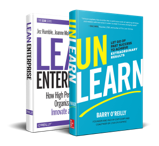
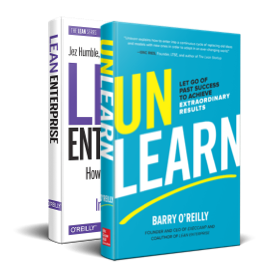
Continuous Delivery | Lean Enterprise | Accelerate | Unlearn
These metrics mattered because they provided evidence-based, outcome-driven indicators. They were simple, comparable across organizations, and directly tied to speed, stability, and ultimately business results.
Most importantly, they helped leaders focus on outcomes, not maturity stages. Instead of asking “What level are we at?” leaders could ask, “How fast do we deploy? How resilient are we when things break? How are these improving over time?”
This is precisely the mindset AI adoption needs. It will not be solved with maturity model stages.
Why Maturity Models Fail for AI
AI is not a stage you progress through. It is a system you experiment with, learn from, and evolve. Success requires iteration, rapid learning, and scaling what works.
MIT research reminds us that ninety-five percent of AI pilots fail[4]. Not because the technology is not good enough, but because leaders rely on outdated playbooks or recycle the same mindset and behavior they have always used. They seek consultants with pre-packaged frameworks instead of coaching their own teams to start small, unlearn fast, and scale what works.
The purpose must be to build the internal capability to experiment, unlearn, and adapt.
Maturity models give a false sense of security. They do not teach your people how to use AI to solve real problems in your business. They suggest that following a checklist will guarantee transformation. But they do not help leaders or teams learn to apply AI in their day-to-day decisions and operations.
What Leaders Are Really Saying About AI
To understand how executives are approaching AI, we recently surveyed more than 5,000 CEOs, C-suite executives, and VPs.
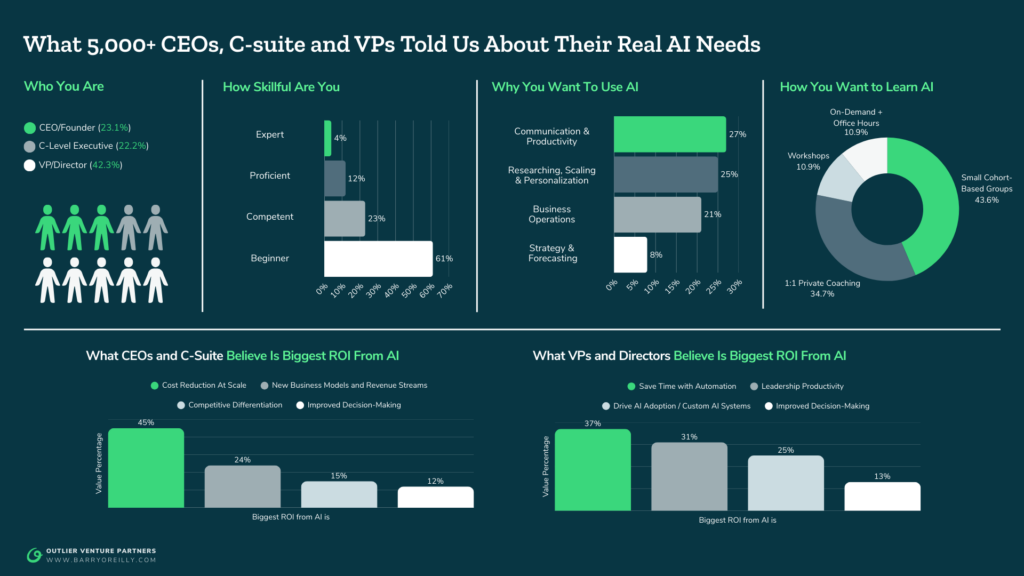
Their responses highlight the limitations of maturity thinking and the urgent need for new approaches:
- 61% describe themselves as beginners with AI, while only 4% consider themselves experts — underscoring the gap between expectation and confidence.
- Leaders are primarily using AI for communication and productivity (27%), researching, scaling, and personalization (25%), and business operations (21%), with only 8% focused on strategy and forecasting — practical applications, but still underweighted toward higher-leverage decision work.
- When asked how they want to learn, 44% prefer small cohort-based groups, while 35% selected 1:1 coaching. Only 11% chose workshops or on-demand courses, suggesting leaders want applied, psychologically safe learning environments over generic training.
- ROI expectations vary by level: 45% of CEOs emphasize cost reduction and efficiency, while 37% of VPs and Directors prioritize time relief and burnout reduction. Only 13% across both groups identified better, faster decisions as the primary return.
The takeaway is clear: leaders are not asking for maturity assessments or staged roadmaps. They are trying to improve how they work — how decisions are made, how time is used, and how results show up in the business.
They want hands-on experimentation, visible outcomes, and measurable improvements in judgment and performance.
Coaching Beats Consulting
That is why our five-session AI program for executives and senior leaders has taken off, along with our AI self-assessment questionnaire and AI Strategy resources. In just a few weeks, we help leaders:
- Architect their system for working with AI
- Improve decision quality by combining instinct with data
- Use AI as a thinking partner, a business challenger, or the best colleague they have ever had
- Design an AI stack that supports their way of working
Leaders save hours, sharpen their decision-making, and begin building the muscle memory their organizations need.
The Metrics That Matter for AI
Just like DORA reshaped software, AI needs outcome-driven metrics that track adoption and impact, not maturity. These are the types of outcome-based metrics we encourage leaders to track, including:
- Minutes back per week per leader (time saved through AI)
- Decisions improved with AI assistance
- AI-powered workflows scaled across teams
- Percentage of employees actively using AI daily
These are the signals of progress, not whether you are a Level Three AI organization.

ROI You Can Feel: Time, Speed, and Volume Gains
And like DORA, these metrics are simple, practical, and comparable. They can be tracked over time, correlated with performance, and used to guide continuous improvement.
Stop Measuring Maturity. Start Building Mastery.
AI is evolving too quickly for staged models. What leaders need is not another consultant’s roadmap but the ability to learn in real time, unlearn outdated approaches, and build mastery through practice.
The organizations that succeed will not be the most mature. They will be the most adaptive, those that treat AI adoption as a system of continuous learning and measurable outcomes.
The future is not about maturity.
It is about mastery, and it starts with you.
FAQ
Q1: Why don’t AI maturity models work for modern organizations?
AI maturity models fail because they assume transformation happens in linear stages, but real progress is nonlinear and driven by rapid learning loops. Organizations evolve through experimentation, iteration, and adaptation, not by checking off static milestones. Maturity models create a false sense of progress and reward compliance over creativity, which slows innovation instead of enabling it.
Q2: What should leaders use instead of an AI maturity model?
Leaders should focus on designing systems that learn in real time. This means setting clear outcomes, running small experiments, gathering data quickly, and adjusting based on results. Adaptive learning systems let teams improve continuously rather than aiming for artificial maturity levels.
Q3: What is the biggest risk of relying on an AI maturity model?
The biggest risk is believing you’re advancing when you’re actually stuck. Maturity models encourage slow decision making, committee-driven scoring, and check-the-box activities that look like progress but don’t improve performance. Leaders can waste time and budget chasing stages instead of building capabilities that deliver measurable outcomes.
Q4: How can organizations measure AI progress without a maturity model?
Organizations should track outcomes that reflect real impact, such as learning speed, reduced cycle time, improved decision quality, enhanced customer experience, and value delivered. These metrics show whether the organization is becoming more adaptive and effective, rather than simply moving through an artificial framework.
Q5: What leadership behaviors replace the maturity model mindset?
Leaders replace maturity models by encouraging experimentation, asking better questions, rewarding learning over predictability, and empowering teams to run rapid tests. They create clarity around meaningful outcomes, remove obstacles, and help teams improve based on evidence. This mindset builds momentum and adaptability that maturity models cannot provide.
References
- O’Reilly, B. (2025). What Leaders Need to Unlearn to Lead in the Age of AI. Barry O’Reilly.
- O’Reilly, B. (2025). Why AI Maturity Models Don’t Work. Barry O’Reilly.
- DevOps Research and Assessment (DORA). (n.d.). DevOps Research and Assessment. Wikipedia.
- Reed, A. (2025, August 18). MIT Report: 95% of Generative AI Pilots at Companies Are Failing. Fortune.
- Humble, J., Farley, D., & North, D. (2010). Continuous Delivery: Reliable Software Releases Through Build, Test, and Deployment Automation. Addison-Wesley.
- Forsgren, N., Humble, J., & Kim, G. (2018). Accelerate: The Science of Lean Software and DevOps. IT Revolution Press.