
Since launching Artificial Organizations, I’ve spent two and a half weeks on the road across North America—San Francisco, San Jose for the AI Summit, Austin, Dallas, Washington DC, New York—working with executives, boards, and leadership teams.
Different industries. Different contexts. Same mistakes.
Too many companies are starting with tools, and it’s costing them millions.
Why Starting With Tools Is A Mistake
AI is everywhere, but results are not.
95% of AI initiatives are failing to deliver meaningful business value. Companies have already poured $30–40 billion into AI pilots, yet only 5% ever scale.
90% of organizations are using AI, yet less than 40% see any meaningful EBIT impact, and most of those gains are under 5%.
These are catastrophic investments that could be avoided with a specific change of focus.
AI initiatives are underperforming, not because the tech doesn’t work, but because too many leaders treat AI as a tool transformation, not a behavior transformation.
So what happens?
- More tools
- More output
- More noise
- No real change
AI without behavior change is just decoration.
Don’t Fear The Productivity Flexers, They Only Talk About Output
The market isn’t helping either. Scroll LinkedIn, YouTube, Instagram—and you’ll see is “productivity flexes.”
- “I built 10 agents this weekend.”
- “I generated a website in an hour.”
- “My AI runs my work, my home, my life.”
It’s impressive but it’s also misleading.
It tricks you to focus on speed and output, not impact and outcomes—and that’s where most companies go wrong.
High output is an advantage, yet without direction, decision quality or fewer reversals, it’s noise.
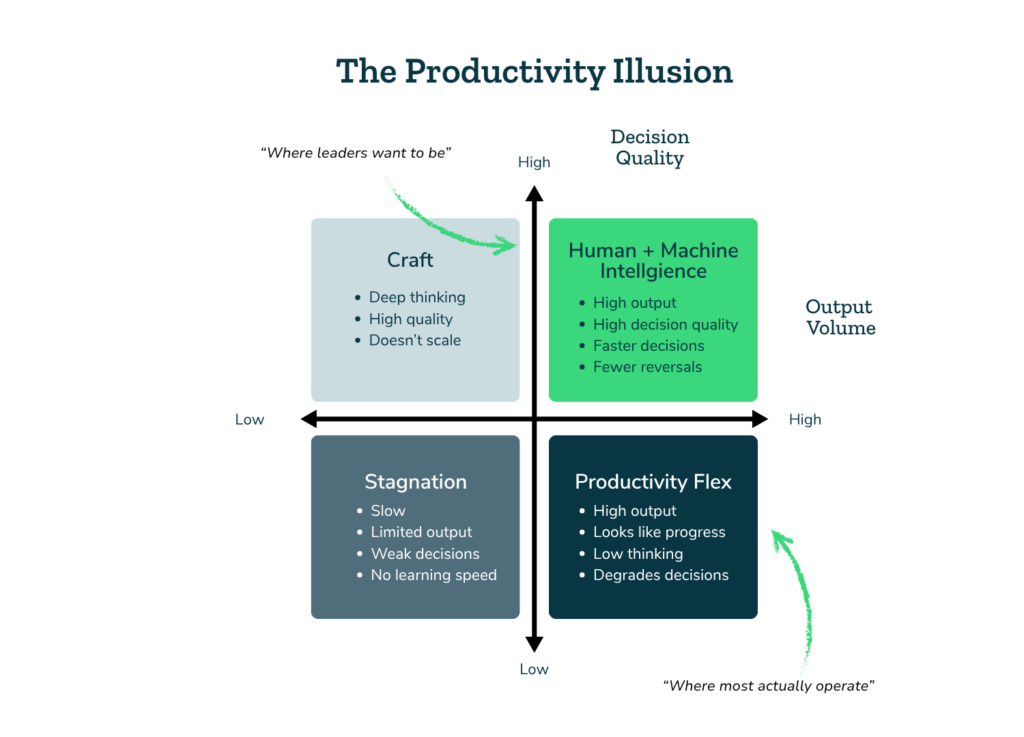
Here’s how to know who’s getting better and who’s simply getting faster.
The real winners don’t focus on productivity flexing, they explain what actually changed.
- What decisions improved?
- What outcomes shifted?
- What business impact was created?
The leaders who are pulling ahead aren’t chasing tools or flexing output. They’re building judgment systems and judgment infrastructure.
They are redesigning their ways of working to use human and machine intelligence to:
- ask better questions
- make better decisions
- act on higher-quality information
That’s the difference. That’s a real flex.
Remember, It’s Not About Tools. It’s About You
The leaders who are actually succeeding aren’t starting with tools.
They’re starting with themselves. They are asking harder, honest questions of themselves.
How do I do my best work?
Where does my judgment matter most?
What tasks actually create value?
Then—and only then—do they choose tools.
Because the truth is simple: You don’t have a tool problem. You have a work design problem.
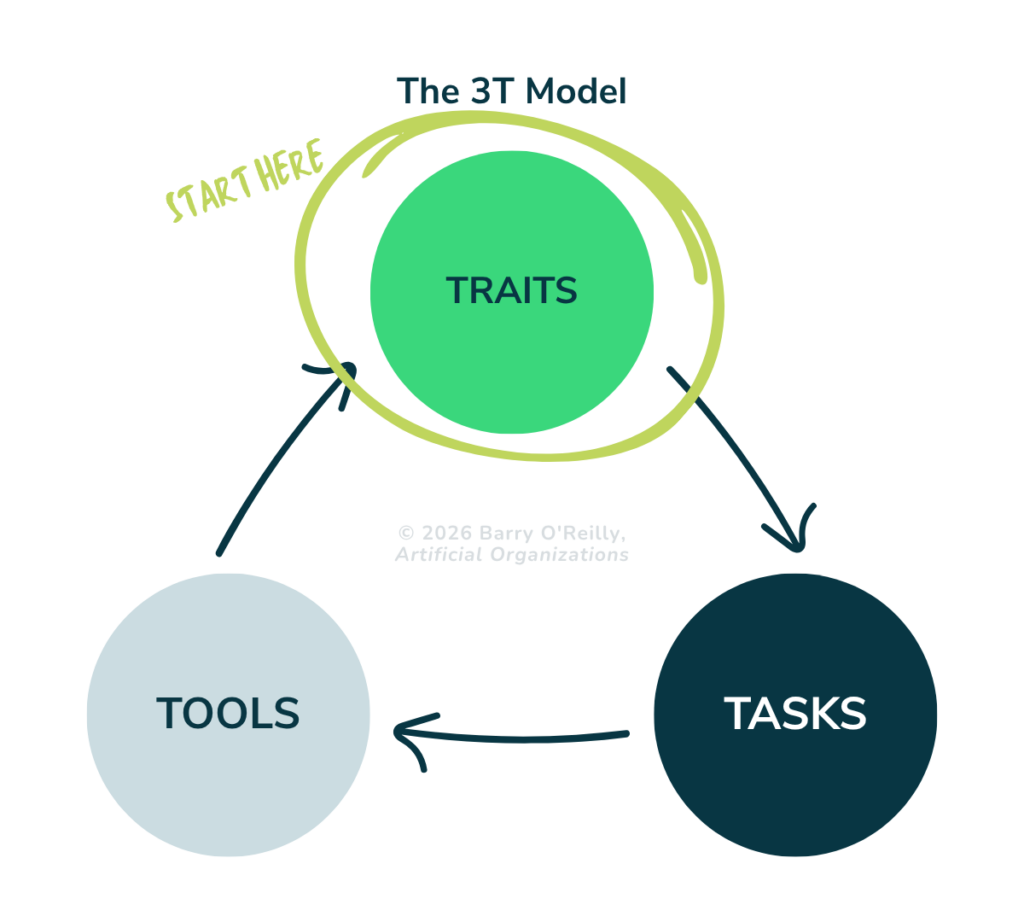
The 3T Model (Where Most People Fail Vs Win)
Most people start like this:
Tools → Tasks → Traits (if they even think about their traits at all)
That’s the failure path.
- Tools create noise
- Tasks become fragmented
- Your natural strengths get ignored
The result? Friction. Confusion. No real performance shift.
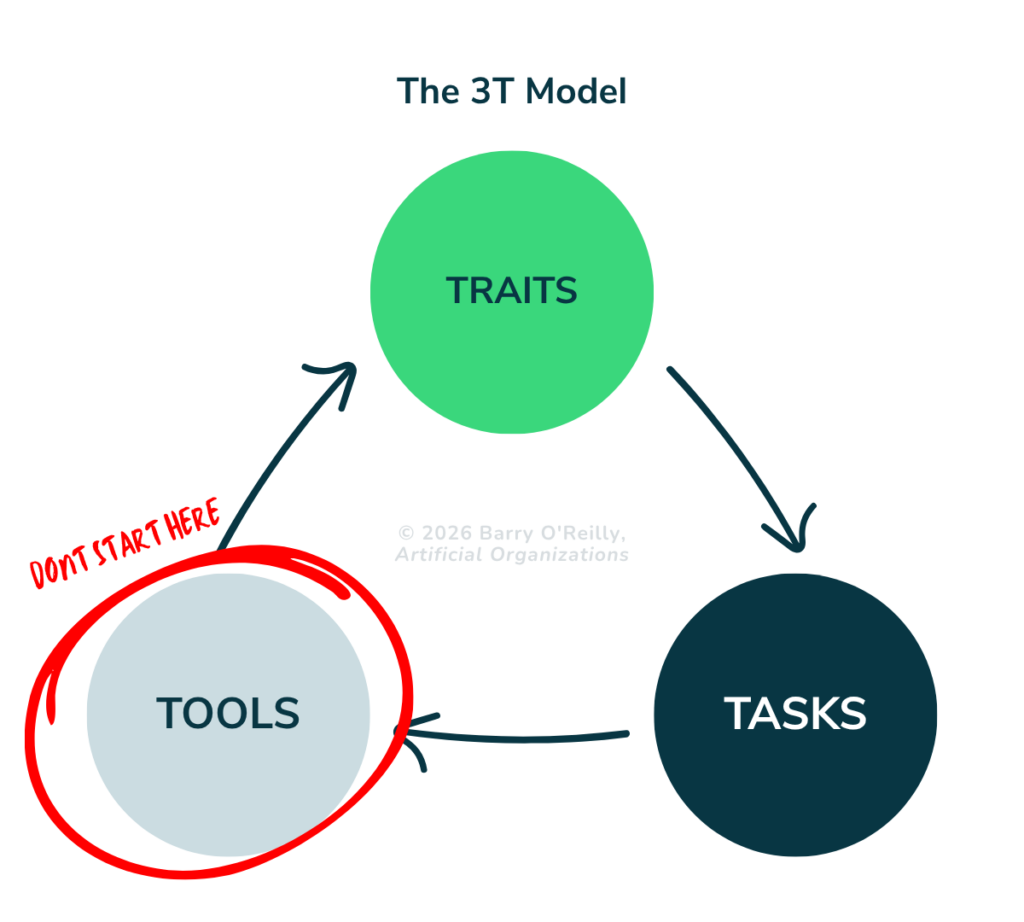
The leaders who win reverse it, or do what we call the 3T model.
Traits → Tasks → Tools
- Start with how you naturally think and do your best work
- Focus on the tasks that create outsized value
- Then choose tools that amplify that
That’s where performance unlocks. That’s where work gets simpler, faster, and more effective.
That’s why this model keeps stopping executives in their tracks because they’ve never thought about it like that before. But once you do, and see it, you can never unsee it.
In fact, this model changed how I worked and wrote forever.
I used to think writing meant sitting down and typing. Being dyslexic, it was slow, painful, and forcing every sentence out. It didn’t suit how I actually work. So I stopped asking “How should this be done?” and started asking “How do I do my best work?” The answer was obvious once I reframed my perspective. I think by talking, not typing.
So I flipped it. I’d outline the chapter, then talk it through in a conversation with a journalist. We’d record it, transcribe it, and they would edit it before sending me an MVP of the chapter. What used to take days took 45 minutes.
Same goal. Completely different result.
That was the breakthrough behind the 3T model. My natural trait was talking. The task was content creation. The tool was transcription.
Once those three aligned, everything accelerated.
It wasn’t about using better tools. It was about designing the work around how I actually perform at my best.
That shift didn’t just help me write faster, it changed how I approach everything after. Meetings, strategy design, development and testing. Business building and more.
The most important question you need to ask yourself is not what tool I need to use to be successful with AI. It’s an honest reflection on how you do your best work, your natural traits. Then your highest value tasks that create outsize outcomes—then consider what tools will help you get there.
That simple shift will move you from the 95% failing, to the 5% succeeding and seeing measurable results.
US Book Tour — What I Heard and Saw On The Road
The last month has truly been amazing. Helping American Airlines celebrate their 100-year Centennial, AI Summit in San Jose, an outstanding set of executive events with Dotwork, and board briefs and keynotes with some of the world’s leading companies.
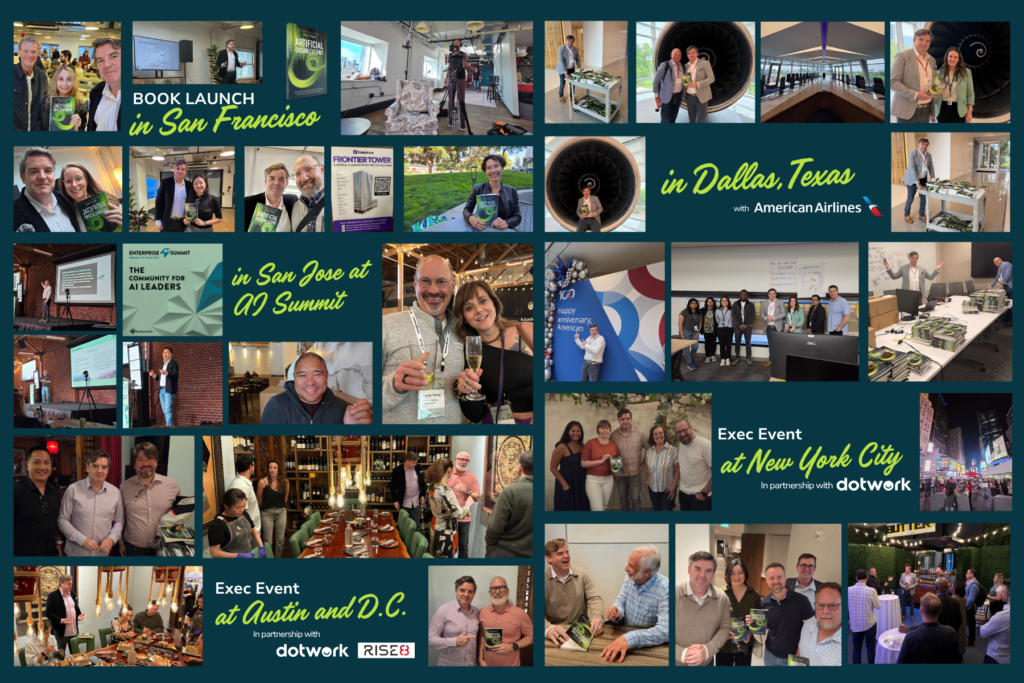
I learned a lot from speaking with people. How they are struggling. What is working. What resonated in the book, and how they are putting the ideas to work.
Across every conversation, a few points became very clear.
1. Fear Is Freezing People
There’s a narrative in the market right now:
- “You’re behind.”
- “You’re late.”
- “You’re going to lose your job.”
It’s wrong, and it’s dangerous. Fear doesn’t accelerate performance, it shuts it down.
People stop experimenting. They play it safe. They pause instead of learning in public, that’s how organizations fall behind.
The truth is, you’re not behind. In fact, you’re earlier than you think. This is still the beginning.
The leaders pulling ahead aren’t the ones who moved first. They’re the ones willing to learn, unlearn, and adapt in the open.
2. The Best Companies Aren’t Eliminating People—They’re Elevating Them
The leaders getting this right are using AI to amplify human capability, not replace it.
- Stronger thinking
- Better decisions
- Higher-quality work
But this doesn’t happen by accident.
Most organizations are over-investing in AI tools while under-investing in people, training, and behavior change—and it’s one of the primary reasons AI initiatives fail to scale.
People are watching. They see the tools. They hear the narrative. It’s easy to assume they’re training something that will replace them. That creates fear, risk-aversion and quiet resistance.
You have to address that head-on.
It’s why so many people bring up the Progyny case study from the book.
When CEO Pete Anevski introduced AI into the company, he didn’t start with tools. He started himself, role modeling how he could use AI day-to-day in his work. Then shared a clear message:
“We’re not using AI to reduce headcount. We’re using it to amplify your human skills. To elevate—not eliminate you and your work.”
That one statement changed everything.
It created psychological safety. People leaned in, experimentation increased, decision cycles shortened and performance improved.
That’s the shift.
The companies accelerating aren’t cutting people. They’re creating the conditions for people to do their best work.
3. AI Is Not a Tool Transformation
It’s a behavior change.
- How you work
- How you think
- How you do your best work
That’s the real shift. Try out the 3T and see how you can align your traits, tasks and tools.
4. Human Judgment Has Never Mattered More
Machines can process information. They can’t decide what matters.
That’s still your job, and it’s never mattered more.
But here’s the risk. If you don’t use your judgment, you lose it.
I’m seeing more and more leaders unintentionally outsourcing their thinking. Let the machine do the work, and they quickly check it.
Judgment is like a muscle. If you don’t use it, you lose it. Or worse, erode your skillset without realizing it. That’s the biggest risk to your future.
Start intentionally building your judgment system and infrastructure, and exercise it and your judgment daily.
Final Thought, It’s Not About Tools 😉
This moment isn’t about learning new tools.
It’s about unlearning how you work.
Start with yourself. Understand your traits. Focus on your highest-value tasks.
Then use tools to amplify that.
Do that and everything changes. And you change with it, for the better.
FAQs
1. Why do most AI initiatives fail to deliver business value?
Most AI initiatives fail because companies treat AI as a tools deployment rather than a transformation in how people work. Without redesigning decision-making, workflows, and behaviors, AI simply adds noise instead of improving outcomes.
2. What’s the difference between AI adoption and AI transformation?
Adoption is using tools. Transformation is changing how work gets done. Many organizations have high AI usage but low impact because they haven’t aligned people, tasks, and decision-making with the technology.
3. How should leaders prioritize AI investment?
Leaders should rebalance investment toward people, training, and behavior change—not just tools. Organizations that succeed with AI invest as much in capability building and ways of working as they do in technology.
4. What is the 3T model and why does it matter?
The 3T model (Traits → Tasks → Tools) helps leaders design work around how people perform best. By aligning natural strengths with high-value tasks and then selecting tools, organizations unlock better performance and measurable outcomes.
5. How can leaders reduce fear and resistance to AI adoption?
Leaders must clearly communicate that AI is there to elevate—not eliminate—people. Role modeling usage, creating psychological safety, and focusing on human development helps teams engage rather than resist.
References
- Davenport, Thomas H., and Nitin Mittal. All-in on AI: How Smart Companies Win Big with Artificial Intelligence. Boston: Harvard Business Review Press, 2023.
- Deloitte. State of Generative AI in the Enterprise. Deloitte Insights, 2024.
- McKinsey & Company. “The State of AI in 2024: Generative AI’s Breakout Year.” McKinsey Global Survey, 2024.
- Microsoft and LinkedIn. Work Trend Index Annual Report: AI at Work Is Here. Now Comes the Hard Part. 2024.
- O’Reilly, Barry. Artificial Organizations: Build Better Judgment, Speed, and Results with Human and Machine Intelligence. 2026.