
AI investment can give people new tools without changing the way the business performs. Leaders need to explain what should improve, help teams develop new ways of working, and ensure their goals and incentives support that change.
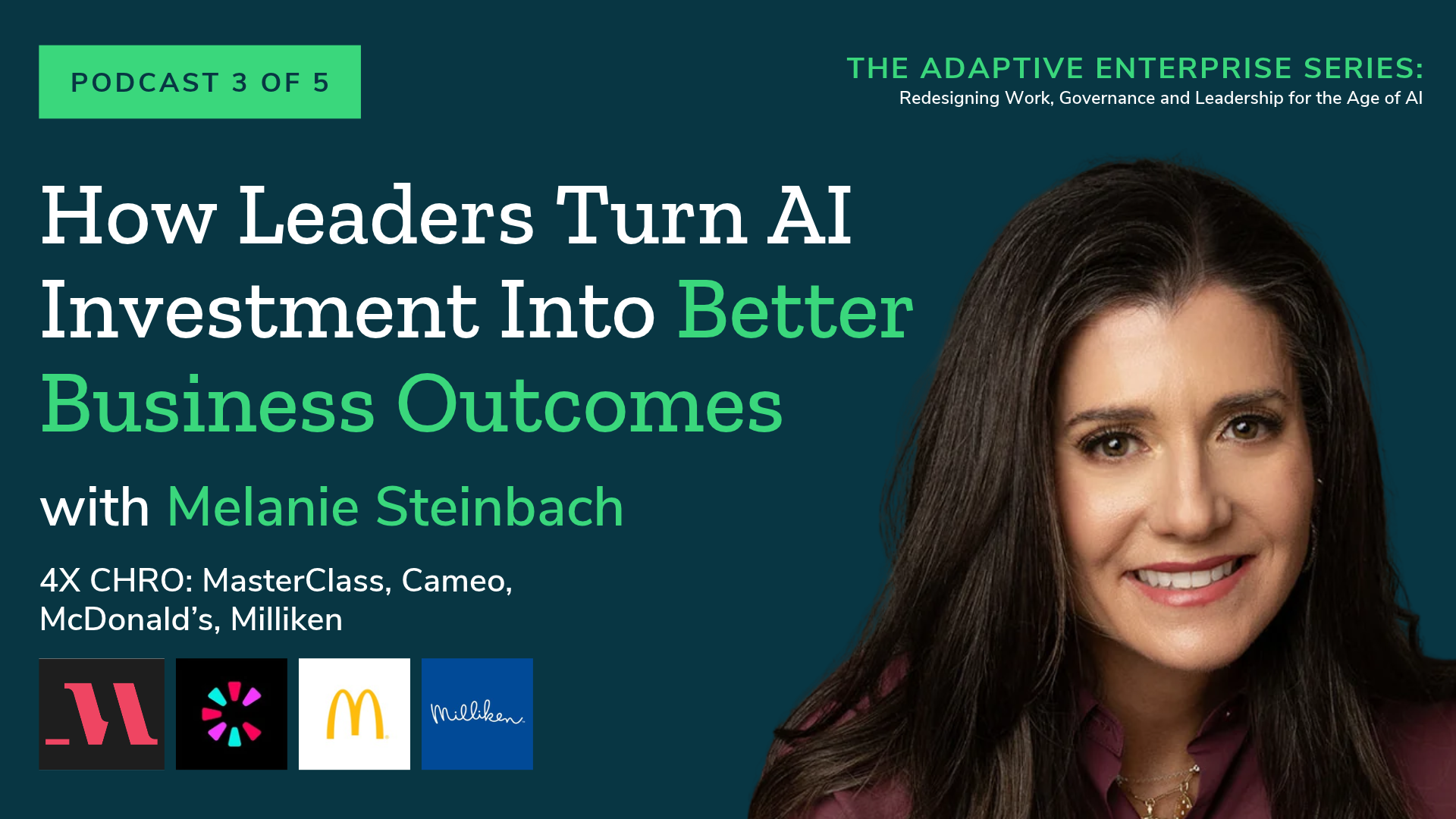
In this episode, Melanie Steinbach, whose people leadership experience spans McDonald’s, Cameo, and MasterClass, joins me to explore how organizations turn AI investment into better business outcomes. Mel explains why benefits take time to emerge, why training needs ongoing practice, and how individual KPIs can undermine shared goals. We also discuss leaders’ responsibility for redesigning work across departments and how recognition can encourage people to share what they learn.
This is the third podcast in The Adaptive Enterprise, our five-part article and podcast series on redesigning work, governance, and leadership for the age of AI.
Subscribe


Key Takeaways
- Connect the purpose to the person: Explain why the organization is investing in AI, what it expects to achieve, and what employees need to do differently. Melanie’s example of changing a promotion model shows why both organizational context and individual expectations matter.
- Measure progress along the way: Capability development and business benefits may emerge on different timelines. Identify meaningful milestones, such as stronger analysis or better cross-functional collaboration, and explain how they contribute to the intended outcome.
- Treat training as the beginning: A workshop or certification does not establish lasting behavior change. Repeated practice, feedback, and opportunities to apply learning help people develop capability in everyday work.
- Make work redesign a leadership responsibility: Individual productivity improvements do not automatically improve the whole business. Leaders need to define shared outcomes, remove obstacles, and support teams in changing work across departmental boundaries.
- Align KPIs with the change you want: Goals and incentives shape what people prioritize. Melanie urges leaders to give individual KPIs the same care as budgets, so that they support collaboration rather than pull people toward competing departmental targets.
Additional Insights
- Learning can be an explicit outcome: Barry describes bank pilots designed to build knowledge about privacy, develop capability, and help risk and engineering work together. Leaders need to be clear about what each investment is intended to teach them.
- Fear needs context and practical experience: Employees may interpret AI through concerns about job loss. Barry’s bank example combines a CEO’s explanation of the direction with hands-on work on decisions and agents.
- Managers help turn shared goals into daily decisions: Executives need to commit to common outcomes and resources, while directors and managers coordinate the work, dependencies, and trade-offs required to deliver them.
- Recognition can sustain knowledge sharing: Barry’s Capital One example shows how celebrating people who taught colleagues helped extend learning beyond certification. Melanie emphasizes that recognition is an incentive and that established lessons about human behavior still apply.
Episode Highlights
00:00 – Episode Recap
Melanie explains why access to technology does not automatically change behavior and why people need a clear organizational and individual purpose.
01:24 – Introducing the Conversation on AI Outcomes
Barry welcomes Melanie back to discuss measuring behavior change, developing capability, and moving beyond counts of AI activity.
03:58 – Explain Why the Change Matters
Melanie uses the analogy of a scale or fitness tracker and shares a promotion-policy example to show why context and expectations matter.
09:35 – What Should an AI Pilot Help You Learn?
Barry describes a bank’s hands-on learning sessions and a discussion about whether pilot success should include knowledge, capability, and cross-functional collaboration.
11:56 – Investment and Benefits Have Different Timelines
Melanie explains the importance of an investment thesis and milestone measures when capability development takes time to produce business results.
18:00 – Training Is the Start of Behavior Change
Melanie describes why one training day is insufficient and how small, repeated practice helps people develop new ways of working.
21:36 – Who Is Responsible for Redesigning Work?
Melanie challenges the expectation that individual employees should identify the wider organizational redesign needed to turn productivity gains into value.
23:35 – Leaders Create the Conditions for Shared Outcomes
Barry explains why executives need firsthand experience with AI, then must clear obstacles and support work that spans multiple departments.
27:14 – Directors and Managers Connect Strategy to Execution
Barry discusses coordination, local incentives, competing priorities, and the executive commitment required to support cross-functional work.
29:20 – Give KPIs the Attention They Deserve
Melanie argues that individual goal setting needs the same care as budget planning because incentives can support or undermine behavior change.
31:11 – Recognition That Helps Learning Spread
Barry shares how Capital One encouraged certification, peer teaching, and visible recognition, then describes learning communities where people shared experiments and failures.
34:22 – Remember What We Know About People
Melanie closes by emphasizing recognition, safety, incentives, and the established principles of behavior change as leaders navigate new technology.
FAQs
Q1. How can leaders tell whether AI investment is improving business outcomes?
Define the intended improvement and the behaviors needed to achieve it, then track relevant evidence over time. Barry and Melanie discuss capability development, collaboration, and changes in how work gets done rather than treating license counts or training attendance as proof of value.
Q2. Why might AI investment take time to show a return?
People need time to develop capability, practice new behaviors, and change established workflows. Melanie recommends milestone measures that show progress toward the intended benefit, while recognizing that the investment and its full business impact may fall in different periods.
Q3. Why is AI training alone insufficient?
Training introduces ideas and tools, but applying them consistently requires practice and feedback. Melanie emphasizes small improvements repeated over time, while Barry describes peer learning and recognition that help knowledge spread beyond a single course or certification.
Q4. Who should lead the redesign of work around AI?
Leaders need to identify the wider opportunity, agree on shared outcomes, and create the conditions for teams to act. Directors and managers help coordinate execution across departments. Employees contribute practical learning, but should not carry responsibility for organizational redesign alone.
Q5. How do KPIs and incentives affect AI outcomes?
People prioritize what their goals and incentives reward. Departmental targets can conflict with shared outcomes and discourage collaboration. Melanie recommends carefully designing individual KPIs around the intended change, while recognizing that incentives can include recognition and opportunities to teach others.