
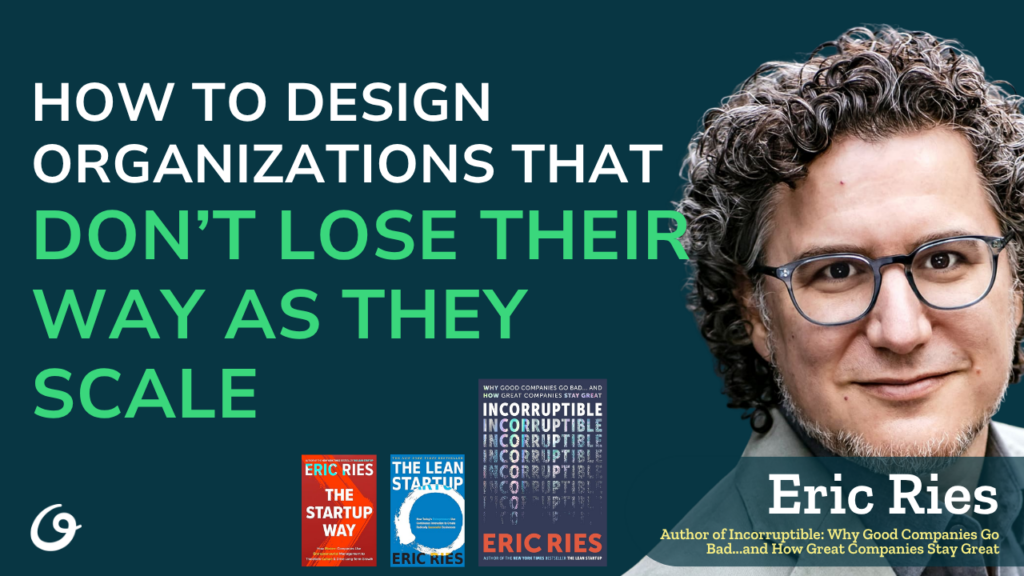
What if the companies that last the longest are the ones building enough trust that people want to keep participating in them? That’s the idea behind my conversation with Eric Ries — entrepreneur, author of The Lean Startup, and now Incorruptible.
Through stories such as Volvo giving away the seatbelt patent, Tony’s Chocolonely opening its ethical supply chain to competitors, and Mary Parker Follett’s idea of the “invisible leader,” we explore how organizations create lasting advantage through trust, shared purpose, and systems that hold together as companies scale.
We also unpack why so many businesses drift toward short-term extraction, what leaders misunderstand about organizational health, and why AI is exposing deeper weaknesses in how companies operate.
Subscribe


If you’re building a company and questioning whether business-as-usual is still the right operating system, this conversation is for you.
Key Takeaways
- Ethical business can outperform extractive business models: Eric argues that mission-driven companies are not sacrificing performance. In many cases, trust, alignment, and long-term thinking create stronger economic outcomes.
- Volvo used open ecosystems as strategy: Giving away the three-point seat belt patent helped establish safety as an industry standard while positioning Volvo as the global leader in automotive safety.
- Tony’s Chocolonely treats its mission as infrastructure: The company’s goal is not simply selling chocolate. Its mission is to eliminate child slavery from the cacao supply chain through systems that competitors can also adopt.
- Positive externalities can strengthen competitive advantage: Eric explains how companies can create value by improving the broader ecosystem around them instead of maximizing short-term value extraction.
- Organizations are shaped by invisible leadership: Mary Parker Follett’s idea of the “invisible leader” shows how shared purpose influences decisions when executives are not in the room.
- Organizational health cannot be commanded: Leaders can issue instructions, but trust, accountability, and commitment have to be cultivated through systems and behavior over time.
Additional Insights
- The current business narrative rewards extraction over durability: Barry and Eric discuss how modern startup culture often glorifies hyper-efficient solo founders, aggressive cost cutting, and short-term returns while ignoring long-term organizational health.
- AI is amplifying leadership weaknesses, not solving them: As companies use AI to accelerate decision-making and productivity, leaders are being forced to confront whether their systems actually create clarity, trust, and aligned behavior.
- Mission statements are easy. Mission transmission is harder: Eric argues that values only matter when they shape real decisions, incentives, hiring, product tradeoffs, and customer experience.
- Open systems can expand both impact and market position: From Linux and Git to Netflix influencing AWS through open source tooling, the episode explores how sharing infrastructure can strengthen an ecosystem while also benefiting the originating company.
- Profit becomes dangerous when it ignores externalities: Eric explains how traditional profit models often fail to account for long-term brand damage, human cost, environmental impact, and deferred liabilities.
Episode Highlights
00:00 – Episode Recap
Eric Ries explains why organizations are living systems, not machines to be controlled. Leaders can command action, but organizational health has to be cultivated through purpose, trust, and the systems people use when no one is watching.
00:57 – Barry’s Opening Reflection
Barry connects AI, leadership, and decision-making systems before introducing Eric’s new book, Incorruptible.
02:14 – Guest Introduction: Eric Ries
Barry introduces Eric Ries, entrepreneur, author of The Lean Startup, and author of Incorruptible, framing the conversation around ethical business as a path to long-term prosperity.
04:34 – Researching the Stories Behind Incorruptible
Eric shares how much research went into the book, including the challenge of finding stories that were not just interesting, but genuinely useful for leaders.
08:07 – Volvo and the “Seatbelt Heist”
Eric breaks down how Volvo’s decision to give away the three-point seat belt patent created a prosperity cascade that reshaped the industry while strengthening Volvo’s long-term brand position around safety.
16:45 – Open Source as Strategy
Barry connects Volvo’s story to Netflix and cloud computing, where open sourcing internal tools helped shape the direction of the broader ecosystem.
17:57 – Positive Externalities as Business Strategy
Eric explains why companies often overlook opportunities to create value by improving the wider system around them.
20:18 – Tony’s Chocolonely and Slave-Free Chocolate
Eric tells the story of how a Dutch journalist turned frustration over child labor in cacao production into a fast-growing chocolate company with a much larger mission.
24:03 – Mission Beyond the Product
Tony’s mission is not simply making chocolate. The business exists to eliminate child slavery from the cacao supply chain and align economics with ethical sourcing.
26:00 – Tony’s Open Chain
Eric explains how Tony’s opened its ethical supply chain to competitors while requiring them to commit to the same standards across all their chocolate products.
30:32 – The False Tradeoff Between Ethics and Performance
Eric challenges the business-school assumption that companies must choose between mission and profit, arguing that the data often shows the opposite.
33:23 – Redefining Profit
Barry and Eric discuss why traditional definitions of profit often ignore externalities, deferred liabilities, human cost, and long-term brand damage.
39:19 – The Myth of the Solo Founder
Barry pushes back on modern founder mythology and explains why anything built to last depends on systems, teams, and shared ownership.
40:36 – Mary Parker Follett and the Invisible Leader
Eric introduces management thinker Mary Parker Follett and explains why her ideas about shared purpose and distributed authority were decades ahead of their time.
45:00 – What Guides Decisions When Leaders Aren’t Present
Eric explores Follett’s idea of the invisible leader: the shared sense of purpose that influences behavior when no executive is in the room.
49:35 – Organizations as Living Systems
Eric compares organizations to emergent intelligence systems like ant colonies or the human body, arguing that leaders can cultivate organizational health but cannot directly command it.
52:30 – Closing Reflections
Barry and Eric reflect on the need for new business models that prioritize trust, mission alignment, and long-term value creation over extraction.
FAQs
Q1: What is Eric Ries’ book Incorruptible about?
Incorruptible explores how leaders can build companies that stay aligned with their mission as they grow. Eric looks at stories from business history to show how purpose, governance, incentives, and ownership shape whether companies create long-term value or lose their way.
Q2: Why does Eric Ries use Volvo as an example?
Volvo’s three-point seat belt story shows how a company can create value by spreading a mission beyond its own products. By making the patent available to others, Volvo helped establish safety as an industry standard while strengthening its own reputation for safety.
Q3: What is Tony’s Chocolonely trying to change?
Tony’s Chocolonely is trying to eliminate child slavery from the cacao supply chain. The company sells chocolate, but the deeper mechanism is building an ethical supply chain that other companies can use through Tony’s Open Chain.
Q4: What does Mary Parker Follett mean by the invisible leader?
The invisible leader is the shared purpose that guides people’s decisions when no formal leader is present. It is what shapes behavior in everyday moments, such as how teams handle quality issues, customer problems, or ethical tradeoffs.
Q5: Can leaders command organizational health?
No. Leaders can command tasks, especially in urgent situations, but they cannot command trust, judgment, or commitment. Organizational health has to be cultivated through systems, incentives, habits, and a clear mission people can actually use to make decisions.