
Building AI startups can make past success a liability when it convinces you that the way you built before is the way you should build next.
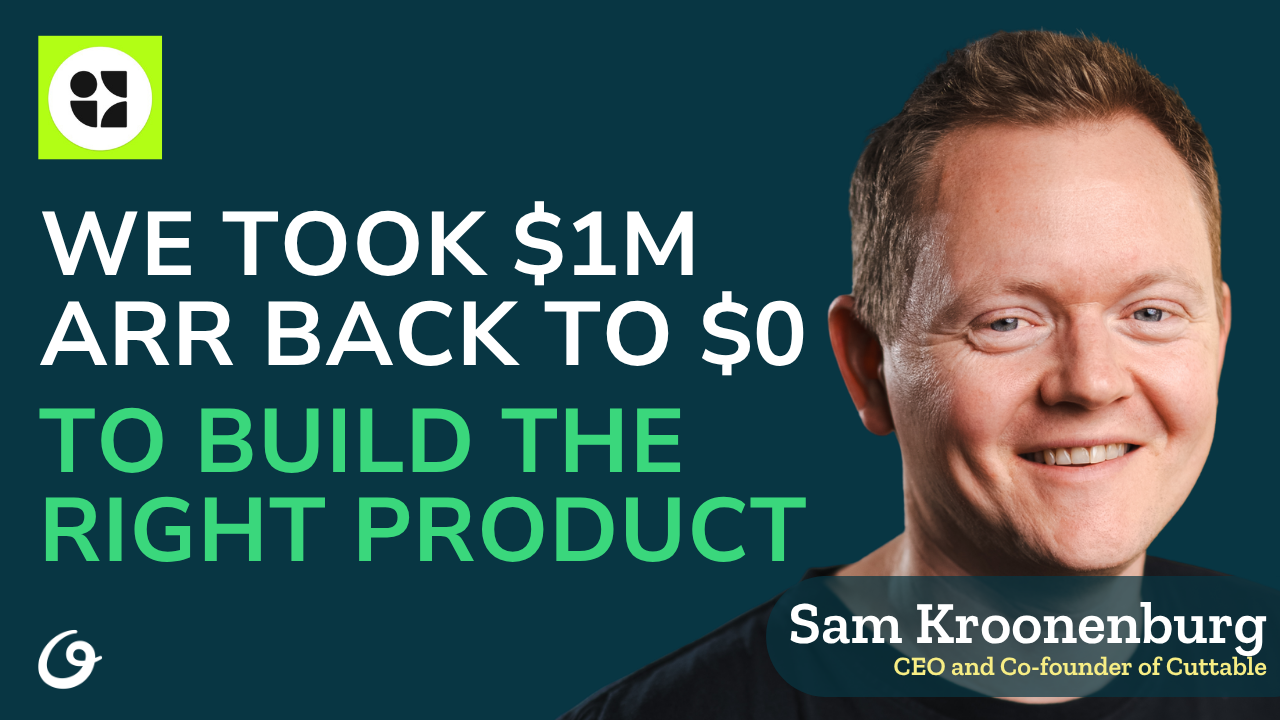
Sam Kroonenburg knows what it feels like to build at scale. He co-founded A Cloud Guru, helped grow it into a business serving millions of learners, and eventually sold the company to Pluralsight. Now, as CEO and co-founder of Cuttable, he’s back at the beginning: finding customers, testing assumptions, shipping imperfect products, and learning how different company-building looks in the AI era.
In our conversation, we explore what Sam had to unlearn when he moved from running a 600-person company back into an early-stage startup. We get into why Cuttable walked away from nearly $1 million in annual recurring revenue, how enterprise customers can pull a young company away from the product it actually needs to build, and why AI is shifting product and engineering teams from owning parts of a system to owning measurable outcomes.
Subscribe


Key Takeaways
- Past success can distort your judgment: Starting Cuttable reminded Sam that reputation means little if the product does not solve a problem customers will pay for.
- Experience does not transfer automatically: Sam could trust his instincts when building for engineers, but entering advertising required him to test assumptions and learn from customers.
- Revenue can hide the wrong product: Cuttable reached nearly $1 million in ARR while engineers were still manually doing work the product was supposed to automate.
- Taking the long view can require a reset: Sam and his co-founders released every customer, returned to zero revenue, and rebuilt around end-to-end automation.
- AI shifts the focus from tasks to outcomes: Instead of teaching AI to copy a human process, teams should define the desired result and let AI determine how to achieve it.
Additional Insights
- Speed can be an advantage over scale: A Cloud Guru prepared courses before AWS certifications launched, then updated them using real exam feedback.
- Playfulness can strengthen a product: Short, entertaining lessons made cloud training easier to engage with and helped A Cloud Guru stand out.
- Paying customers provide stronger signals: Payment shows whether a problem matters enough to solve and makes the customer’s feedback more meaningful.
- AI is changing team ownership: Cuttable is moving from teams that own system components to teams accountable for measurable customer outcomes.
- Founder optimism needs a counterweight: Glitch Capital uses analysts and experienced operators to challenge assumptions and add rigor to investment decisions.
Episode Highlights
00:00 – Episode Recap
Sam reflects on starting again after a major exit and learning that customers care more about solving their problem than a founder’s reputation.
02:13 – Guest Introduction: Sam Kroonenburg
Meet Sam Kroonenburg, CEO and co-founder of Cuttable, co-founder of A Cloud Guru, and founder investor at Glitch Capital.
03:29 – The Moment Technology Clicked
Sam traces his entrepreneurial journey back to receiving his first computer and learning to code through an online pen pal.
09:11 – Winning Through Speed and Play
Sam explains how A Cloud Guru used informed bets, rapid updates, and playful learning experiences to move faster than larger organizations.
12:26 – Starting Again and Unlearning Founder Instinct
Moving from a 600-person company to an early-stage startup forced Sam to test his assumptions and relearn how to earn customer trust.
17:51 – Running a Startup Like a Large Company
Sam initially brought too much structure, reporting, and sales pressure into Cuttable before refocusing on product-market fit.
20:56 – Why Cuttable Went Back to Zero
After reaching nearly $1 million in ARR, Cuttable released every customer and rebuilt around end-to-end automation.
27:48 – Why Paying Customers Change the Signal
Sam explains why payment reveals whether a problem matters enough to solve and makes customer feedback more meaningful.
29:43 – Stop Teaching AI to Work Like a Human
Cuttable learned to give AI the available data and desired outcome instead of forcing it to follow a prescribed human process.
34:45 – Organizing Teams Around Outcomes
Sam explores why engineers focused on customer impact often embrace AI and how Cuttable is organizing teams around measurable outcomes.
38:41 – Why Founder Optimism Needs a Filter
Sam explains how Glitch Capital balances founder optimism with analysts and experienced operators who challenge assumptions.
42:03 – Smaller Teams and Bigger Impact
Sam shares his optimism that AI will help smaller teams create impact at a scale that once required much larger organizations.
FAQs
Q1. What did Sam Kroonenburg have to unlearn after building A Cloud Guru?
Sam had to unlearn the confidence and operating habits that came with previous success. At Cuttable, he found that reputation could not replace customer value, evidence, or the search for product-market fit.
Q2. Why did Cuttable give up nearly $1 million in annual recurring revenue?
Enterprise demands were pulling Cuttable toward custom work and manual intervention. When engineers began generating and fixing campaigns themselves, the team released those customers and rebuilt around end-to-end automation.
Q3. How does Sam Kroonenburg think AI changes product development?
Sam believes teams should spend less time telling AI how to perform a task and more time defining the desired outcome. AI can then use the available data to determine the best method.
Q4. Why does Sam prefer feedback from paying customers?
Payment shows that a problem matters enough to solve. Free users can offer feedback without genuinely valuing the product, while paying customers provide a stronger signal.
Q5. How is AI changing the way Cuttable organizes engineering teams?
Cuttable is organizing teams around measurable customer outcomes instead of software components. Teams can use AI and evaluation systems to improve those outcomes continuously.