
Walk into almost any executive meeting today and the conversation around AI has changed.
A year ago, leaders were asking, “Which AI platform should we buy?”
Today, that question has largely been answered.
According to LayerX Security’s State of AI Usage Report 2026, 45% of enterprise employees have used AI tools at work. ChatGPT remains the leader, used by 36% of enterprise AI users, followed by Microsoft Copilot M365 at 30%, Gemini at 13%, and Claude at 12%.
Employees have licenses. Teams have experimented. Hundreds of pilots have been launched. AI has become part of everyday work.
Adoption is no longer the hard part. Measuring AI outcomes is.
Understanding whether AI is making the organization better.
That is the question I hear everywhere, from boardrooms and executive coaching sessions to conversations with CEOs, CIOs, CFOs, and Heads of AI.
The challenge is that most organizations are still measuring AI the same way they measure software deployments..They count:
- Licenses purchased
- Active users
- Prompts written
- Models deployed
- Training sessions completed
- Hours supposedly saved
Those metrics tell us AI is being used. They tell us almost nothing about whether AI is improving how the organization operates.
The organizations pulling ahead aren’t simply adopting AI faster. They’re becoming better at measuring how AI improves decisions, workflows, and business outcomes.
They are becoming Artificial Organizations.
The next leadership challenge isn’t AI. It’s organizational capability through cross-functional coordination.
One conversation recently captured this perfectly. I was speaking with the Head of AI at one of the world’s leading airline groups about how AI is changing work inside the company.
What struck me wasn’t the technology. It was how quickly the conversation moved beyond prompts and copilots toward organizational thinking.
They described how leaders naturally view problems through the lens of their own function. Marketing sees marketing. Operations sees operations. Technology sees technology. Everyone optimizes their own area. Very few people see the entire system.
AI changes that. It requires leaders to think big, end to end and more cross-functional than ever!
Instead of simply generating ideas, leaders need to start exposing each dependency required to make those ideas real.
A simple proposal suddenly becomes connected to technology architecture, customer operations, regulatory requirements, staffing, investment, and dozens of decisions happening across the business.
The conversation needs to shift from, “Can we build this?” to “What would it actually take to make this succeed?”
That isn’t automation. That’s better organizational judgment.
The value isn’t the answer AI generated. The value is the better executive coordination to create meaningful business outcomes, together.
When faster creation creates slower decisions
Another conversation with a global CEO the same day has stayed with me too.
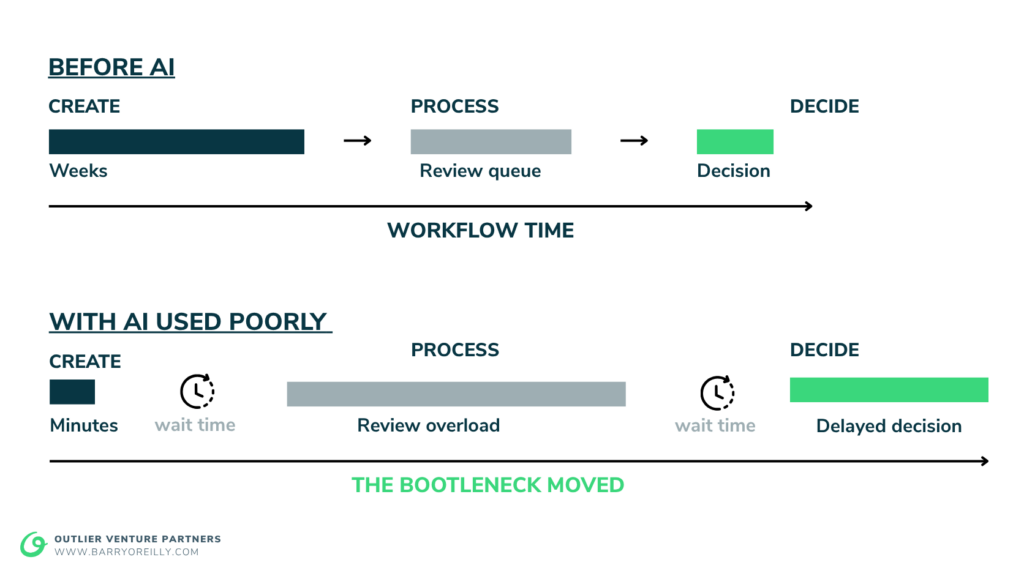
When creation time falls but decision time rises, AI may be transferring the burden rather than improving the workflow.
It’s one of the biggest unintended consequences of generative AI.
Creating a strategy paper used to take three weeks. Now it takes twenty minutes. Creating five options to pressure test the strategy used to be almost impossible. Now it happens before lunch.
Creation has become dramatically cheaper, yet somebody still has to do the work to process the information and decide.
In too many companies, the work has simply been shifted.
Executives are increasingly spending more time reviewing, validating, comparing, and making sense of exponentially more content than ever before.
The bottleneck hasn’t disappeared. It has simply moved.
Processing Pass-Off
Producing Is Not Processing The Work
We saw this very early in our venture studio, Nobody Studios.
Once ChatGPT launched in late 2022, by early 2023 we suddenly had founders showing up with perfectly crafted sets of artifacts for their business strategy, product design, go-to-market plans, financial projections, and more.
The dream data room, ready for investors to dive into.
Yet once we got started going through the hundreds of pages of documentation, investing half a day to see how the business hung together, you could see something wasn’t adding up.
Once we got on a call with the founder who produced all the work for us to review and asked two or three questions, it was obvious.
They didn’t do the work. They produced the work.
They created the output and shifted the processing, review (or as some would say, the real work) onto us. Not acceptable.
If AI helps create work faster but makes decisions slower, the workflow hasn’t improved. The burden has simply been transferred to the next person.
That’s why measuring productivity purely through output is becoming dangerously misleading.
More documents do not necessarily create better organizations. Better decisions do.
I’m seeing the same behavior inside organizations today. People can produce twelve-, fourteen-, or twenty-page documents in minutes and send them to someone else with a simple request, “Can you review this and tell me what you think?”
The production cost has collapsed. The processing cost has moved downstream.
And too often, it keeps filtering upward toward executives… the people with the least capacity to absorb more processing work.
That’s why I’ve started encouraging executives to establish a very simple cultural expectation:
A respectful way to work with colleagues is for you to do the work and call on their capacity to improve your work in meaningful ways.
Don’t generate massive documents and move the production tax from you into a processing tax for them. Show up having done the hard work.
Show how, “I looked at 25 scenarios. Here are the options. Here are the pros and cons. I recommend B. Here’s why. You have expertise I need. What am I missing?”
That’s a great use of someone else’s judgment.
Dumping twenty pages on somebody and asking them to work out what matters isn’t.
In the age of AI, that is increasingly a sign of disrespect for your coworker’s time, capacity, and energy. If AI helps create work faster but makes decisions slower, the workflow hasn’t improved. The burden has simply been transferred to the next person.
That’s why measuring productivity purely through output is becoming dangerously misleading.
More documents do not necessarily create better organizations. Better decisions do.
AI is exposing work, not replacing it
I heard a similar pattern again with the CFO of a global retailer investing approximately $100 million yearly in AI-related initiatives. The conversation wasn’t about replacing people. It wasn’t even primarily about AI. It was about day-to-day work.
Who owns decisions? How does work flow across the organization? Where does intent become disconnected from execution?
What becomes clear very quickly is that AI rarely exposes technology problems first. It exposes organizational problems.
- Unclear ownership
- Duplicated effort
- Broken workflows
- Poor decision-making
- Weak coordination
Those problems already existed. AI simply makes them impossible to ignore. It exposes your leadership systems.
Organizations that redesign work around these insights create lasting advantage.
Organizations that simply add AI on top of existing processes accelerate existing inefficiencies.
Stop measuring AI activity. Start measuring organizational capability.
This is where many executive dashboards begin to fail. They jump directly from AI adoption to financial return. The missing piece is understanding how AI changes the organization’s capability along the way.
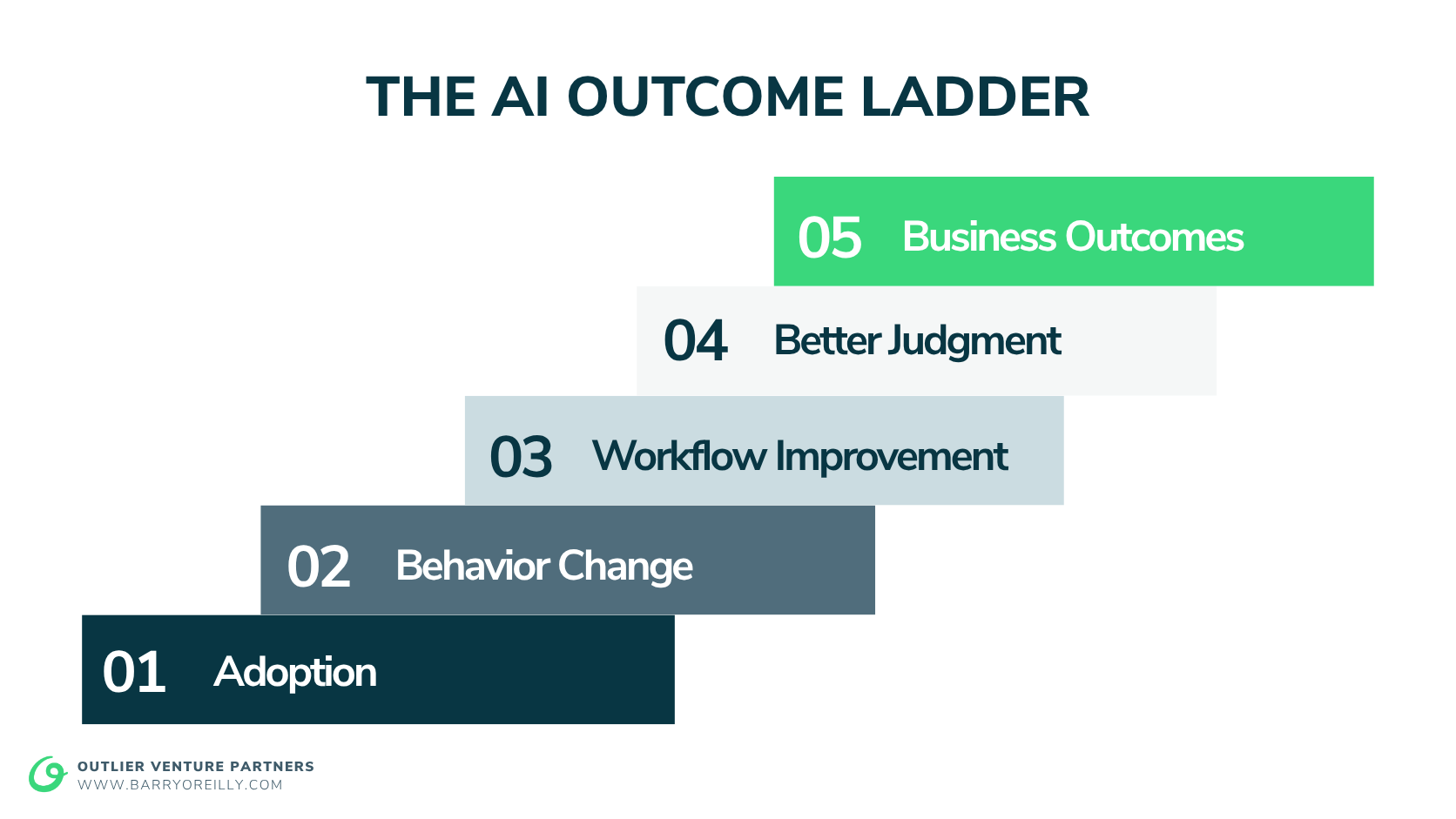
We use this technique when working with leaders to think, define, and start measuring AI outcomes as a progression toward ROI. We call this progression the AI Outcome Ladder.
It helps leaders move beyond measuring access and activity to examine whether AI is changing behavior, improving workflows, strengthening judgment, and contributing to meaningful business outcomes. Let me know if you want to run it with your teams.
The AI Outcome Ladder
Level 1 — Adoption
Are people actually using AI?
This is where most organizations stop measuring.
It’s important to understand utilization but it isn’t enough, plus it’s already over. 71% of knowledge workers globally use at least one generative AI assistant in a typical week; 44% use three or more tools weekly.
Level 2 — Behavior Change
Has AI changed how people work? Have you and your leaders unlearned, and relearned.
Have meetings changed? Has preparation improved? Are leaders making different decisions?
Are employees spending more time solving problems instead of producing information?
Level 3 — Workflow Improvement
Has work become easier across the entire process? Or have we simply shifted effort from one team to another?
Remember:
When creation time falls but decision time rises, AI may be transferring the burden rather than improving the workflow.
Real workflow improvement removes friction. It doesn’t relocate it.
Level 4 — Better Judgment
Are better decisions being made? Are decisions faster?
Are more assumptions tested? Are risks identified earlier?
Are cross-functional dependencies understood sooner?
This is where AI begins creating executive advantage.
Level 5 — Business Outcomes
Only now do we ask the questions every CEO and CFO ultimately care about.
Has customer experience improved? Has revenue increased?
Has quality improved? Has risk fallen?
Has innovation accelerated? Has the organization become more capable than it was before?
That is AI ROI.
The organizations winning with AI are measuring work differently.
They are no longer asking, “How many people are using AI?”
They are asking:
- Which decisions became better?
- Which workflows became simpler?
- Which bottlenecks disappeared?
- Which teams became more capable?
- Which customers experienced better outcomes?
Those are fundamentally different questions, and they produce fundamentally different organizations.
AI is not another software implementation. It is forcing leaders to rethink how work gets done, how decisions are made, and how organizations learn.
The competitive advantage won’t belong to the companies with the most AI. It will belong to the companies that can consistently demonstrate AI is improving organizational capability.
How you can understand where you are, and what could help
Last year, while writing Artificial Organizations, we surveyed more than 5,000 CEOs, C-suite executives, VPs, and Directors to understand how organizations were adopting AI.

Artificial Organizations Executive AI Survey 2025
Sixty-one percent described themselves as beginners with AI, while only 4% considered themselves experts. Leaders were primarily using AI for communication, productivity, research, and operational activities. Only 8% were applying it to strategy and forecasting.
More importantly, when we asked where leaders saw the biggest return from AI, only 13% identified better, faster decisions. That’s the opportunity.
This September, we’ll publish the 2026 Artificial Organizations Executive AI Survey. Sign up to the newsletter so you can take part and receive the early findings.
The conversation has evolved. We’re no longer asking who is experimenting with AI. We’re asking:
- What measurable outcomes has AI created?
- Which organizations are redesigning work instead of accelerating existing processes?
- How are executives measuring better judgment?
- Where is AI genuinely improving organizational capability?
If the last year was about adoption, the next year will be about evidence.
Because the future won’t be shaped by organizations using the most AI.
It will be shaped by organizations that can prove AI is making them better.
FAQ
Q1. Hasn’t AI adoption still got a long way to go?
Depth of adoption certainly does. LayerX’s 2026 data shows that nearly half of enterprise employees have interacted with AI at work, while only around 18% use it weekly.
That’s exactly why adoption alone is becoming a poor measure of progress.
The question for leaders is no longer simply whether people have access to AI. It is whether that access is changing behavior, improving workflows, strengthening judgment, and producing meaningful outcomes.
Q2. What is the AI Outcome Ladder?
The AI Outcome Ladder is a way to measure AI progress across five levels:
Adoption → Behavioral Change → Workflow Improvement → Better Judgment → Business Outcomes
The point is to stop jumping directly from licenses and usage to ROI.
Each step asks whether the organization has developed a stronger capability because of AI.
Q3. Why aren’t time saved and productivity enough to measure AI?
Because saving time in one part of a workflow can create more work somewhere else.
A person may create a twenty-page document in twenty minutes instead of three days, but if five executives must now spend hours reviewing and interpreting it, the organization hasn’t necessarily become more productive.
The burden has moved.
That is why leaders should measure the whole workflow, not simply the individual task.
Q4. What should leaders measure instead of AI usage?
Start with decisions and workflows.
Ask:
- Is time-to-decision improving?
- Are decisions being reversed less often?
- Is rework decreasing?
- Are bottlenecks disappearing?
- Are risks being identified earlier?
- Are customers experiencing better outcomes?
Usage tells you AI is present.
These measures tell you whether AI is useful.
Q5. How should leaders stop AI from creating more work for everyone?
Set a cultural expectation that people use AI to reduce the work they ask others to do, not increase it.
Do the processing before you seek someone else’s judgment.
Come with the analysis, the options, the assumptions, and your recommendation.
Then use your colleague’s scarce attention for what you actually need from them: their expertise and judgment.
That is a much more respectful—and valuable—way to work in the age of AI.
References
- LayerX Security. 2026. State of AI Usage Report 2026.
- Master of Code Global. 2025. “Generative AI Statistics: Trends, Adoption, and Market Growth.” Accessed August 2026.
- O’Reilly, Barry. 2025. “AI Maturity Models Don’t Work: What’s the Alternative for Leaders?” Barry O’Reilly, September 30, 2025.
- O’Reilly, Barry. 2026. Artificial Organizations: Build Better Judgment, Speed, and Results with Human and Machine Intelligence.
- O’Reilly, Barry. 2018. Unlearn: Let Go of Past Success to Achieve Extraordinary Results. Hoboken, NJ: Wiley.
- SaaStr. 2026. “Who’s Winning Enterprise AI Now? Claude Up 128%, Gemini Up 48%, OpenAI Down 8%, Grok Still a Rounding Error.” Accessed August 2026.