
For the last two years, most executive conversations about AI have been about tools.
Which copilots should we buy? Which large language model should we use? Which teams should get access first? How do we stop people from using shadow AI?
Those questions mattered. They got leaders started. But the conversation is moving on.
The next wave isn’t about ChatGPT, copilots, or better prompts. It’s about AI agents: systems that can complete tasks, coordinate workflows, interact with other systems, and increasingly take action with less direct human input.
That shift sounds technical. It isn’t. It is an operating model shift.
Because once AI can do more than answer questions, leaders have to ask much harder ones.
- Who decides what an agent is allowed to do?
- Where does human judgment stay in the loop?
- How do we measure whether agents are improving outcomes, or simply creating more automated activity?
- Who is accountable when an agent acts across functions, systems, and teams?
This is why I believe the real opportunity with agents isn’t automation. It’s redesigning how humans and machines work together.
As I wrote in Artificial Organizations, “This is not automation. It is judgment infrastructure.”
That distinction matters more now than ever.
Why Agents Are Changing the Conversation
Copilots help people do work faster. Agents begin to change how work flows.
A copilot might summarize a meeting, draft an email, or help prepare a board memo. An agent can go further. It can monitor inputs, trigger actions, update systems, escalate exceptions, coordinate handoffs, and keep work moving without waiting for someone to manually push every step.
That is powerful. It is also risky.
Deloitte predicts that by the end of 2025, 25% of companies using generative AI will launch agentic AI pilots or proofs of concept, rising to 50% by 2027. McKinsey’s 2025 global AI survey found that 23% of respondents say their organizations are already scaling an agentic AI system somewhere in the enterprise, while another 39% are experimenting with agents. Yet in any individual function, no more than 10% report scaling agents.
In other words, the market is moving quickly, but most organizations are still early.
That gap between experimentation and scale is where operating models either evolve or break.
Many companies are still treating agents like productivity add-ons. A better customer support agent here. A sales research agent is there. A software engineering agent in another team. Useful experiments, yes. But disconnected from how the organization actually makes decisions, allocates accountability, and learns.
That is the trap.
AI agents do not simply automate tasks. They expose the system of work around those tasks.
If your decision rights are unclear, agents will amplify the confusion. If your data is fragmented, agents will move faster through bad context. If your teams already suffer from handoff delays, agents may create faster handoffs without better ownership. If your organization lacks clear judgment infrastructure, agents will not fix it. They will reveal it.
AI does not replace leadership. It amplifies it, or exposes its absence.
The Real Question: What Operating Model Are You Building?
Most organizations begin with the wrong question: “Where can we use agents?”
A better question is: “Where does work repeatedly stall because judgment, context, or coordination breaks down?”
That points leaders away from novelty and toward operating model design.
In Artificial Organizations, I describe a progression:
Personal Productivity → Executive Workflows → Departmental Pilots → Organizational Scale
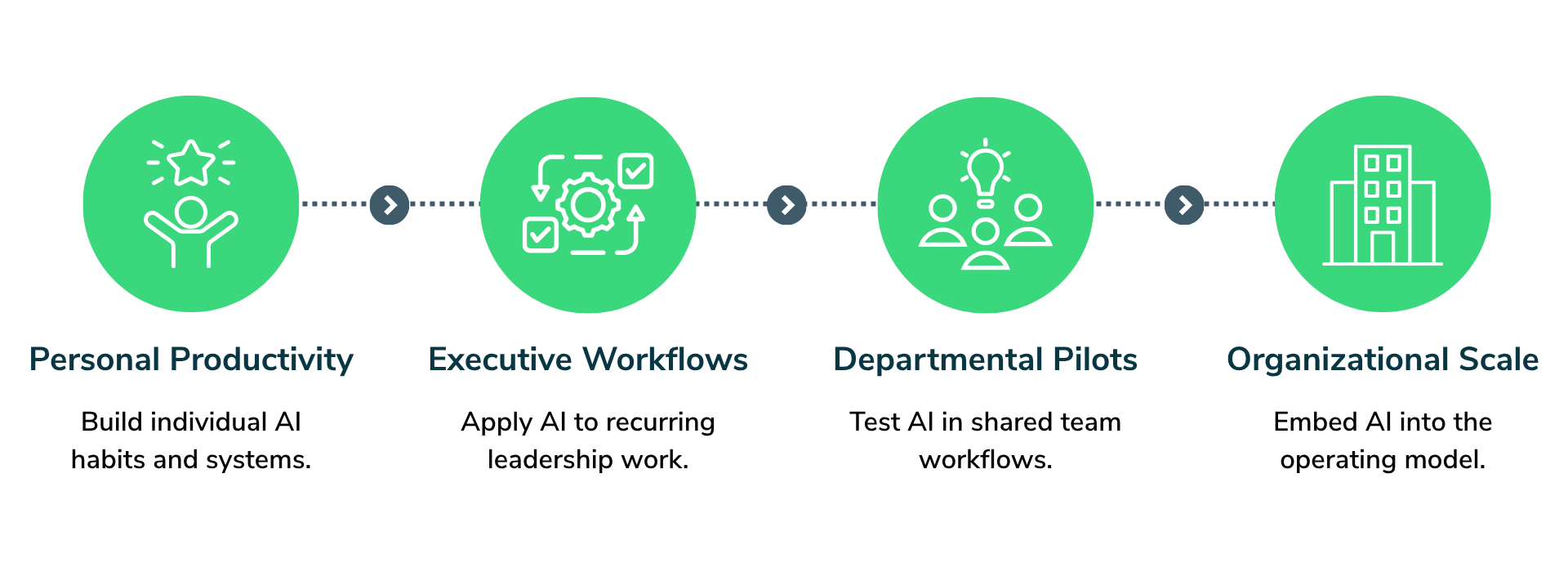
The AI Transformation Journey
Most companies want to jump straight to scale. They want enterprise platforms, AI task forces, centers of excellence, dashboards, and roadmaps.
But if leaders have not redesigned how they personally think, decide, and lead with AI, scaling agents across the company becomes theater.
The more useful path starts smaller and sharper.
At the individual level, leaders need a Judgment System: a repeatable way to capture, synthesize, decide, and act with AI as a thinking partner.
At the organizational level, that becomes Judgment Infrastructure: the operating architecture that ensures decision quality improves as speed increases across teams.
Agents make this more important because they increase the speed of action. But speed without judgment creates chaos. Judgment without speed becomes irrelevant.
The advantage is in combining both: decision velocity and decision advantage.
Decision velocity is how quickly you move from signal to insight to decision to action.
Decision advantage is the quality, context, and confidence behind those decisions.
The companies that win with agents will not be the ones with the most agents. They will be the ones who redesign their workflows so agents increase decision velocity without sacrificing decision advantage.
How Leaders Should Think About Agents
There are three shifts leaders need to make.
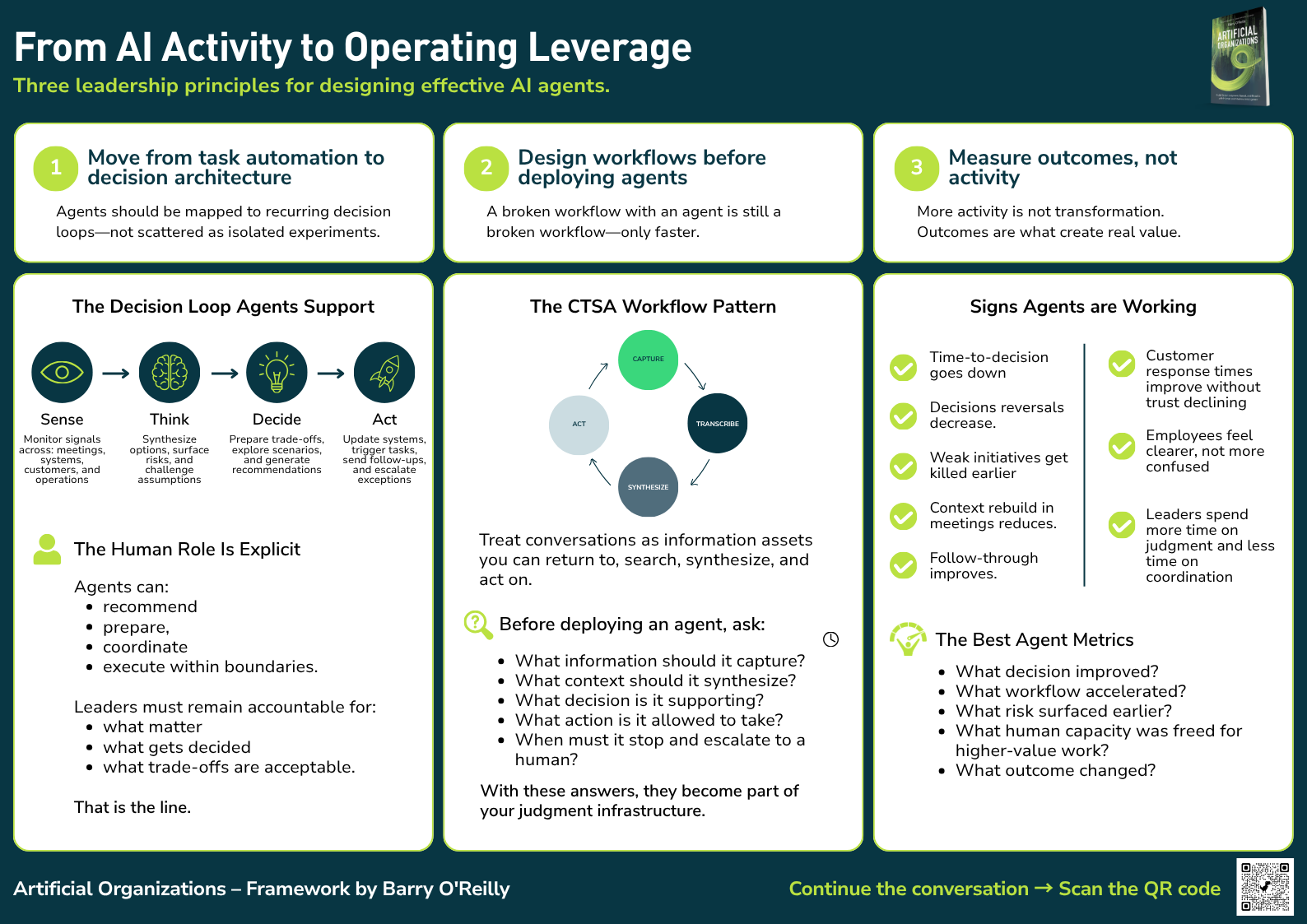
How Leaders Should Think About Agents
1. Move from task automation to decision architecture
Agents should not be scattered across the business as isolated experiments. They should be mapped to recurring decision loops.
Every meaningful workflow has a decision shape:
Sense → Think → Decide → Act
- You sense what is changing.
- You think through the options.
- You decide what to do.
- You act and learn from the result.
Agents can support each part of that loop.
- They can sense by monitoring signals across meetings, systems, customers, and operations.
- They can think by synthesizing options, surfacing risks, and challenging assumptions.
- They can support decisions by preparing trade-offs, scenarios, and recommendations.
- They can act by updating systems, triggering tasks, sending follow-ups, or escalating exceptions.
But the human role has to be explicit.
Agents can recommend, prepare, coordinate and execute within boundaries.
Leaders must remain accountable for what matters, what gets decided, and what trade-offs are acceptable.
That is the line.
2. Design workflows before deploying agents
A broken workflow with an agent is still a broken workflow, only faster.
This is why one of the most practical patterns in Artificial Organizations is CTSA:
Capture → Transcribe → Synthesize → Act
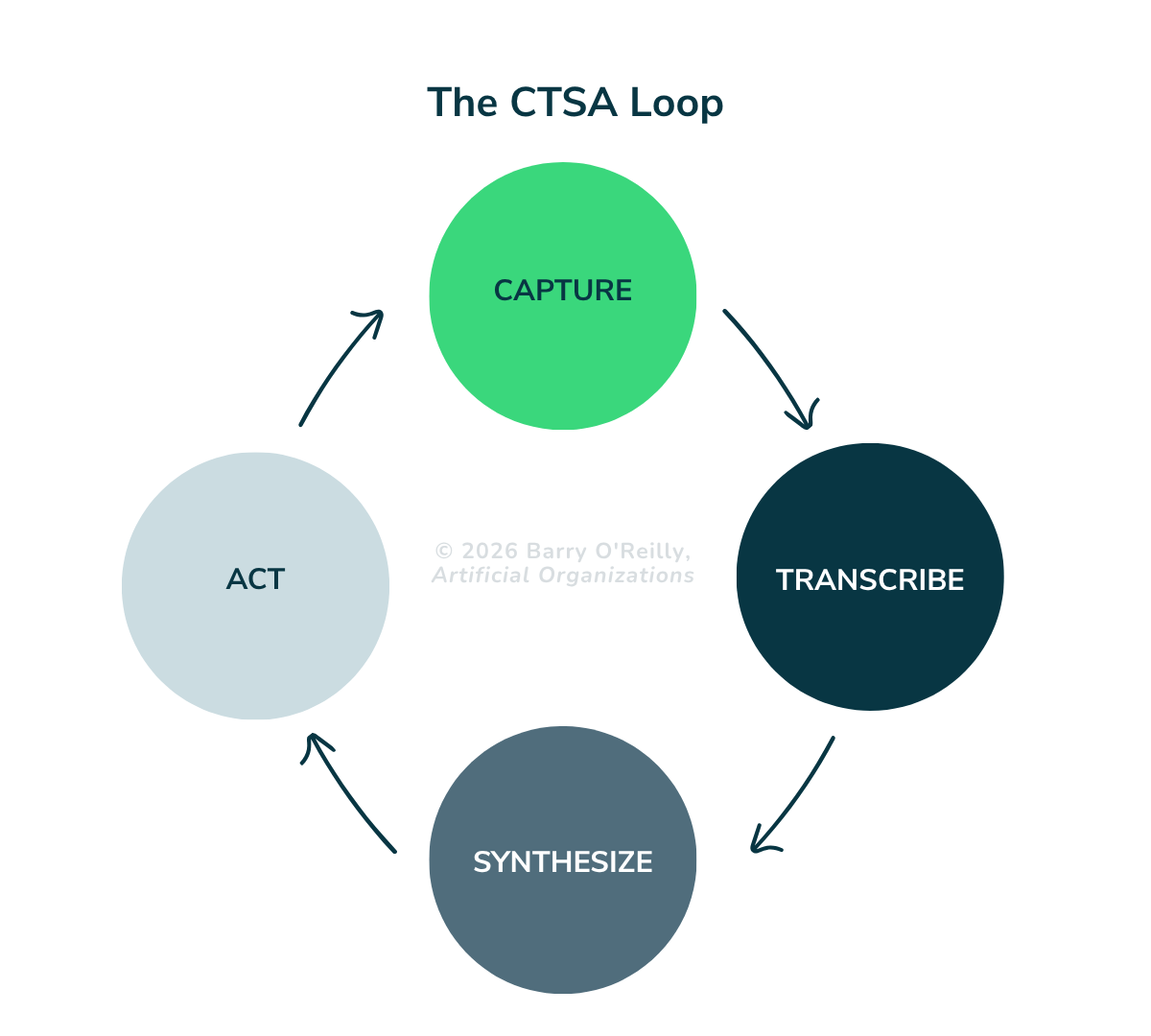
The CTSA Loop
This was the first step in my own operating system. I stopped treating conversations as moments and started treating them as information assets. Meetings, coaching calls, board discussions, and strategy sessions became data I could return to, search, synthesize, and act on.
That simple shift changed the work.
Preparation took minutes instead of hours. Follow-ups became clearer. Context stopped leaking. I walked into conversations calmer and better prepared. The machine did not replace me. It supported me.
Now apply that same logic to agents.
Before asking an agent to execute a workflow, ask:
- What information should it capture?
- What context should it synthesize?
- What decision is it supporting?
- What action is it allowed to take?
- When must it stop and escalate to a human?
Without those answers, agents become automated ambiguity.
With those answers, they become part of your judgment infrastructure.
3. Measure outcomes, not activity
One of the biggest risks with agents is that they will make organizations look busier.
More tickets closed. More summaries generated. More messages sent. More tasks updated. More dashboards refreshed.
But more activity is not transformation.
McKinsey found that while AI adoption is broadening, only 39% of respondents attribute any EBIT impact to AI, and most of those say less than 5% of EBIT is attributable to AI use. BCG similarly argues that real value comes when companies move beyond deploying tools and reshape workflows end-to-end.
That should be a wake-up call.
If agents are working, leaders should see measurable changes in how the business operates:
- Time-to-decision goes down.
- Decision reversals decrease.
- Weak initiatives get killed earlier.
- Context rebuild in meetings reduces.
- Follow-through improves.
- Customer response times improve without trust declining.
- Employees feel clearer, not more confused.
- Leaders spend more time on judgment and less time on coordination.
The best agent metrics are not “how many agents did we launch?”
They are:
- What decision improved?
- What workflow accelerated?
- What risk surfaced earlier?
- What human capacity was freed for higher-value work?
- What outcome changed?
That is how you move from AI activity to operating leverage.
What This Looks like in Practice
The case studies in Artificial Organizations point to what agent-enabled operating models can become.
At Progyny, CEO Pete Anevski started with a simple but powerful leadership move. He used AI meeting support to improve how 1:1s were captured, synthesized, and followed up. Actions, owners, and due dates became clearer. His private notes moved into a more visible system. Decision cycles shortened. But the defining moment was not the tool. It was the message he sent: “We’re not using AI to reduce headcount. We’re using it to amplify your human skills. To elevate, not eliminate you and your work.”
That is the cultural foundation agents need. Without psychological safety, people will hide their experiments, resist new workflows, or assume agents are a headcount strategy in disguise.
Also at Progyny, CHRO Cassandra Pratt showed what workflow redesign looks like in HR. The team built an HR bot to answer common employee questions around onboarding, benefits, policies, and basic organizational information. But the real value was not just faster answers. It was the feedback loop. Employee questions revealed where policies were unclear, documentation was outdated, or onboarding needed improvement. Standard HR queries moved from roughly 24-hour response times to near-instant answers, and HR time shifted toward higher-trust, higher-judgment conversations.
That is an operating model shift.
The bot did not replace HR judgment. It protected it.
And at Skyscanner, CTO Andrew Phillips modeled another critical behavior: learning in public. He did not pretend to have mastered AI. He shared what he was trying, where tools fell short, and what felt useful or distracting. That kind of leadership matters because agentic AI will require teams to experiment, surface risk, and adapt workflows together.
The future will not be designed by leaders who pretend certainty. It will be built by leaders who learn fast, visibly, and responsibly.
The operating model for agents
So what should leaders do now?
Start with one workflow that matters.
Not the flashiest use case. Not the most impressive demo. Pick a recurring workflow where context, coordination, and decision quality matter.
A weekly business review, a customer escalation process, sales pipeline review or board preparation cycle.
Then map the current flow:
- Where is context captured?
- Where is it lost?
- Where do decisions wait?
- Where does work get handed off?
- Where do humans add judgment?
- Where are people doing repeatable coordination that agents could support?
Next, design the agent’s role.
- Is it a scout, sensing signals?
- Is it a synthesizer, turning noise into options?
- Is it a coordinator, moving work across systems?
- Is it a challenger, pressure testing assumptions?
- Is it an executor, taking bounded action?
Finally, define the boundaries.
- What can it do alone?
- What requires approval?
- What must never be delegated?
- What data can it access?
- What audit trail is needed?
- What metric proves it is working?
This is how agents move from experiments to operating models.
The Leadership Choice
Agents will make some work faster. That is obvious.
The bigger question is whether they will make organizations better.
Better at sensing change, making decisions, learning from action and focusing human judgment where it matters most.
That will not happen by installing more tools. It will happen when leaders redesign the system of work.
The next phase of AI adoption is not about who has the most advanced agent strategy. It is about who has the clearest judgment infrastructure.
Because once agents can act, the quality of the operating model around them becomes the differentiator.
AI agents are moving from experiments to operating models.
The question is whether your organization is ready to move with them.
FAQs:
Q1. What are AI agents in business?
AI agents are software systems that can complete tasks, coordinate workflows, interact with other applications, and take action with limited human intervention. Unlike AI assistants that respond to prompts, AI agents can operate continuously within defined boundaries to support business processes.
Q2. How should leaders prepare for AI agents?
Leaders should begin by redesigning important workflows before introducing AI agents. Understanding where human judgment is required, how decisions are made, and where context is captured creates the foundation for successful AI adoption.
Q3. What is judgment infrastructure?
Judgment infrastructure is the combination of people, processes, and AI systems that improve how organizations capture information, synthesize insights, make decisions, and learn over time. It enables organizations to increase decision speed without sacrificing decision quality.
Q4. How are AI agents different from AI assistants?
AI assistants primarily help individuals complete tasks such as writing, summarizing, or researching. AI agents extend those capabilities by coordinating workflows, triggering actions, interacting with multiple systems, and supporting end-to-end business processes.
Q5. Why do AI initiatives fail to deliver business value?
Many organizations focus on deploying AI tools instead of redesigning how work flows through the business. Sustainable value comes from improving workflows, decision-making, and organizational operating models—not simply adding more AI technology.
References
- Boston Consulting Group. 2025. AI at Work 2025: Momentum Builds, but Gaps Remain. Boston: Boston Consulting Group.
- Deloitte. 2025. Three New AI Breakthroughs Shaping 2026: AI Trends. Deloitte.
- Deloitte. 2026. Enterprise AI Trends in 2026: AI Transformation Strategy Opportunities and Predictions. Deloitte.
- McKinsey & Company. 2025. The State of AI: How Organizations Are Rewiring to Capture Value. QuantumBlack, AI by McKinsey.
- O’Reilly, Barry. 2026. Artificial Organizations: Build Better Judgment, Speed, and Results with Human and Machine Intelligence.