
AI capabilities are advancing quickly, but changing how people work takes time. Leaders need to give teams the confidence to experiment while protecting sensitive information and keeping responsibility clear. How they manage that balance shapes whether AI leads to better business outcomes.
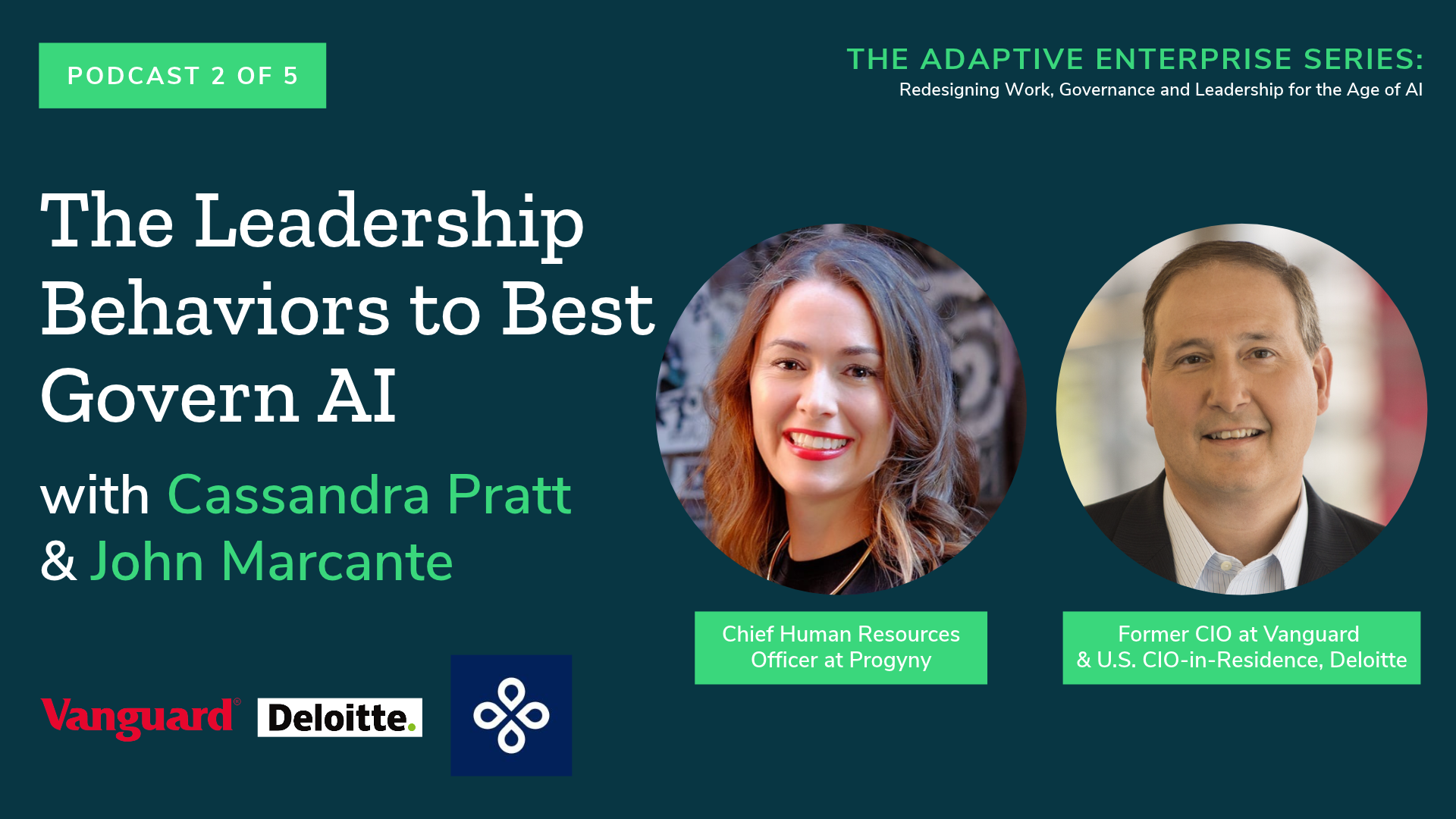
In this episode, Cassandra Pratt, CHRO at Progyny, and John Marcante, former Global CIO of Vanguard, join me to explore how governance can support that change. Cass shares lessons from Progyny’s internal HR tool, Lumi, and efforts to redesign workflows while building employee trust. John recalls how a Vanguard team improved website conversion by listening to clients and simplifying their choices. He connects that experience to governing AI through clear business outcomes, accountability, and oversight matched to risk.
This is the second podcast in The Adaptive Enterprise, our five-part article and podcast series on redesigning work, governance, and leadership for the age of AI.
Subscribe


Key Takeaways
- Start with a business outcome: Define the problem you want to solve before choosing how to use AI. John’s Vanguard example shows how customer research and simpler choices helped address a conversion problem that previous technology investment had not resolved.
- Design governance into the whole workflow: Bring the relevant business, risk, and technical partners together early. Cass explains why understanding the data and the full process makes it easier to establish appropriate controls.
- Build trust through visible action: Explain how information is handled and show what happens when work is automated. Cass describes employees moving into a new member services area after automation, giving them evidence that leadership would follow through on its commitments.
- Put recovered capacity toward what matters: At Progyny, reducing manual work can give people more time to listen to and support members. Judge progress against the business outcome and the experience you want to improve.
- Match oversight to the risk: John contrasts an internal productivity tool with autonomous trading to explain why different uses need different levels of oversight. Clear responsibility, human involvement, and monitoring remain important as AI becomes more autonomous.
Additional Insights
- An initial tool can be a starting point: Cass describes Lumi evolving beyond its original HR use. At the time of recording, Lumi Landing, which would compile and present information across the company, was still being developed.
- Learning needs support across levels: Progyny’s champions program brings employees from different roles and seniority levels together, with engineers helping on more complex challenges.
- Leaders need firsthand experience: Cass’s executive team built skills and agents themselves. Experiencing the difficulties helped make the learning process more tangible and reinforced the importance of sharing mistakes.
- Human judgment remains a leadership responsibility: John describes AI’s value in gathering a fact base while emphasizing leaders’ responsibility to imagine the organization’s future and determine its direction.
Episode Highlights
00:00 – Episode Recap
Cass describes the gap between the speed of AI and organizational change, while John introduces his analogy of roadblocks, speed bumps, and guardrails.
02:39 – What Should Leaders Govern Now?
Barry introduces the conversation, and Cass explains why progress in HR has been slower than she expected.
04:37 – Start With the Outcome at Vanguard
John shares how a cross-functional team used customer feedback to identify confusing language and excessive choices affecting website conversion.
08:18 – Protecting the Human Experience
Cass describes how operational automation can free people to focus on member conversations and the human service Progyny values.
11:56 – Building Trust in an Internal HR Tool
Barry introduces the employee experience behind Lumi, and Cass explains how the team addressed concerns about information handling and anonymity.
14:06 – From an Initial Tool to Wider Learning
Cass discusses Lumi’s evolution, initiatives still in development, and the champions program supporting experimentation across the organization.
18:09 – Redesigning Work With Fresh Perspectives
Cass explains how colleagues from other disciplines help challenge familiar processes and design governance around the whole workflow.
21:17 – The Courage to Lead While Learning
John and Barry discuss vulnerability, visible experimentation, and leaders’ responsibility to keep attention on business outcomes.
24:15 – Giving Employees Evidence They Can Trust
Cass shares how employees moved into new work after automation and how hands-on executive learning supports confidence in change.
30:27 – Guardrails, Risk, and Accountability
John explains oversight matched to risk, enterprise-level coordination, and the governance questions raised by increasingly autonomous AI.
34:48 – Where to Start on Monday Morning
Cass recommends involving the right partners early, defining the problem, and understanding the data needed to redesign the workflow.
36:18 – Machine Intelligence and Human Ingenuity
John explains why leaders should use AI to inform strategy while retaining responsibility for imagining the future of the business.
FAQs
Q1: What does behavioral governance mean for leaders using AI?
It means examining how people work with AI and whether their decisions and working practices improve outcomes. In this conversation, that includes clear accountability, appropriate controls, and learning from actual use as the work evolves.
Q2: How can organizations govern AI without stopping experimentation?
John recommends matching oversight to the risk of each use. Cass emphasizes bringing risk and other relevant partners into workflow design early. Together, these approaches help teams understand the boundaries within which they can experiment.
Q3: How did Progyny build employee confidence in AI?
Cass describes explaining how Lumi handles information, discussing AI openly, and supporting learning through a champions program. She also shares an automation project where employees moved into new member services work, demonstrating that leadership followed through on its commitments.
Q4: What should leaders measure when introducing AI?
Measure the business outcome the work is meant to improve, such as employee experience, client loyalty, or conversion. Cass and John caution that adoption and utilization figures alone do not establish whether AI is helping the business.
Q5: Why redesign an entire workflow rather than automate individual tasks?
Automating isolated tasks can leave unnecessary steps and handoffs in place. Cass recommends defining the intended outcome and data needs upfront, then examining the whole process with relevant partners to improve the experience and establish suitable governance.