
In our first article, we argued that AI doesn’t change technology. It changes work.
That raises a more important question: “If AI is changing how work gets done, what exactly should leaders govern?”
For the past forty years, governance focused primarily on technology. Did the software behave as expected? Was it secure? Was it compliant? Did it perform reliably? Those questions still matter but they are no longer sufficient.
What makes this AI era distinct? Put simply, AI goes beyond executing instructions to influencing decisions. It changes how people work. It reshapes how organizations learn. That means the object of governance has fundamentally changed.
Traditional governance focused on controlling software that behaved predictably. AI requires governing systems whose behavior evolves over time, and whose recommendations influence human judgment.
We’re no longer just governing software. We’re governing the behaviors that emerge when people and AI work together. That’s a very different leadership challenge.
The Governance Gap
The first wave of enterprise AI was driven by urgency. No CEO wanted to explain to their Board why competitors were moving faster. Organizations launched pilots, purchased licenses, experimented with copilots and created AI task forces. Governance often came afterwards. Today we’re living with the consequences.
AI capabilities are improving faster than most organizations are improving the way they govern them. Despite billions invested, in the region of $30-40 billion in the last 12 months alone, many executives are still asking a simple question, “Where’s the business value?” With the main response being silence.
And while we do have a way to help you address that silence by measuring AI outcomes, the point proved true again and again from all the companies we’ve worked in and with is a lack of AI is not the problem. It’s a lack of leadership systems capable of helping organizations continuously adapt.
What Are We Actually Governing?
For decades software governance asked one primary question, “Did the system do what we programmed it to do?”
Behavioral governance asks a different question, “Are people achieving better outcomes because of how they work with AI?”
That’s a profound shift because it reminds us that organizations don’t create value from AI, people do.
AI is amazing at analyzing, summarizing, predicting and generating output (probably too good for many executives dealing with the produced yet not processed work feedback requests). It can even act autonomously within defined boundaries! But whether those capabilities improve the business depends entirely on how people respond.
- Do leaders challenge AI or simply accept it?
- Do teams redesign work or bolt AI onto existing processes?
- Do employees learn new behaviors or continue working exactly as before?
Those are behavioral questions, and increasingly, they’re governance questions.
Behavioral Governance Starts at the Top: Vanguard’s Behavior Aha!
People often ask John where Vanguard’s engineering transformation began.
Most assume it started with Agile, cloud or DevOps. It didn’t. It began when he took Vanguard’s Chairman and executive leadership team to Silicon Valley.
They spent several days meeting founders, venture capitalists, technology leaders, and some of the world’s most innovative companies. The expectation was to discover better technology. Instead, they discovered better behaviors.
The organizations they visited weren’t succeeding because they had superior technology. They were succeeding because they learned faster, made better decisions, stayed closer to customers and adapted continuously.
On the flight home, the conversation changed. The conclusion wasn’t that IT needed to modernize. It was that “we”, Vanguard needed to change, and the executive team needed to change first.
As John reflects:
“We realized we weren’t short of capability. We had talented people throughout Vanguard. What we’d become was slow, expensive, organizationally siloed, and disconnected from the pace of innovation around us.”
That realization led to a new aspiration: Business Value at Startup Speed.
Not because Vanguard wanted to become a startup, but because it wanted to combine the trust of an established institution with the speed, learning, and customer focus of the world’s best technology companies.
That’s behavioral governance.
Before changing systems, before changing processes, even before changing technology. The leadership team changed its own assumptions about how the organization should behave.
Governance Isn’t a Checkpoint
One of the biggest mistakes organizations make is treating governance as something that happens at the end of an AI project. Follow the famous sign off steps of;
- Review
- Approve
- Deploy
- Audit
That’s how we governed traditional software.
The difference is that AI doesn’t work like that. AI capabilities evolve continuously, are released daily, especially as model costs, speed and competitive advantages change and the ability to rewire your stack in a minute becomes the norm.
Organizations must learn to evolve with the technology, at pace with the change of technology. Good governance is no longer a checkpoint, it’s a continuous operating discipline.
Every deployment should generate learning. Every insight should improve how work gets done. Every improvement should create better business outcomes. Governance becomes the mechanism that connects learning with action—not bureaucracy with compliance.
Three Questions Every Executive Team Should Ask
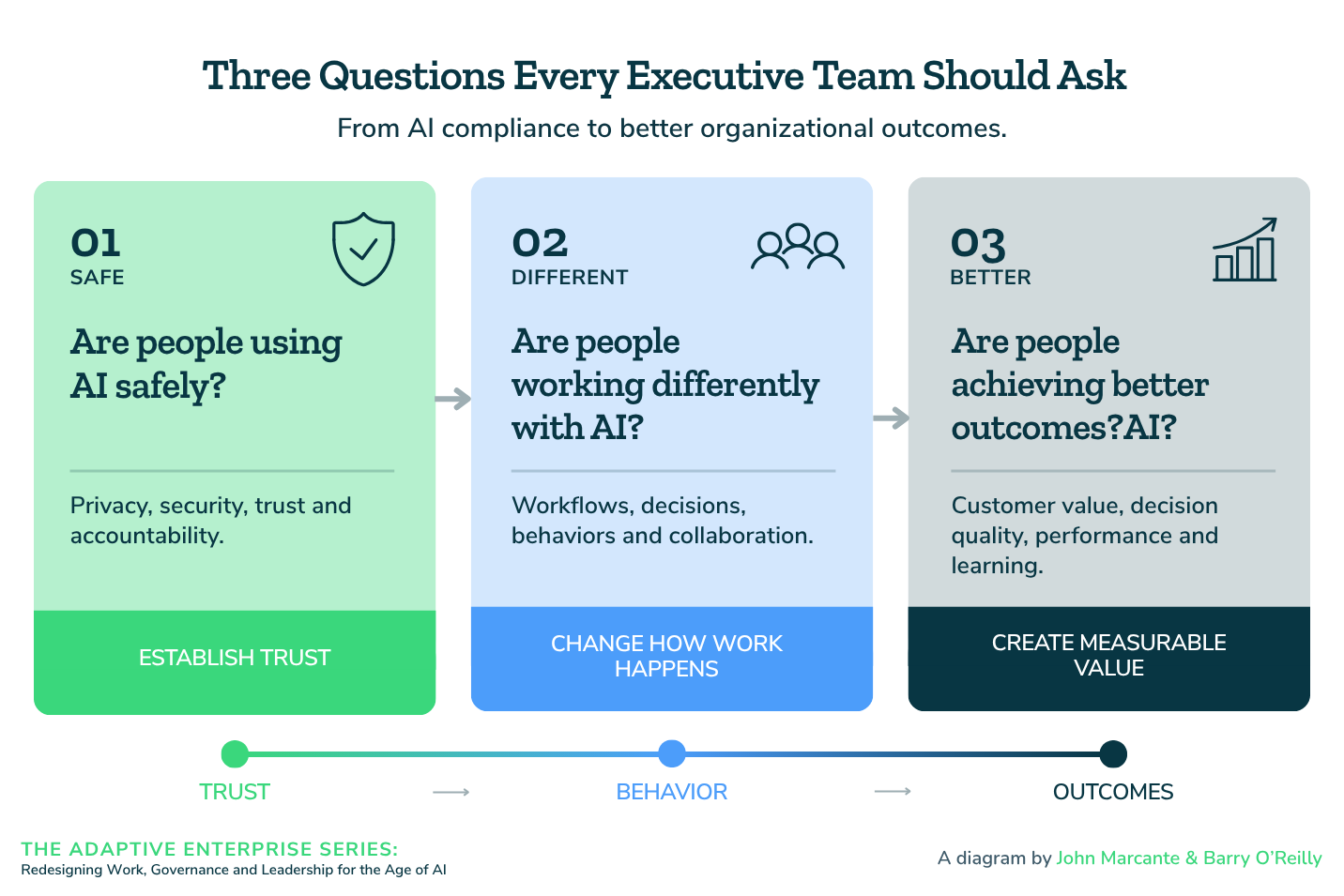
Most governance frameworks are becoming more complicated. We think they should become simpler. Every executive team should regularly ask three questions.
1. Are people using AI safely?
Have we established the right guardrails around privacy, security, regulation, ethics, and risk?
2. Are people using AI differently?
Have we actually changed how work gets done, or have we simply added AI to yesterday’s processes?
3. Are people creating better outcomes?
Are decisions improving? Are customers benefiting? Are teams learning faster? Is measurable business value increasing?
Everything else in AI governance should support those three questions.
Three Questions Every Executive Team Should Ask
Governance Happens at Every Level
Behavioral governance doesn’t replace technology governance, it builds upon it.
Strong organizations still need secure infrastructure. Trusted data, reliable models, appropriate oversight and clear accountability.
But we must never forget that those capabilities exist for one reason… To help people make better decisions.
Technology governance creates trust. Behavioral governance creates value.
Behavioral Governance in Practice: Progyny’s HR Bot
Behavioral governance isn’t just something that happens in the boardroom, it happens every day in how organizations design work, and it’s already happening inside organizations that are creating meaningful value from AI.
One company that worked with Barry, and was a case study in Artificial Organizations was Progyny, where Chief Human Resources Officer Cassandra Pratt began exploring AI, the question wasn’t, “How do we build an HR chatbot?”
It was, “How do we create a better employee experience while ensuring AI supports people in the right moments, and humans step in when judgment, empathy, or trust matter most?”
That distinction created an entirely different approach.
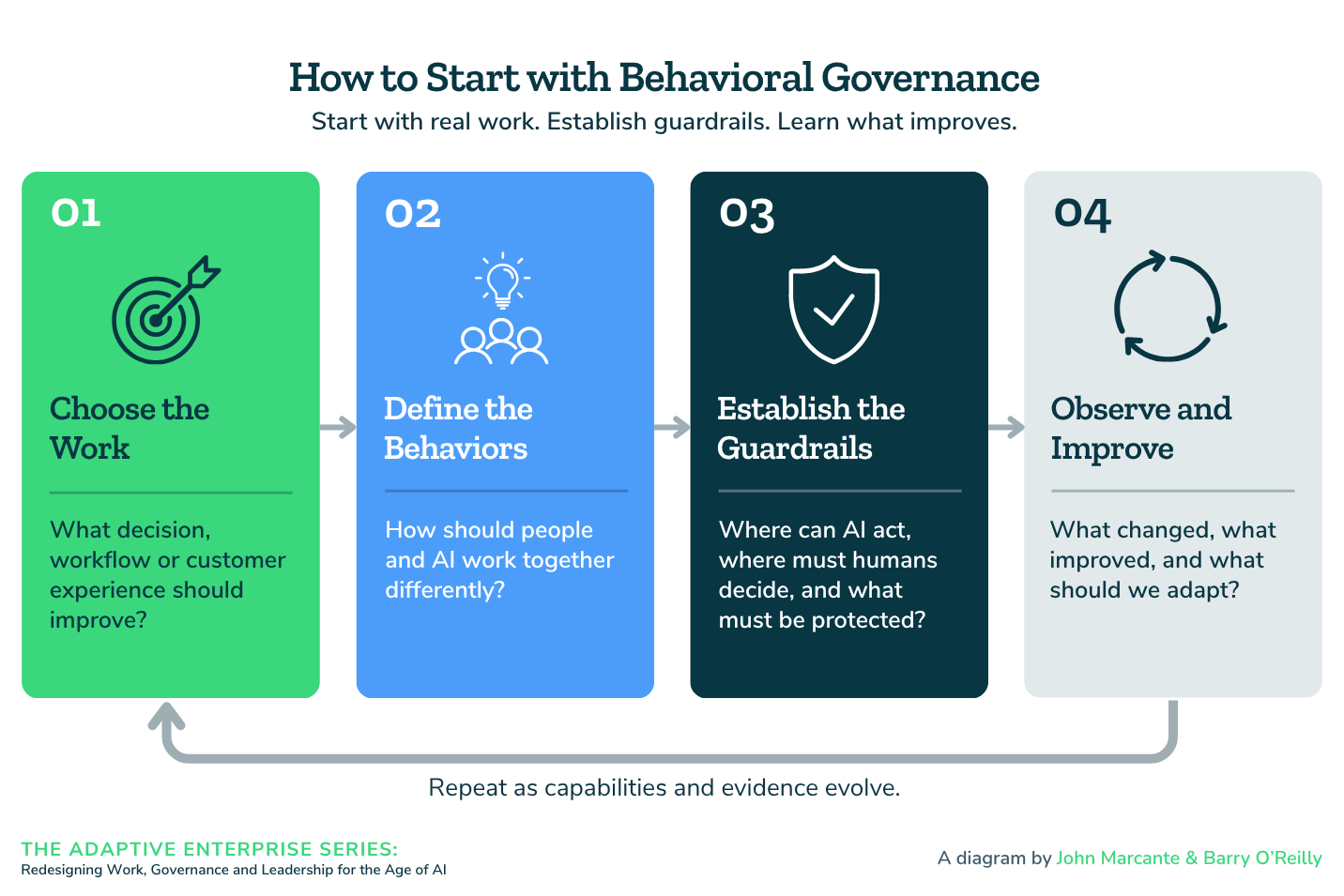
Before a single workflow was built, the team established clear behavioral guardrails.
They defined which questions AI should answer, which conversations should always be handled by a human, how employee privacy would be protected, how responses would be monitored for quality, and how the system would continuously improve over time.
Only then did they begin experimenting.
Interestingly, the first version of the HR Bot wasn’t built by a large engineering team. It started as a focused experiment, allowing the team to learn how employees interacted with AI before expanding its capabilities, all built by an intern.
What happened next was the real breakthrough.
The value wasn’t simply that employees received answers more quickly. Every interaction became a learning opportunity.
The team could immediately see which policies created confusion, which onboarding topics generated the most questions, where documentation was unclear, and where employees genuinely needed more human support.
In other words, the AI wasn’t just answering questions. It was helping the organization understand itself. Those insights were then used to improve documentation, redesign onboarding, simplify HR processes, and continuously improve the employee experience.
That’s behavioral governance in action.
Traditional governance would have measured whether the chatbot was accurate, secure, and compliant.
Behavioral governance asked a different question, “Did the way people worked with AI improve the employee experience and create better organizational outcomes?”
How to Start with Behavioral Governance
The answer was yes. Employees received answers faster. HR professionals spent less time responding to repetitive requests and more time coaching managers, supporting employees, and solving higher-value problems. Training and content updates became dramatically faster because the team could identify knowledge gaps almost immediately.
The technology mattered but the real advantage came from deliberately governing how people and AI learned together. That’s the shift every executive should be thinking about.
Because governance is no longer simply about controlling technology. It’s about continuously improving how humans and AI work together to create better outcomes.
The Leadership Shift
For decades, governance was designed to control technology. The next generation of governance must help organizations continuously improve how people work with technology. That’s a very different responsibility.
The organizations that succeed won’t have the thickest governance manuals. They’ll have leaders who continuously observe how AI changes behavior, measure whether those behaviors improve outcomes, and redesign work as new capabilities emerge.
Because behavioral governance isn’t measured by whether AI was deployed. It’s measured by whether people achieved better outcomes because of how they worked with AI.
– An article by John Marcante and Barry O’Reilly
What would better AI outcomes look like in your organization?
Spend 15 minutes with me to explore where AI could improve business performance and what needs to change in how your organization works.
FAQs
Q1. What is behavioral governance in AI?
Behavioral governance focuses on how people work with AI and whether those interactions improve business outcomes. It involves setting expectations, observing changes in decisions and working practices, and using what teams learn to improve how work gets done.
Q2. How does behavioral governance differ from technology governance?
Technology governance addresses security, privacy, reliability, and compliance. Behavioral governance builds on those foundations by examining how people apply judgment, respond to AI recommendations, and change their work. Together, they support safe use and better business outcomes.
Q3. Why does AI governance need to continue after deployment?
AI capabilities and how people use them change over time. Ongoing governance helps organizations monitor those changes, identify risks, and learn from results. Leaders can then adjust working practices and guardrails as new needs emerge.
Q4. What should executive teams measure when governing AI?
Executive teams should assess whether people use AI safely, whether working practices change, and whether outcomes improve. Measures might include decision quality, customer experience, and reduced errors. Usage figures alone do not show whether AI creates business value.
Q5. How can organizations put behavioral governance into practice?
Start with a workflow and a clear outcome. Define what AI can handle, when humans should step in, and who is accountable. Use feedback to improve the surrounding work, as Progyny did with its HR bot.
References
- Marcante, John, and Barry O’Reilly. “AI Doesn’t Change Technology. It Changes Work.” Barry O’Reilly. October 6, 2026.
- O’Reilly, Barry. “AI Adoption Has Already Happened. Measuring AI Outcomes Has Not.” Barry O’Reilly. August 11, 2026.
- O’Reilly, Barry. “The Human Side of AI: How HR Can Lead the Transformation with Cass Pratt.” Unlearn, episode 168. November 18, 2025. Podcast, 46 minutes.
- Tabassi, Elham. Artificial Intelligence Risk Management Framework (AI RMF 1.0). NIST AI 100-1. National Institute of Standards and Technology, 2023.