
Before copilots, GPTChats and AI agents dominated the office debate, one of our favorite stories of leadership was well underway. It began on the first morning a group of fresh faced graduates arrived at HSBC.
Most organizations start those first few days the same way. New hires are handed playbooks, introduced to established processes, shown the technology they’ll use, and taught how work gets done. Joe Norena, COO of Global Markets Americas, took a very different approach.
Instead of giving the graduates answers, he gave them problems. Not hypothetical exercises, but real business problems that he and his own leadership team were actively working on.
He didn’t tell them how to solve them. He didn’t prescribe a methodology or explain the “right” process to succeed. Instead, he encouraged them to use their own judgment, curiosity, and techniques of choice to see where they would end up.
You see, Joe wasn’t looking for the same answer he would have reached himself. He wanted to understand how this set of people with fresh perspectives, different experiences, and new technologies might approach the challenges in their way.
They weren’t constrained by years of organizational assumptions. They weren’t burdened by “the way we’ve always done it.” They simply reacted by pulling together their set of skills, strategies and technology know-how to see the possibilities to address his problems.
Within minutes, people with limited domain knowledge, no organizational baggage, and a different set of tools and techniques were already making progress. Their fresh perspectives quickly revealed new possibilities and became role models for transforming the way work was done.
Every generation inherits new technology. The leaders who create lasting advantage help people (and themselves) rethink how work itself should change because of it.
Joe’s leadership is exactly why AI represents a unique opportunity shift in how we lead, think, decide and act to change work.
Technology creates new capabilities. Leadership capabilities change work.
Walk into almost any executive team meeting today and you’ll hear the same conversation.
“How quickly can we deploy AI?”
“Which model should we standardize on?”
“Should we build our own agents or buy them?”
They’re sensible questions. They’re also the wrong place to start. Because AI isn’t fundamentally changing technology, it’s changing work, and that distinction matters.
Over the past thirty years, organizations have become remarkably good at implementing technology. We’ve modernized infrastructure, moved to the cloud, embraced mobile, digitized customer experiences, and adopted agile ways of working.
Those technology practices largely helped us automate or digitize existing ways of working. AI presents a different opportunity.
It allows us to rethink how decisions are made, how knowledge is shared, how people collaborate, and where human judgment creates the greatest value.
The organizations that create the greatest advantage won’t necessarily be those deploying the most AI. They’ll be the ones that redesign work faster than everyone else.
Technology creates new capabilities. Leadership is required to turn those capabilities into how we change work.
Every Company Can Buy the Same AI
For the first time in modern business history, almost every organization has access to the same extraordinary capabilities.
Whether you use OpenAI, Anthropic, Google, Microsoft, or another leading provider, the technology itself is becoming increasingly accessible. Stanford’s 2026 AI Index found that 88% of organizations now report using AI in at least one business function.
Technology is no longer scarce, human judgment is.
That’s a profound shift.
For decades, organizations competed by owning better systems, better data centers, or better software. Increasingly they’ll compete by making better decisions.
The question is no longer, “Can we deploy AI?”
It’s, “Can we redesign work faster than our competitors?”
The Real Unit of Value Is No Longer the Task
One of the biggest misconceptions executives make is thinking AI automates tasks. Tasks are only the visible part of work. The real value of work has always been judgment.
Every important role in an organization is ultimately a series of judgments with meaningful consequences.
- What should we prioritize?
- Which customer matters most?
- Is this investment worth making?
- How should we respond to changing market conditions?
AI is becoming exceptionally good at helping us gather information, analyze options, generate alternatives, and automate routine activities.
What it cannot do is remove the need for high quality human judgment.
In fact, as information becomes abundant, judgment becomes even more valuable. That changes leadership. The leaders who create the greatest advantage won’t be those with the most AI. They’ll be those who build better judgment systems.
Technology Doesn’t Transform Businesses. Leaders Do.
John spent nearly a decade leading technology transformation at Vanguard as their Chief Information Officer. Looking back, the technology wasn’t the hardest part. Helping people rethink how they created value was.
As automation, analytics, and AI became more capable, many of the activities that traditionally defined the role of a financial advisor became increasingly automated.
Portfolio construction. Asset allocation. Portfolio rebalancing. Tax-loss harvesting. Cash management. All became faster, more consistent, and increasingly intelligent. The technology worked, that wasn’t the challenge. The more difficult dilemma was helping talented professionals answer a much more personal question.
“If technology can now do much of what I’ve built my career around, where does my value come from?”
That’s a leadership question, no technology needed. The breakthrough was redefining how advisors work, not redefining them.
Instead of spending their time building portfolios, advisors spent more time helping families navigate life’s most important decisions.
Estate planning. Charitable giving. Retirement. Caring for aging parents. Preparing the next generation.
Technology didn’t reduce the advisor’s value, it elevated it. That was the real transformation.
It wasn’t about changing technology. We changed the work and achieved stronger client relationships and better client outcomes. That was the value of the Vanguard crew.
The Same Pattern Is Emerging Again
Over the past few years, Barry’s seen exactly the same pattern across organizations such as American Airlines, Slack, Progyny, and many others.
The companies seeing the greatest impact aren’t asking employees to “use AI.” They’re redesigning how leaders make decisions, how teams collaborate, how customer work flows across the enterprise, and where people create the most value.
And the gap between individual productivity and enterprise performance is becoming increasingly visible. McKinsey’s 2026 State of AI research found that while 80% of respondents report AI improving individual productivity, only 37% say their organizations are seeing a positive EBIT impact.
Making individuals faster isn’t the same as making the enterprise better.
One CEO recently described it perfectly, “Technology can deploy AI. Technology alone can’t transform the business.”
Business leaders redesign work. Technology teams deploy capabilities. Risk leaders establish trust. Executives align incentives and Boards govern outcomes. Transformation only happens when all of those pieces of your organizational puzzle move together.
The Adaptive Enterprise
This is why we believe organizations need a different mental model. Transformation can no longer be viewed as a project with a beginning and an end. AI capabilities improve every month. Customer expectations change continuously, competitors learn constantly, thus organizations must do the same.
That’s why we think of AI transformation as an Adaptive Enterprise.
An adaptive enterprise continually moves through four activities:
- New AI capabilities emerge.
- Leaders redesign work around those capabilities.
- They measure business outcomes, not technology activity.
- They capture what they learn and adapt again.
Competitive advantage doesn’t come from moving through this cycle once. It comes from repeating it faster, and more rigorously than everyone else.
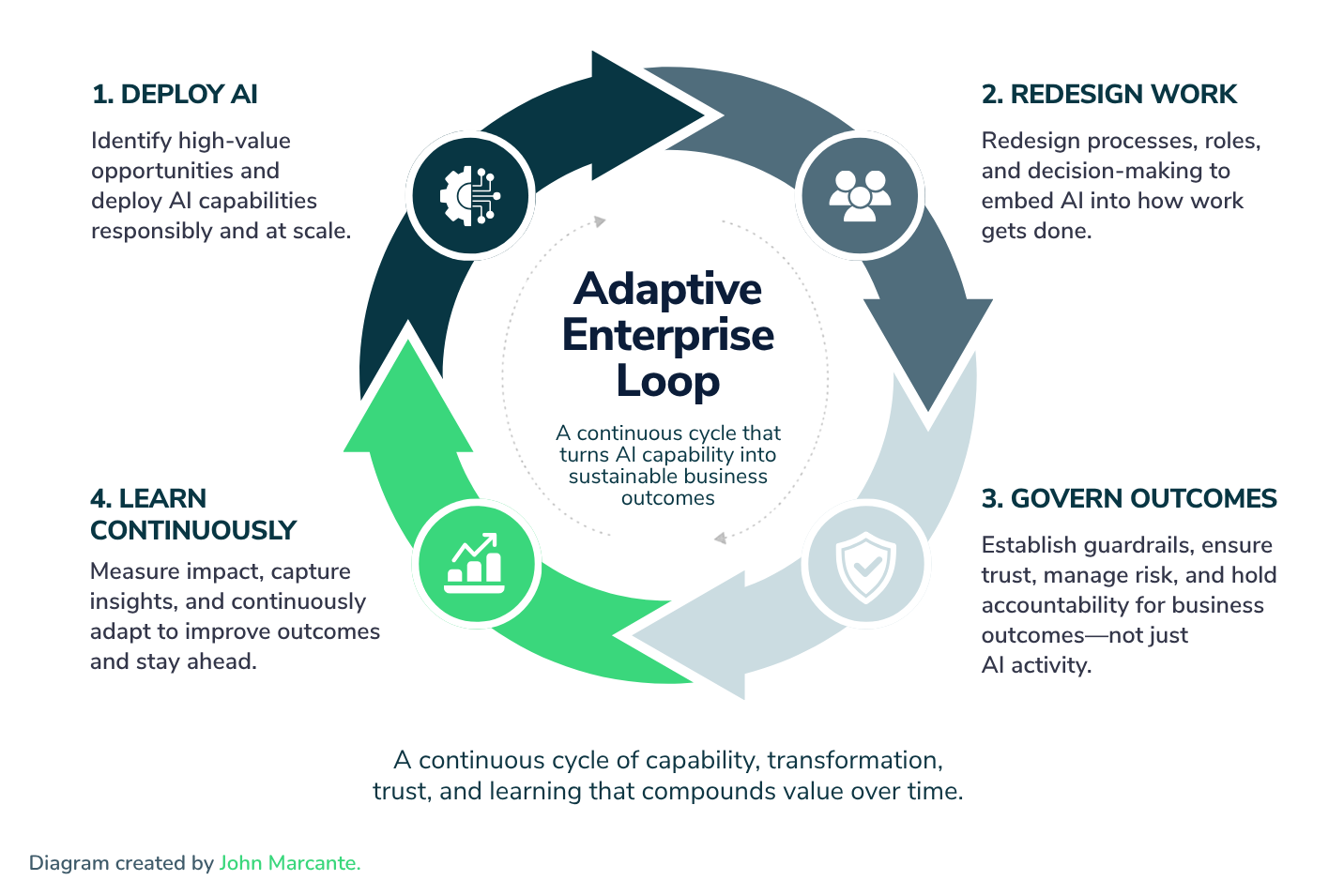
Adaptive Enterprise Loop
The Leadership Shift
The biggest mistake organizations can make is treating AI as another technology implementation. The reality is that it is an enterprise leadership challenge.
Technology creates new capabilities. Capabilities only create value when leaders redesign work around them. That’s the responsibility of leadership. Not simply adopting new technology, but helping people discover better ways to create value together.
The organizations that outperform over the next decade won’t necessarily build better AI, most will or already have access to the same models.
The winners will be those whose leaders continually turn new capabilities into better ways of working.
AI doesn’t create competitive advantage, leadership does. Adaptive enterprises are simply the result.
– An article by John Marcante and Barry O’Reilly
This is the first article in a five-part series between John and Barry on The Adaptive Enterprise: Redesigning Work, Governance and Leadership for the Age of AI. We’ll also be hosting live events with industry experts on each article, all published on the UNLEARN podcast. Make sure you subscribe to not miss out.
FAQs
Q1. How does AI change the way organizations work?
AI changes more than individual tasks. It changes how information is gathered, decisions are made, knowledge is shared, and people collaborate. The leadership opportunity is to redesign work around these new capabilities rather than simply adding AI to existing processes.
Q2. Why isn’t deploying AI enough to create competitive advantage?
Leading AI models are increasingly accessible to every organization. Access to the technology therefore becomes less differentiating. Competitive advantage comes from how effectively leaders turn those capabilities into better decisions, redesigned workflows, faster learning, and improved business outcomes.
Q3. What role does human judgment play as AI becomes more capable?
As AI makes information, analysis, and alternatives easier to generate, human judgment becomes more important, not less. Leaders still need to determine what matters, which opportunities to pursue, what risks to take, and where human expertise creates the greatest value. The opportunity is to use AI to strengthen judgment rather than attempt to remove it.
Q4. What is an Adaptive Enterprise?
An Adaptive Enterprise continuously turns emerging capabilities into better ways of working. Leaders identify new capabilities, redesign work around them, measure business outcomes rather than technology activity, capture what they learn, and adapt again. Competitive advantage comes from repeating that cycle faster and more rigorously over time.
Q5. What should executive teams do differently with AI?
Executives should move the conversation from “How are we deploying AI?” to “How should work change because of what AI now makes possible?” That means role-modelling new behaviors themselves, redesigning decision-making and workflows, establishing appropriate governance, aligning incentives around outcomes, and creating systems that continuously learn. The goal isn’t more AI activity. It’s better organizational performance.
References
- Anthropic. “Anthropic Economic Index Report: Cadences.” June 26, 2026.
- McKinsey & Company. Tinkoff, Dan, Lieven Van der Veken, Michael Chui, and Tara Balakrishnan. “The State of AI in 2026: On the Road to ROI.” August 25, 2026.
- Microsoft. “2026 Work Trend Index Annual Report: Agents, Human Agency, and the Opportunity for Every Organization.” May 5, 2026.
- O’Reilly, Barry. Artificial Organizations: Build Better Judgment, Speed, and Results with Human and Machine Intelligence. 2026.
- O’Reilly, Barry. Unlearn: Let Go of Past Success to Achieve Extraordinary Results. New York: McGraw-Hill Education, 2018.
- Humble, Jez, Joanne Molesky, and Barry O’Reilly. Lean Enterprise: How High Performance Organizations Innovate at Scale. O’Reilly Media, 2014.
- Stanford Institute for Human-Centered Artificial Intelligence. AI Index Report 2026. Stanford University, 2026.
- World Economic Forum. The Future of Jobs Report 2025. Geneva: World Economic Forum, 2025.