
Most leaders don’t need more information. They need better judgment.
After years of advising CEOs, executive teams, and founders through multiple waves of technological change, I’ve learned something uncomfortable but undeniable:
Despite more data, more tools, and more dashboards than ever before, decisions are getting slower, not better.
Complexity is rising. Stakes are higher. And the cost of getting decisions wrong is compounding.
Our situation is broken, and needs change.

Artificial Organizations
Why Artificial Organizations Matters Now
Every executive I work with, be that CEOs, C-suite leaders, or founders tell me the same story, regardless of industry or role:
- Days packed with meetings
- Endless information coming in
- Less time to think
- More pressure to decide
AI was supposed to help. Instead, it often added noise.
What I kept seeing wasn’t a technology problem. It was a leadership system problem.
Not a lack of ambition or capability, but a struggle to adapt how we work to keep pace with the environments we’re leading in.
Organizations chase efficiency rather than better judgment.
Transformation programs launch before leaders change how they work.
It’s not surprising that MIT found 95% of GenAI initiatives are failing to deliver measurable ROI. Most organizations are simply amplifying broken or outdated systems of work.
Human + Machine = Better Outcomes
Better outcomes don’t come from humans or machines in isolation.
They come from human judgment deliberately paired with machine intelligence.
AI doesn’t replace leadership. It exposes it.
When leaders stay in the loop using AI to sharpen thinking, synthesize complexity, and pressure-test decisions, performance improves.
When they don’t, AI simply accelerates confusion.
The opportunity isn’t automation.
It’s a decision advantage.
That’s why I wrote Artificial Organizations.
This is not a book about AI tools.
It’s a book about:
- how leaders work
- how decisions get made
- how to stay effective as complexity keeps rising
Artificial Organizations captures the mindset shifts, behaviors, and practical systems I’ve used and seen work to help leaders reclaim time, sharpen thinking, and lead with clarity under pressure.
It’s a leadership operating system for the age of intelligence.
Real Leaders, Real Case Studies
This book is grounded in real experience and case studies with leaders doing real work under real pressure.
Across the book, I draw on lived examples from leaders including:
- Peter Anevski, CEO at Progyny and former CFO at WebMD, setting direction for AI to elevate people, not replace them.
- Stephen Franchetti, former CIO at Slack, creating leadership learning communities during massive disruption
- Misty Shafer Sterne, VP Commercial Technology at American Airlines, using AI as a thinking partner to turn raw insight into strategic clarity
- Andrew Phillips, CTO at Skyscanner, leading adoption through personal experimentation rather than mandate
- Steve Elliott, Founder and CEO of Dotwork and four-time excited founder, revealing why decision structure not more data is the real bottleneck
- Cassandra Pratt, CHRO at Progyny, redesigning judgment-heavy HR workflows
- Joe Noreña, former COO of Global Markets Americas at HSBC, role-modeling learning in highly hierarchical environments
These aren’t edge cases.
They’re early signals of how leadership is changing.
How I Wrote Artificial Organizations
This book is also the clearest case study for the system it teaches.
When I wrote Unlearn, my breakthrough was realizing I wasn’t a “typing” writer, I was a “talking” writer.
Once I aligned my traits to my tasks, my output changed completely.
With Artificial Organizations, the breakthrough went further.
I wasn’t starting from scratch.
Every coaching session, workshop, executive briefing, and experiment I’ve run since 2017 exists as data I could leverage to create this book in weeks.
A digital set of assets that were:
- recorded
- searchable
- structured
- reusable
I didn’t open a blank page. I opened a system.
I used AI as a thinking partner, to surface patterns across years of leadership work, talk chapters through, synthesize insights, and iterate fast as the best collaborator I could have hoped for.
What once took months or weeks now takes hours.
Not because I work harder, but because the system works the way I work.
That’s the shift this book is asking leaders to make.
Who Artificial Organizations Are For (And Not For)
Artificial Organizations is written for CEOs, C-suite executives, senior leaders, founders, and anyone responsible for high-stakes decisions in uncertain, fast-moving environments.
This book is for you if you:
- make difficult choices under pressure and ambiguity
- feel busy and well-informed, yet short on time to think clearly
- are curious about AI but unimpressed by hype and tool demos
- understand that real transformation starts with how you work
- want to lead AI adoption by example, not delegation
This book is NOT for you if you’re:
- a technical leader looking to write code or build models
- looking for a catalogue of AI tools or prompt libraries
- focused only on efficiency, automation, or cost-cutting
- waiting for certainty before experimenting
- unwilling to unlearn the habits that made you successful in the past
What “AI Productivity” Means For Leaders
For executives and senior leaders, productivity isn’t about doing more.
It’s about:
- making higher-quality decisions with confidence
- reducing decision latency
- spending more time on judgment, not administration
- creating space to think
In Artificial Organizations, AI is positioned as:
- a thinking partner
- a synthesis engine
- a private space to pressure-test ideas
- a way to turn every interaction into an information asset
The leaders who benefit most from AI aren’t the most technical.
They’re the ones willing to change how they work.
Where, and When Can I Get A Copy of Artificial Organizations?
Artificial Organizations will be released late February 2026.
You can:
- sign up for updates
- access early previews
- join the executive community
at www.artificialorganizations.com
This is a one-day read designed for busy leaders — practical, opinionated, and immediately usable.
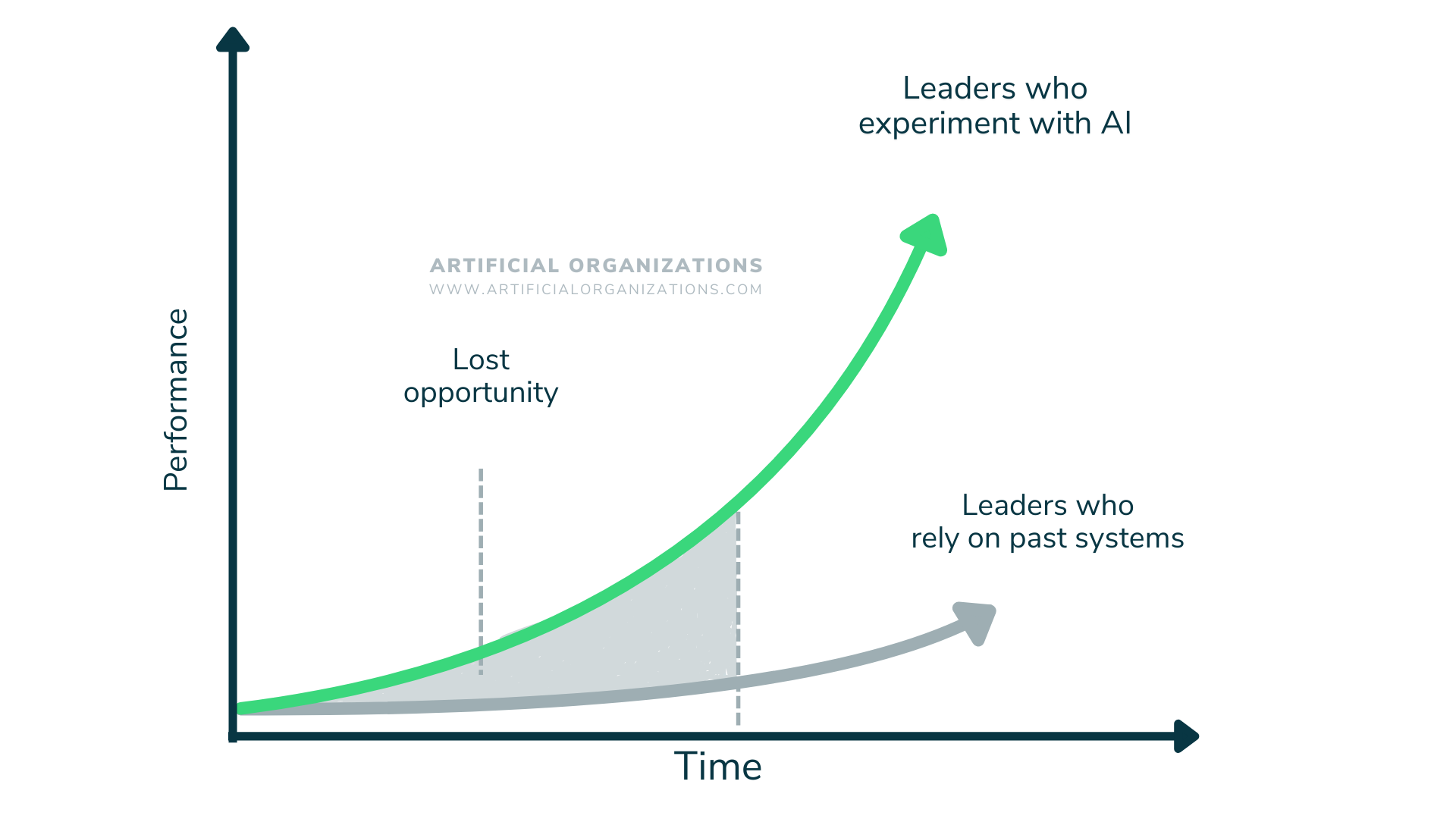
The Advantage of AI Experimentation
What Path Will You Choose?
This book isn’t asking you to work faster, or tell you that you will be replaced.
It’s asking you to work differently.
Artificial Organizations don’t begin with AI.
They begin with leaders willing to unlearn how they work and relearn deliberately.
This book will help you build better judgement, speed and results with human and machine intelligence combined, together.
That choice is already in front of you.
The question is whether you act before the gap compounds.
FAQ
Q1. What is an Artificial Organization?
An Artificial Organization is a human-led organization augmented by machine intelligence to learn, decide, and adapt faster.
It uses AI, data, and real workflows to turn everyday work—meetings, decisions, feedback, outcomes—into insight that helps people make better decisions and continuously improve.
Think of it as an organizational operating system: sensing, learning, and evolving in real time.
Q2. What isn’t an Artificial Organization?
It’s not about replacing people or automating everything.
It’s not a chatbot, tool, or piece of software.
It’s not surveillance or control.
And it’s not set-and-forget.
An Artificial Organization keeps humans accountable, in charge, and at the center—using AI to remove friction, not judgment.
Q3. Is Artificial Organizations a technical AI book?
No. There’s no jargon, no vendor hype, and no requirement to be technical.
Q4. Who is the Artificial Organization book written for?
Artificial Organizations is written for CEOs, C-suite executives, senior leaders, and founders responsible for high-stakes decisions in uncertain, fast-moving environments.
It is not written for technical leaders looking to write code or build AI models.
Q5. Is Artificial Organizations about replacing people with AI?
No. It’s about amplifying human judgment, not removing it.
Q6. Is Artificial Organizations about organizational transformation or personal change?
It starts with personal change. The book argues that meaningful organizational transformation only happens after leaders change how they work, decide, and lead themselves.
Personal operating systems come before enterprise programs.
If you’re looking for a book on organization change, read Barry’s other book, Lean Enterprise: How High Performance Organizations Innovate At Scale.
Q7. What will I be able to do differently after reading Artificial Organizations?
You’ll have a practical way to redesign how you work as a leader — using AI to improve decision quality, reduce decision latency, create space to think, and show up with greater clarity and confidence in high-pressure moments.
References and Influences
This book is grounded in:
- Over two decades of executive advising
- Personal experience design as a leadership system with AI
- Starting a global Top 10 AI venture studio, Nobody Studios
- Real-world case studies from Amazon, American Airlines, HSBC, Progyny, Skyscanner, and Slack
- Research from: