
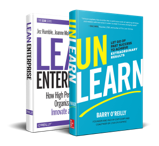
When I announced Artificial Organizations last week, a few people asked how I managed to write it so quickly.
I told a few friends over the 2025 holidays that I was thinking of writing a book, and if they could review it over New Year’s, they laughed in the way people do when something is both surprising and immediately curious.
Because the way this book came together is the exact same transformation I’m asking you to make in the book itself.
Let me rewind.
When I wrote Unlearn, I discovered something important about how I actually do my best work. As someone who’s dyslexic, forcing myself to sit alone and type was slow and draining. My thinking didn’t emerge on the page, it emerged in conversation.
So I stopped pretending I was a “typing” writer.
Instead, I worked with a co-writer, Peter. We talked through each chapter. We recorded the conversations. They were transcribed. Peter took those transcripts, copyedited them, and sent them back to me in hours, becoming raw MVP chapters I could edit, iterate, and eventually turn into an entire book.
What felt unconventional at the time turned out to be a breakthrough. Not because of technology, but because I stopped fighting my natural traits and redesigned the work around my strengths.
With Artificial Organizations, that insight evolved again.
This time, the breakthrough wasn’t just how I create, it was what I already had.
I Didn’t Open a Blank Page. I Opened a System.
Everything I’ve done since 2017 — every coaching session, every workshop, every leadership offsite, every prompt experiment, every hard conversation with a CEO — is captured.
Not in my memory. Not in scattered notes. But in data.
Searchable. Structured. Reusable. Trainable.
When I sat down to write Artificial Organizations, I didn’t open a blank page. I opened a system.
In a call with a CEO, I said something that made them stop mid-sentence: “I have all my coaching notes in data. Information assets I created, captured, and can access at any moment. I’m not writing the book from scratch. I’m formatting my data.”
It surprised him because it sounds impossible yet so simple.
Just like creating Unlearn felt like a secret hack when I stopped typing and started talking, creating Artificial Organizations has inspired me even more, and pushed my limits further.
I’m working in alignment with my best traits, on high-leverage tasks, with tools that accelerate my abilities instead of struggling for progress.
I Didn’t Write Faster. I Worked Differently.
The honest answer is: I didn’t write Artificial Organizations faster. I worked differently.
Like most leadership work, the constraint wasn’t effort.
Ideas were there. Experience was there. Insight was there.
What was broken was the way that information moved from my head into something useful.
So instead of trying to “be more productive,” I redesigned how the work actually happened.
That redesign became the backbone of the book, and, more importantly, the backbone of how I now work as a leader.
The Mistake Most Smart People Make
Most executives assume writing — like decision-making — is about output.
Sit down. Focus harder. Push through. Produce.
That model rewards endurance, not judgment.
But if you look closely, your best thinking rarely happens when you’re staring at a blank page. It happens in conversation. In reflection. In moments where ideas collide, get challenged, sharpened, and reframed.
That’s where human instinct shows up.
The problem is what happens next. Those moments evaporate. Context leaks.
Decisions get reconstructed from memory.
Insight gets diluted into bullet points.
Leaders end up doing the same thinking twice, or worse, making decisions without it.
This is where machines change the game.
Human Instinct + Machine Insight
Let me be precise, because this is where most AI conversations go wrong.
Human instinct is judgment:
- Pattern recognition built over the years
- Contextual awareness
- Values, trade-offs, and consequences
- Knowing what matters when information is incomplete
Machine insight is not judgment. It’s leverage.
Machine insight is the ability to:
- Capture work as it happens
- Recall conversations with precision
- Synthesize across large volumes of material
- Surface patterns humans miss under pressure
- Compress time between thinking and action
Machines don’t decide. They support decision-making.
Once you understand that boundary, everything changes.
How I Actually Wrote the Book
I didn’t sit down and type chapters. I captured thinking.
Here’s the system I used throughout the writing of Artificial Organizations, the same system I now use for leadership work.

The CTSA Loop
1. Capture
I take the slide decks, artifacts, and tools I use to teach leaders.
I clean transcripts from coaching sessions with executives, founders, and leadership teams.
I talk because that’s how I think, and naturally generate my best information.
No scripts. No polishing. Just raw signal.
2. Transcribe
Every meaningful conversation is recorded and transcribed.
Not summarized. Not “noted.” Captured at full fidelity.
When capture is cheap and complete, you stop filtering prematurely. You stop guessing what will matter later.
Every interaction becomes an asset you can return to, reuse, and build on.
3. Synthesize
This is where machine insight earns its place.
I run these materials through my AI models.
Patterns emerge. Themes surface. Blind spots even become visible.
Insights I’ve repeated hundreds of times suddenly show up clearly, codified.
I’d still talk through ideas with executives or the chapters with Peter, the same way I once talked through Unlearn.
Yet suddenly, AI also became my thinking partner, challenger, and coach too.
4. Act
Then I do the most human part of the work.
I review it. I refine it. I challenge it. I tune it.
And within hours, I have what used to take me weeks.
AI accelerates the cycle, speed to output.
It never owns the outcome—that remains my responsibility, and always should be.
The Compounding Effect
The version of me who wrote Unlearn could finish the book in 18 months.
The version of me who built Artificial Organizations finished it in 6 weeks.
Not because I became smarter.
Not because I became more disciplined.
But because I finally built a system that works the way I work.
Aligning my Traits → Tasks → Tools for better outcomes.

The 3T Model: Traits, Tasks, & Tools
Exactly the model you’ll see throughout Artificial Organizations.
The irony is beautiful. This book is the best case study for the system it teaches.
I’m not imagining what’s possible. I’m living it.
Why This Matters for Leaders (Not Writers)
This isn’t a writing trick. It’s a leadership operating model.
Most leaders aren’t overloaded because they lack intelligence. They’re overloaded because their thinking isn’t treated as an asset.
Meetings happen. Decisions get made. Insights surface and then disappear.
So leaders compensate by:
- Preparing longer
- Sitting through more meetings
- Rebuilding context manually
- Carrying decisions in their head
That doesn’t scale.
The leaders pulling ahead are redesigning how insight flows:
- From conversation → to asset
- From intuition → to evidence
- From reaction → to judgment
They use machines to carry the weight of recall and synthesis, so humans can focus on presence and decision-making.
That’s the real leverage, and uniquely human.
The Shift Leaders Need to Make Next
AI isn’t primarily a productivity tool. It’s a judgment support system.
Used poorly, it creates noise, speed without clarity, and false confidence.
Used well, it:
- Improves decision quality under pressure
- Shortens decision cycles without rushing
- Creates space to think again
- Allows leaders to show up calm, prepared, and present
This requires one uncomfortable move.
Stop asking:
“How can I do more?”
Start asking:
“How do my best decisions actually get made — and how do I protect and scale that?”
That question sits at the heart of Artificial Organizations.
The System Behind Artificial Organizations
The book wasn’t written faster. It was written with a system designed for judgment, not endurance.
Capture → Transcribe → Synthesize → Act
This is now how I:
- Prepare for board meetings
- Run executive coaching
- Make strategic decisions
- Design organizations that can move at AI speed without losing human judgment
This is the system behind Artificial Organizations. And it’s the same shift I see leaders needing to make next.
Your AI transformation isn’t in the tools. It’s in the system you build around yourself, one that amplifies your traits, sharpens your judgment, frees your time, and creates space for the work only you can do.
Your Artificial Organization doesn’t begin with AI.
It begins with you.
By combining your human judgment with machine intelligence for better outcomes, together.
FAQ
Q1. Is this system just a writing workflow?
No. Writing was the test case. This is a leadership operating system that protects insight from being lost between conversation and decision. It improves judgment, not output.
Q2. How is this different from AI productivity tools?
Productivity tools focus on speed. This system focuses on decision quality. AI captures and synthesizes thinking so leaders can decide with clarity under pressure.
Q3. Does this mean relying on machines for decisions?
No. Machines capture and synthesize. Humans decide and remain accountable. The boundary is clear: AI supports judgment. It does not replace it.
Q4. Who benefits most from this system?
Leaders operating in complexity. CEOs, founders, and senior executives making high-stakes decisions benefit most because their thinking compounds over time.
Q5. Where should I start?
Start by identifying where your best thinking appears and where it disappears. Redesign how insight flows before adding tools. Then deliberately apply AI within that loop.