
What if the real promise of AI isn’t productivity but presence?
Ask any time-poor, overloaded executive or team leader why they’re interested in AI and you’ll hear one—or all—of the following: faster decisions, better insights, less admin, more time, and greater cost efficiency.
But scratch beneath the surface and a deeper truth emerges.
Nobody dreams of ChatGPT, Claude, or distributed data center clusters. What people really want is their life back.
They want time to enjoy moments with family and friends, to finish work without that nagging sense that there’s still more to do.
They want to work hard and then relax. Go to the yoga class they’ve rescheduled 14 times. Show up to book club. Actually cook that meal they’ve been meaning to from the show they like.
They want to live a life that doesn’t involve sitting down to dinner with a friend, partner, or child while thinking about the five emails they still need to write straight after.
And they want to work on problems that challenge them, bring out their best thinking, creativity and judgment—not just chase notifications across Slack, WhatsApp, or email.
Executives don’t want more AI tools.
They want to get sh*t done, shut the laptop, and be done.
They want presence with their families, their friends, their passions—not just productivity.
This is the true promise of AI for executives.
Not to make you more efficient, but to make you feel more alive. To help you do your best work and live your best life.
The Real ROI of AI? Reclaiming Time, Presence, and Joy
How do I know this? Well, because that was me.
Five years ago, five years into starting a business, with a packed calendar, big ambitions, a second child arriving and zero time for anything… and at times, anyone.
Since then, I’ve launched numerous more companies and coached hundreds of executives leading Fortune 500s and high-velocity startups. A clear pattern keeps surfacing:
It’s not just about performance. It’s about presence.
I even ran a survey of over 5,000 CEOs, C-suite leaders, and VPs to ask what they really want from AI.
Spoiler Alert! It wasn’t more tooling.
The most compelling AI vision isn’t filled with dashboards and copilots. It’s human:
- More joy in your work
- More capacity for complex, creative problem solving
- Fewer time-sinking, manual tasks
- More minutes and moments that are yours again
We’re not chasing productivity. We’re trying to own our time again, and experience joy in our work and in our lives.
It’s about moving the needle and our work ratios of time-sinking tasks to more creative problem-solving.
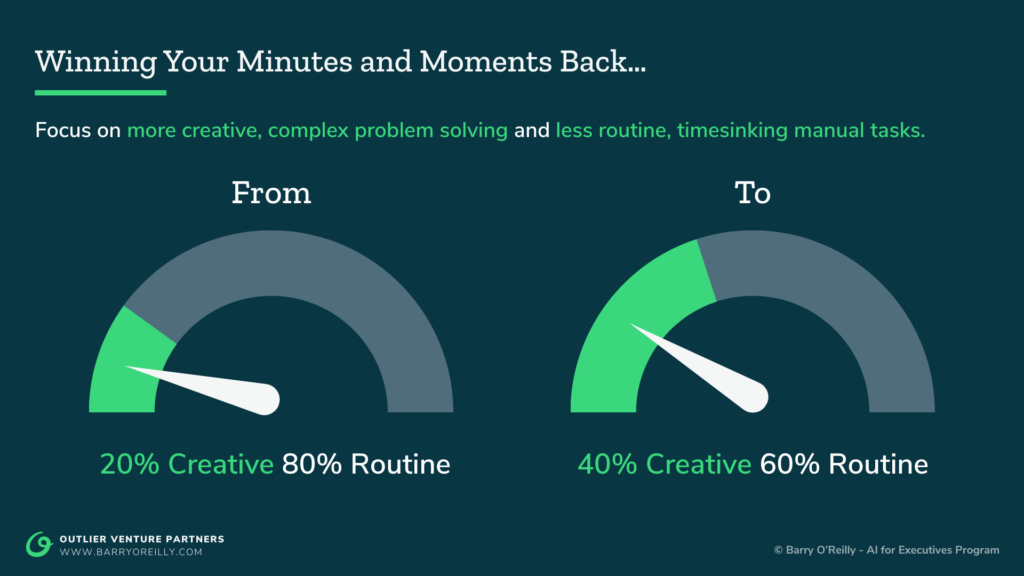
Because when too many of these tiny tasks eat up your day, there’s not enough time for the Big Hairy Audacious Goals. The ones that really matter. The ones where your time and input has the most leverage. The ones where your impact really matters, and are the moments that matter at work.
Losing those minutes at work? It spills into your personal life. And you start losing in places that cost you more than you want to imagine.
You Don’t Want to Save Time, You Want To Make Better Use Of It
Yet this isn’t just about saving time. It’s about making better use of it.
This is the real KPI: Not efficiency. Not throughput.
But whether you’re doing the best work of your life AND have your evenings, weekends, and wellbeing back.
That’s the shift. That’s the vision. That’s what every executive truly wants.
You finish your day. You close your laptop. You’re not depleted. You’re pumped! Proud of what you achieve during the work day, and on your way to your next time slot of choice, to create more amazing moments in your life.
An executive I coach shared that after 8+ hours of meetings, they’d spend 2–3 more hours at night doing follow-ups, writing summaries, and catching up on admin. Once they implemented an AI workflow (Otter + GPT prompt + email formatter), they reduced this to minutes.
“Now I close out my day in 30 minutes—and then go do whatever I want with my evening.”
Another executive started using AI to summarize 1:1s and weekly team meetings. What used to take hours of mental space and strain was now offloaded. The real breakthrough? They started using that saved time to prep big-picture strategy, challenge assumptions, and reconnect with creative thinking.
“The magic isn’t just saving hours. It’s freeing up your personal RAM to work on the big, hairy problems you never had time for.”
One leader preparing for a high-stakes board presentation used GPT to iterate through their key talking points, play devil’s advocate, and refine messaging. They walked into the meeting feeling more confident than ever—because they’d already battled their own objections.
“I realized I could spar with AI before a big one-on-one. It was refreshing to have a safe place to practice, get challenged, and go into the meeting confident I’d covered everything I wanted.”
Start Small. Start Personal.
There are many mindset and behavior shift leaders need to unlearn to lead in the age of AI.
One is that executives often try to fix their companies first. Automate departments. Optimize functions.
But transformation doesn’t start at scale. It starts with you.
You don’t start by solving the biggest problem in your company on day one. Start with your own work right in front of you. Where do you lose time? What tasks drain your energy? What moments do you want back?
- Start with one workflow: Meeting prep. Follow-up. Weekly synthesis.
- Choose one tool: Otter. Copilot. ChatGPT. Claude.
- Build your system: Record voice notes. Summarize calls. Automate follow-ups.
I used to spend 10–20 minutes per meeting writing follow-up emails. By the end of a day, I have four or five added to my to-do list.
My recaps were based on what I could remember from 6 hours and 10 meetings ago. I’d have a few badly written down notes, a post-it I drew something on, and my list of actions, owners, next steps for other people to process after hours, and be ready for in the morning.
All the activities I believed we needed to be aligned on, aware of and accountable to. In short, two or three hours of admin after a day of back-to-back meetings.

Those days are gone.
Now it takes minutes because I’ve built a system that supports me. I’ve stacked the traits, tasks and tools that make me the best version of myself.
This is how you win back your minutes and reclaim your moments.
And I’m Not Alone
We’ve helped hundreds of executives do the same through our AI Coaching Program. The transformation is profound:
- Higher performance
- Faster, smarter decisions
- Greater presence
- And most importantly—rediscovered joy in their work
Here are just a few more reflections from participants:
“It’s been a long time since I’ve felt this excited about something at work.”
“People feed off your energy. When they see you using it, experimenting, and role modeling, they get curious too.”
“I now know how you can close your day in 30 minutes and then go do whatever you want with your evening.”
“The magic isn’t just saving hours. It’s freeing up your personal RAM to work on the big, hairy problems you never had time for.”
“I realized I could spar with AI before a big one-on-one. It was refreshing to have a safe place to practice, get challenged, and go into the meeting confident I’d covered everything I wanted.”
Interested? Get in touch.
This Isn’t About AI. It’s About You.
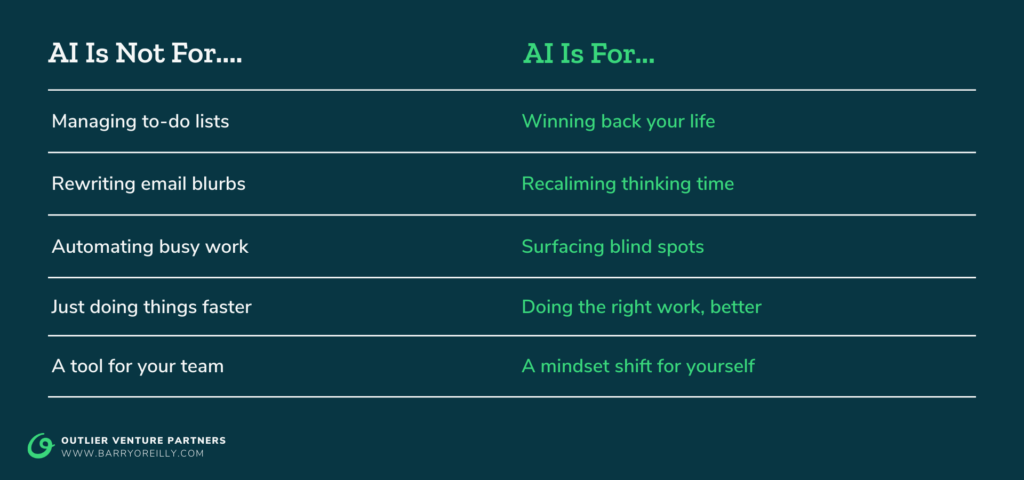
AI isn’t a hack. It’s a habit.
It isn’t another inbox. It’s a new interface for your leadership.
The real opportunity isn’t just to do more.
It’s to be more: more thoughtful, more present, more you.
That’s the kind of leadership the world needs now.
And that’s how you start winning the minutes and moments back (with AI).
FAQs
1. What is the real promise of AI for executives?
The true promise of AI is not increased productivity but the ability to regain presence and meaningful time. As the blog highlights on page 1, leaders want more space to think clearly and enjoy their lives without constant mental overload. AI helps people focus on higher-value work instead of drowning in routine tasks.
2. How does AI help leaders improve the quality of their work?
AI reduces mental load by taking over administrative and repetitive tasks. Leaders then have more capacity for creative problem-solving, better decision-making, and strategic planning. As described in the real examples on page 4, using AI for summaries, prep, and iteration frees mental bandwidth for deeper thinking.
3. What kinds of tasks are ideal to automate with AI?
Tasks that consume time but require low creativity are strong candidates. Meeting summaries, follow-up emails, weekly synthesizing, and research are listed in the blog and illustrated in the time-savings table on page 5. Automating these tasks quickly frees hours that can be reinvested into more valuable work.
4. How does AI improve personal wellbeing for leaders?
By offloading routine work, AI reduces stress and restores evenings, weekends, and family time. Leaders describe feeling more prepared, more creative, and more energized. The blog shares testimonials on page 6 showing how this shift improves both satisfaction and performance.
5. What mindset shift is necessary to benefit from AI?
Leaders must see AI as a habit rather than a tool. The blog concludes on page 7 that AI becomes a new interface for leadership, enabling people to be more thoughtful, present, and effective. This mindset enables sustainable change rather than short-term hacks.
References
McKinsey: “The Economic Potential of Generative AI” (2023)
Harvard Business Review: “Stop Wasting Time in Meetings”
Deloitte: “Generative AI Can Unlock Productivity and Wellbeing” (2023)
Microsoft Work Trend Index (2023): “Will AI Fix Work?”
Stanford HAI: “Generative AI as a Tool for Knowledge Work”
Gallup: “Employee Burnout: Causes and Cures”
Future Forum (Slack): “Time, Talent, and Technology: The Executive Productivity Gap”