
Before we can redesign our organizations with AI, I believe we first have to rethink how we think, work, and make decisions as leaders.
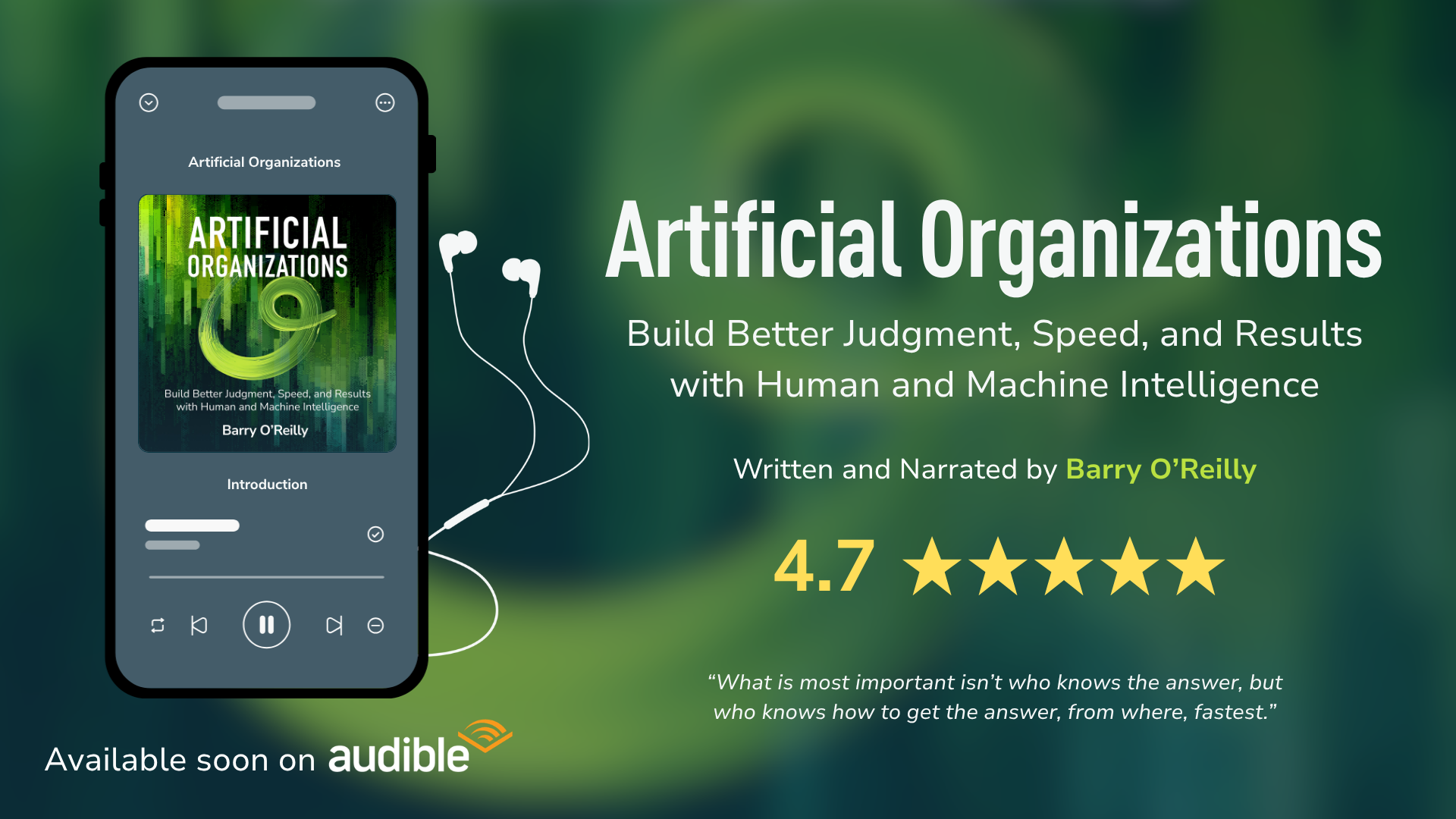
I’m excited to share the opening chapter of the audiobook edition of Artificial Organizations, narrated in my own voice. After hearing from so many readers who wanted another way to experience the book, I spent four days in the recording studio bringing its ideas and stories to life. It was one of the most rewarding and demanding projects I’ve taken on. As someone who is dyslexic, reading every word aloud required a very different kind of focus than delivering a keynote, teaching a workshop, or hosting a podcast conversation.
The chapter explores why I believe many organizations are approaching AI adoption from the wrong direction. We often start with licenses, pilots, and tools while leaving leadership behaviors and decision-making systems unchanged. Instead, I explain why meaningful transformation begins with our human traits, the tasks where our judgment creates the most value, and only then the tools that help us do that work better.
Subscribe


Key Takeaways
- AI should strengthen judgment, not simply increase output: Machines can process and synthesize information at a scale no individual can match, but leaders still have to decide what matters. The opportunity is to use AI to prepare, capture, and pressure-test thinking so attention stays focused on consequential decisions.
- Start with traits, then tasks, then tools: The 3T model begins with how leaders naturally think, create, communicate, and make decisions. Only after identifying the tasks where their judgment creates the most value should they choose the tools that best support that work.
- Decision velocity must be paired with decision advantage: Decision velocity is how quickly leaders move from question to insight, decision, and action. Decision advantage is the quality and depth of context behind those choices. Speed without insight creates chaos, while insight without timely action becomes irrelevant.
- Most leadership time is allocated away from leadership value: Meetings, updates, administration, and context reconstruction consume most of a leader’s time, even though the greatest value comes from framing problems, evaluating tradeoffs, and making high-stakes decisions.
- Organizational AI adoption begins with personal behavior change: Broad mandates, task forces, and tool rollouts are often the wrong starting point. Leaders build more credible adoption when they experiment in their own workflows, share what they learn, and make new behaviors visible to their teams.
Additional Insights
- Presence can be more valuable than productivity: A simple experiment with an AI meeting assistant showed that the greatest benefit wasn’t faster preparation or follow-up. It was the ability to stop carrying every detail mentally and remain fully present during important conversations.
- Experience becomes a liability when it is not augmented: The instincts and institutional knowledge that helped leaders succeed can become limiting when treated as sufficient. Experience continues to compound only when combined with broader recall, faster synthesis, and continuous testing.
- Senior leaders need psychological safety to learn: Executive leaders often prefer one-on-one coaching and small peer cohorts over large workshops or self-paced courses. Being a beginner is uncomfortable at senior levels, making smaller environments better suited for experimentation and honest discussion.
- New capacity should create thinking space, not more workload: At Progeny, AI reduced the effort required to capture meetings, actions, owners, and deadlines. Rather than increasing workload, the additional capacity was used to create more time for strategic thinking and better decision-making.
- The unit of change is the judgment inside a role: AI may automate parts of a project manager’s, analyst’s, or executive’s work while increasing the importance of interpretation, challenge, and decision quality. The role may remain, but the judgment required within it changes.
Episode Highlights
00:00 – Episode Introduction & Why I Created the Audiobook
Barry introduces this special preview of the Artificial Organizations audiobook, shares why he chose to narrate it himself, and explains why leaders need a different approach to AI adoption through the 3T framework: Traits, Tasks, and Tools.
04:33 – A Quick Favor Before We Begin
Barry invites listeners to leave an Amazon review, recommend the audiobook to their network, and help more leaders discover its ideas.
05:16 – Preface: Why the Way We Work Is Broken
Barry introduces the central challenge facing modern organizations: leaders are overwhelmed by information, while better decisions remain harder than ever.
07:11 – Judgment Under Pressure
Barry explores why more data, more tools, and more technology haven’t created better leadership, arguing that the real constraint is our ability to process information and make sound judgments.
10:07 – The First AI Leadership Experiment
A simple experiment with an AI meeting assistant transformed Barry’s leadership by improving clarity, presence, and decision-making, leading to a new perspective on AI’s role.
12:00 – AI as Judgment Infrastructure
Barry reframes AI as more than a productivity tool, explaining how it strengthens judgment, improves decisions, and helps leaders focus on what matters most.
16:07 – Part One: The Judgment Constraint
Barry introduces the first section of the book, explaining why AI creates little value unless it changes how leaders think, decide, and lead.
18:08 – Chapter One: Your Legacy Is Now Your Liability
Barry examines why experience alone is no longer enough and how decision velocity and continuous learning are becoming the defining advantages of modern leadership.
22:20 – The AI ROI Blind Spot
Barry challenges the common focus on efficiency and cost reduction, arguing that AI’s greatest value lies in helping leaders make better and faster decisions.
28:16 – From Linear Leadership to Exponential Innovation
Barry explains why traditional leadership models struggle in the AI era and why organizations must adopt new ways of learning, experimenting, and making decisions.
34:10 – What Makes an Artificial Organization
Barry defines artificial organizations and shares how leaders can replace memory-based management with shared judgment systems that accelerate decision-making and collaboration.
40:09 – The New Leadership Divide
Barry explores the widening gap between leaders who actively experiment with AI and those who continue relying on legacy ways of working, and why that difference will compound over time.
43:15 – Where to Start
Barry explains why successful AI transformation begins with personal experimentation, encouraging leaders to model new behaviors before scaling change across their organizations.
45:15 – Closing Reflections
Barry concludes the first chapter, thanks listeners for joining this special audiobook preview, and invites them to continue the journey with Artificial Organizations.
FAQs
Q1: Is this Unlearn episode an audiobook preview?
Yes. This special episode includes Barry O’Reilly’s recorded introduction followed by the opening chapter of the audiobook edition of Artificial Organizations, narrated by Barry himself. He explains why the audio edition was created, what recording the book required, and how its ideas connect to his work with executive leaders and teams.
Q2: What is an artificial organization?
An artificial organization is a company that deliberately combines human and machine intelligence to redesign how context is captured, information is synthesized, and decisions are made. Instead of adding AI to the edges of existing workflows, it builds judgment infrastructure into how the organization operates.
Q3: How can leaders use AI to make better decisions?
Leaders can use AI to capture conversations, summarize context, test assumptions, explore scenarios, prepare for meetings, and identify unresolved actions. This reduces the information leaders must carry mentally and gives them more capacity to focus on tradeoffs, consequences, and high-value judgment.
Q4: What is the difference between decision velocity and decision advantage?
Decision velocity is the speed at which a leader moves from a question to insight, decision, and action. Decision advantage is the quality, accuracy, and depth of context behind that decision. Strong leadership requires both because speed without insight creates chaos, while insight without action loses relevance.
Q5: Why do many enterprise AI initiatives fail to create business value?
They often begin with tool purchases, pilots, and mandates without redesigning how work, context, and judgment flow through the organization. When leaders do not change their own workflows and behavior first, AI remains disconnected from the decisions and operating systems that produce results.
Q6: Where should a leader begin with AI adoption?
Barry recommends beginning with personal workflows rather than a company-wide transformation program. Leaders should understand how they naturally think and work, identify the tasks where their judgment creates the most value, and then experiment with tools that reduce low-leverage effort and improve decision quality.