
On my first day at Thoughtworks, I kept waiting for someone to tell me how it worked.
There were no obvious signposts. No “this is how we do things here” handbook. No managers, by design, walking me through a checklist. No neat onboarding flow.
Instead, it felt like a treasure hunt.
You learned by observing. By asking. By trying to figure it out and getting feedback, sometimes subtle, sometimes blunt. The culture wasn’t written down anywhere obvious, but it was everywhere. In how people made decisions. In how they challenged each other. In what got rewarded and what didn’t.
It was powerful, but it was hard because if you couldn’t decode the system, you stayed on the outside of it.
That experience stayed with me. Not because it was broken, but because it was invisible. For some people, it was energizing. For others, deeply disorienting. An initiation process of unspoken culture.
Over the years, watching organizations across industries and geographies, I realized something uncomfortable: most companies work this way.
The rules that determine success are often implicit. The information people actually need is trapped in silos, hidden in relationships, or buried inside experienced operators who do not even realize what they know.
People are expected to “figure it out.” Sometimes they do. Often they burn enormous energy trying.
That invisible friction creates organizational debt. Hidden context debt. The slow accumulation of ambiguity, inconsistency, and misalignment that quietly limits performance. I kept wondering if “figuring it out” was really the best information flow when every company I know is trying to move with more speed and agility.
The Missing System
Most organizations do not have a clear operational philosophy for how work should happen.
They have values on a wall. Leadership principles in slide decks. They have onboarding programs, playbooks, and frameworks to take at your own pace and “be productive” in your new role.
But they do not have a clear answer to a deceptively simple question: How do we believe work should actually happen here? That answer is your Work Charter.
A Work Charter defines:
- how information flows
- how decisions get made
- how context is transferred
- and what humans versus machines are responsible for
It is not about control. It is about clarity.
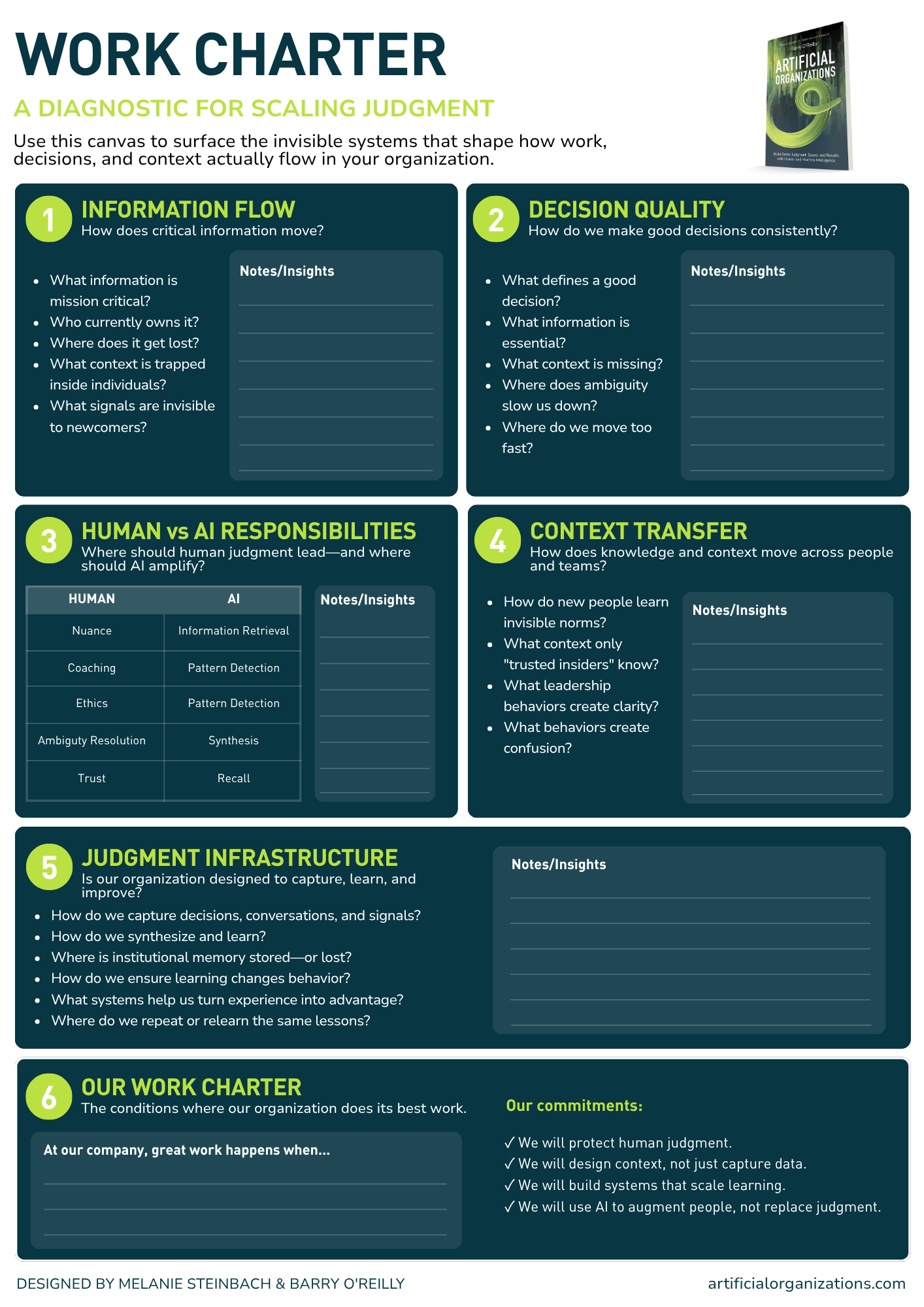
Work Charter Diagnostic
Organizations have always been systems of work. AI simply makes the design of those systems impossible to ignore.
Because for the first time, companies can separate:
- information from people
- context from memory
- knowledge transfer from human effort
Which forces a deeper question: If AI increasingly handles information, what becomes uniquely human? The answer is judgment.
Why This Matters Now
In the industrial era, companies scaled labor. In the software era, companies scaled information. In the AI era, companies will scale judgment. That is the shift most organizations still do not fully understand.
For decades, leadership relied on three responsibilities:
1. Transfer knowledge
2. Remove obstacles
3. Support growth
That model was built for a world where information was scarce, fragmented, and unevenly distributed. That world no longer exists.
AI can now distribute information faster and more personally than any manager. It can deliver “what you need to know, when you need to know it” instantly and at scale. That fundamentally changes the role of leadership.
The shift moves organizations:
- from knowledge transfer to knowledge context
- from process enforcement to experience design
- from control to clarity
- from managing information to designing judgment systems
This is where most companies are stuck. They are bolting AI onto systems built for a different era. Optimizing outdated assumptions about how people learn, decide, collaborate, and perform.
That does not create transformation. It accelerates existing dysfunction on faster, further and more confidently wrong.
All the latest research shows that between 70% to 95% of corporate AI transformations and pilots fail to deliver tangible financial returns or scale to production for the same reason: companies automate work they never properly designed in the first place.
Organizational Philosophy, Work Charters, and Judgment Infrastructure
The organizations succeeding with AI are not simply deploying better tools. They are redesigning how judgment happens.
That requires three layers working together:

Three Layers of Organizational Judgment
This distinction matters as AI does not replace organizational philosophy, it operationalizes it.
Which means unclear systems become more inconsistent, weak decision-making becomes amplified and perverse incentives scale faster.
Organizations without a clear Work Charter will not become AI-enabled. They will become AI-confused.
What Leaders Need to Design Now
The work now is to become explicit about how judgment should operate inside the company. That requires answering a set of foundational questions:
- What should people know, and at what moment?
- Where does context come from?
- How is context maintained over time?
- What is the role of a manager when information is universally accessible?
- What should remain deeply human?
- What should be automated?
- What conditions produce better decisions?
- How do you reduce invisible organizational ambiguity?
These are not abstract questions, they are operational design choices. And increasingly, they determine whether AI improves organizational performance or magnifies existing weaknesses.
To make this concrete, we will walk through three situations where a Work Charter had to be defined, not declared.
Two from Mel’s experience at McDonald’s and Milliken. One from Barry’s work at Nobody Studios.
These are not polished case studies. They are real operating environments. High stakes. Messy constraints. Real systems redesign.
Example 1: McDonald’s, From Guesswork to Work Charter
What Made It Unique
McDonald’s had built one of the most operationally reliable organizations in the world.
But the talent system supporting it was quietly changing.
Historically, much of corporate leadership came from inside the restaurants. People understood the business because they had lived it. They knew the pressure, the pace, the operational reality.
As the franchise mix evolved globally, more leaders began entering from outside the system. At the same time, the company itself was transforming:
- new digital platforms
- expanding partnerships
- increasingly global coordination
- growing complexity between local and centralized decision-making
That combination created a specific kind of organizational risk. Not a dramatic crisis. A slower one.
People making decisions without enough context. New leaders misreading invisible cultural signals. The growing gap between strategy on paper and behavior in practice.
The onboarding system had not kept up. Nobody had named the problem yet.
The Insight
The realization was surprisingly simple: We did not actually have a Work Charter for onboarding.
We had programs, schedules, training modules and good intentions. But we did not have a shared definition for what good onboarding was designed to achieve.
So we created one: What you need to know, when you need to know it, in a warm and welcoming way.
Simple but operationally transformative. Because once you define the charter, you can design systems around it. Managers were no longer simply responsible for task completion. They became responsible for transferring context. That changed onboarding from an administrative process into a judgment system.
Performance became less dependent on luck:
- having a generous manager
- finding the right mentor
- asking the “correct” questions
- accidentally discovering invisible rules
The organization stopped leaving critical context to chance, and chose to be systematic.
Micro Story
A new hire is ten days into the role and about to meet their boss’s boss for the first time.
Before the Work Charter existed, that person walked in with whatever information they had managed to gather themselves:
- maybe a LinkedIn profile
- maybe a few meeting observations or priorities they read
- mostly guesswork or what they heard about the place
After the Work Charter existed, their manager approached the situation differently. Not to transfer facts, but to give new hires the real version. The new hire could find the fact independently. Instead, the manager transferred context that mattered.
For example, why this leader gets quiet when process discussions become public. Why a loud tone does not necessarily signal frustration. Why foot tapping means the meeting is already over, even if nobody has spoken yet. Those invisible operating signals became part of the system.
The manager was not simply being thoughtful. The organization had designed for that conversation to happen. The new hire walked into the meeting calm, prepared, and grounded.
And the manager understood something important: Their job was no longer information transfer. It was context transfer.
Outcomes
New hire confidence accelerated significantly in the first 90 days. Meetings became productive earlier. Managers themselves changed. They stopped viewing onboarding as a checklist and started viewing it as one of the organization’s most important judgment systems.
Now Imagine This with AI
Everything described above happened before AI became mainstream. The Work Charter succeeded because the organization got explicit about what mattered. Now AI changes the economics of delivering that charter.
Career histories, org structures, meeting patterns, communication styles, strategic priorities, relationship maps, behavioral signals, all of it can now be surfaced instantly through judgment infrastructure supported by AI.
Which means managers can spend less time transferring information and more time helping people interpret nuance.
AI did not create the need for contextual decoding. The Work Charter did. AI simply makes it scalable.
That is the difference between organizations using AI to automate onboarding and organizations using AI to deepen it. The technology may be identical. The charter determines the outcome.
Example 2: Milliken, When the Decision Is the Product
What Made It Unique
Milliken was already considered an exceptionally well-run company. Operationally disciplined, highly respected and strong market positions, which made the core problem difficult to see.
Many of the markets the company led were not collapsing. They were slowly declining, thus creating a dangerous illusion.
You can be excellent inside a shrinking market and still lose strategically. The organization needed to move into higher-growth areas. But the real challenge was not strategic intent. It was organizational judgment.
The company lacked a consistent system for:
- identifying emerging opportunities
- evaluating markets rigorously
- and making significant decisions with confidence
Business Managers closest to the market were not expected to think strategically because historically they had not needed to. The review processes focused heavily on operational reporting, not decision quality. There was no Work Charter for how strategic decisions should actually happen.
The Insight
A new strategy alone would not solve the problem. The organization needed a new judgment system. The shift began by redefining what Business Managers were responsible for understanding before decisions could be made.
Every significant decision now required four perspectives:
- market
- customer
- competitor
- self
That sounds obvious. In practice, most reviews contained one or two of those dimensions at best. Rarely all four together in a way that made judgment possible.
The second shift was structural:
- templates
- cadence
- information standards
- shared decision protocols
Not bureaucracy but judgment infrastructure for teams.
The Work Charter became clear: A decision is only as good as the information and context that precede it. And the organization is responsible for ensuring both exist.
Micro Story
One division had consistently delivered stable results for years. Reliable. Stable. The kind of business that gets a nod in the quarterly review and moves on. Because it wasn’t a problem it rarely received strategic attention.
Before the new judgment system, reviews followed the same familiar pattern:
- numbers presented
- numbers accepted
- next business
After redesigning the Work Charter, Business Managers were required to evaluate:
- the market
- customers
- competitors
- internal capability
And something surprising emerged.
Inside a market everyone assumed they understood, there was a rapidly growing segment hidden in plain sight. The opportunity had always existed, yet the organization simply had no systematic way to reveal it.
That discovery eventually led to an acquisition that transformed the division from a stable business into a meaningful growth engine. The breakthrough was not the opportunity itself. It was the realization that the organization’s existing confidence had become its own blind spot.
Outcomes
Milliken completed several strategic transactions that repositioned the company into higher-growth market but the more important outcome was organizational.
Business Managers began thinking like strategists. Leaders gained confidence in the quality of their decisions, and the organization developed a repeatable judgment system capable of surfacing opportunities it previously could not see.
Now Imagine This with AI
The original process was slow by necessity. Gathering market data, customer insights, competitor intelligence, and internal analysis took weeks.
AI radically compresses that timeline. Organizations can now:
- gather external intelligence continuously
- synthesize patterns across large data sets
- surface contradictions
- identify weak signals earlier
- and distribute insights dynamically
But the technology does not eliminate the need for judgment. In fact, it increases the need for it because faster information without a Work Charter simply creates faster confusion.
AI can accelerate analysis. It cannot define what a good decision requires. Only the organization can do that.
Example 3: Nobody Studios, Turning Every Moment into Context
What Made It Unique
Nobody Studios operates as a venture studio designed to create multiple companies simultaneously under conditions of uncertainty. That environment produces enormous amounts of information and output daily:
- founder conversations
- investment decisions
- venture reviews
- strategy debates
- hiring discussions
- product pivots
The pace is relentless and the cost of losing context is high.
Traditional approaches to organizational memory break quickly in that environment.
Meetings disappear, decisions become disconnected from their original reasoning and lessons get repeated instead of accumulated.
The challenge was not documentation. It was designing a system where context could compound, and output didn’t misalign with the true desired corporate objectives.
The Insight
The organization adopted a simple principle: Every interaction should become an asset, designed to improve future judgment.
Meetings, conversations, and decisions stopped being treated as isolated events. They became part of a continuous learning loop, called CTSA:
- Capture the interaction
- Transcribe it into structured form
- Synthesize insights across interactions
- Act on those insights
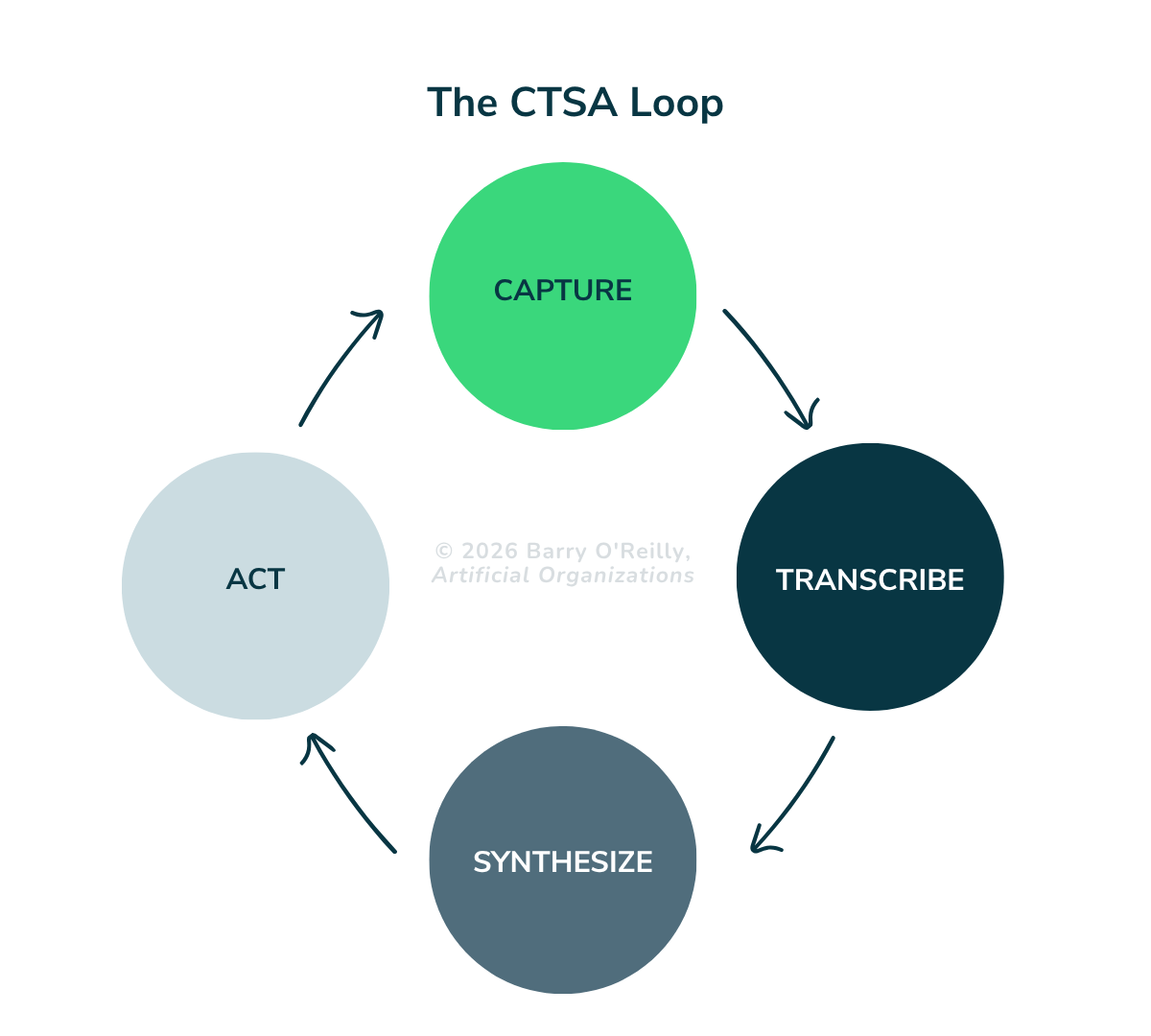
The CTSA Loop
Not for reporting, for presence. The breakthrough was not productivity. It was the ability to show up to important moments with the right context available at the right time.
Micro Story
A leader is preparing for a difficult conversation:
- performance feedback
- a founder issue
- possibly shutting down a venture
Traditionally, preparation would involve reconstructing fragmented memory:
- reviewing scattered notes
- searching old documents
- trying to recall previous commitments
- rebuilding context manually
Inside a CTSA-driven judgment system, preparation becomes fundamentally different. The leader has access to synthesized context across time:
- recurring patterns
- unresolved tensions
- previous decisions
- commitments made
- signals missed
- similar situations from other ventures
The conversation starts from shared understanding instead of reconstruction. That changes the quality of judgment dramatically.
The leader walks in calm, clear, prepared. That is executive presence. That is the state to be in for high-stakes decisions in certain situations.
Outcomes
The immediate effects included:
- faster decisions
- reduced cognitive load
- stronger conversations
- improved alignment
But over time, something more important happened. The organization itself became a continuous learning system. Context accumulated instead of disappearing. Patterns became visible earlier. Decisions improved because the system itself retained judgment. This created a compounding advantage.
Now Imagine This with AI
AI dramatically expands the scale and speed of this judgment infrastructure.
Interactions can be captured automatically. Patterns identified continuously. Insights surfaced proactively.
But AI does not define the purpose of the system, the Work Charter does.
The organization still decides:
- what matters
- what gets captured
- how context should inform decisions
- and what quality judgment actually looks like
At Nobody Studios, the guiding principle remains simple: Every interaction should improve future decisions. AI makes that principle operational at scale.
What This All Adds Up To
Across all three examples, the pattern is clear:
- AI handles information.
- Humans provide context.
- Organizations must design how judgment happens between the two.
The companies succeeding with AI are not simply deploying tools faster. They are building better judgment systems—more intentional, more contextual and more human under pressure.
Organizations that define clear Work Charters can use AI as an amplifier. Organizations that do not will amplify confusion instead. Because ultimately, AI does not just scale activity. It scales judgment.
Back to the Beginning
When I think back to that first day at Thoughtworks, what stands out most is not the challenge itself. It was the absence of a map.
Success depended on decoding invisible signals and surviving long enough to understand how the system really worked. That is still how many organizations operate today, but it does not have to be.
You can define your Work Charter.
Make it visible. Make it operational. Make it scalable.
Not as a replacement for people but with AI as judgment infrastructure that helps people make better decisions together.
Call to Action
If you are leading a team, function, or company, start here:
- What is your Work Charter?
- How should judgment happen inside your organization?
- Where is critical context still invisible?
- What are you leaving to chance?
- Which assumptions are embedded in your current systems?
- How might AI amplify them?
The challenge in the age of AI is not simply moving faster.
It is ensuring the system you scale produces the decisions and outcomes you actually want.
Because the organizations that win in the AI era will not be the ones with the most tools.
They will be the ones with the clearest judgment systems.
– A blog by Melanie Steinbach & Barry O’Reilly
FAQ
Q1. What is a Work Charter?
A Work Charter defines how work happens inside an organization, including how information flows, how decisions are made, how context is transferred, and what responsibilities belong to humans versus machines.
Q2. Why is a Work Charter important in the age of AI?
As AI makes information more accessible, organizations need clear systems for context, judgment, and decision-making. A Work Charter helps create that clarity.
Q3. How does AI change organizational design?
AI allows organizations to separate information from people, context from memory, and knowledge transfer from human effort. This requires leaders to rethink how judgment operates across the company.
Q4. What is judgment infrastructure?
Judgment infrastructure consists of the systems, processes, and technologies that capture, distribute, and operationalize context to improve decision quality throughout an organization.
Q5. What is the relationship between a Work Charter and AI?
AI can scale information and automate tasks, but a Work Charter defines how that information should be interpreted and applied. The charter determines whether AI amplifies clarity or confusion.