
As AI becomes part of everyday work, I’ve become less interested in which tools organizations are adopting and more interested in what those tools are revealing.
The conversation often starts with questions like, “Which tools should we buy? Which model should we use? How do we get people to adopt AI? How do we make sure we don’t fall behind?”
Those questions matter. But they are not the real work.
The deeper question to consider is, “What is AI teaching us about how our organizations actually work?”
While AI is obviously increasing speed, it is revealing the quality of the systems underneath the work. It shows where decisions are unclear, where teams rely on heroic individuals, where processes are held together by meetings, memory, and manual follow-up. It also shines a light on where leaders are protecting the very operating model that slows them down.
That is the uncomfortable gift of AI. It exposes old constraints.
As I wrote in Artificial Organizations, “The constraint in AI-augmented leadership is no longer information. It is judgment under pressure.”
The leaders who understand this are moving beyond productivity tricks. They are using AI to redesign how work gets done, how decisions get made, and how people grow.
This month, across conversations with Eric Baxley and John Cutler, writing about AI agents, and new research from Ramp on AI adoption and hiring, four lessons stood out.
Together, they point to one conclusion: AI will help strong organizations get stronger, faster and more decisive. Weak organizations will fall even further behind.
Lesson 1: AI exposes weak systems
In my podcast with Eric Baxley, CMO at Nobody Studios, we explored why AI makes great systems matter even more.
That may sound counterintuitive. Many people assume AI reduces the need for structure. If tools can generate copy, build prototypes, analyze data, automate outreach, and summarize meetings, surely systems matter less?
The opposite is true. AI makes weak systems visible.
Eric shared a story from earlier in his career where a large business was executing hard, but against the wrong foundation. The team was “doing things right,” but not “doing the right things.” The segmentation was off. Once they challenged that base assumption and corrected who they were really going after, the business hit its goals for the next three years. That is a systems lesson, not a marketing lesson.
AI can help you move faster. But if you are pointed at the wrong customer, solving the wrong problem, or telling the wrong story, it will simply help you accelerate in the wrong direction.
This is what many organizations are discovering now. They adopted AI expecting productivity. Instead, they found messy data, unclear ownership, broken handoffs, weak customer understanding, and inconsistent narratives across teams. AI did not create those problems. It revealed them.
That is why the best leaders do not start with “Where can we use AI?” They start with “Where is our system already weak?”
Use this quick audit yourself:
- Where are we rebuilding context every week?
- Where are decisions waiting for someone senior to clarify intent?
- Where do customers hear different messages from sales, marketing, product, and support?
- Where do teams confuse speed with progress?
- Where do we create more output without creating better outcomes?
AI forces those questions to the surface.
For leaders, this is actually good news. A weak system you can see is a system you can improve.
But the work requires honesty. It requires the courage to challenge the foundation before execution. It requires leaders to stop hiding behind polished corporate narratives and start showing the real journey: what is working, what is hard, what is being learned, and what needs to change.
The organizations that benefit most from AI will not be the ones with the most tools. They will be the ones with the strongest learning systems.
Lesson 2: AI rewards better judgment
In my podcast with John Cutler, Head of Product at Dotwork, we went deeper into judgment.
One theme listeners commented on a lot from our conversations was: AI does not just help leaders make decisions. It exposes how leaders make decisions.
That is a big shift, and one of the core behaviors to unlearn included in Artificial Organizations.
For years, experienced leaders could rely on intuition, pattern recognition, and tacit knowledge. They could say, “I’ve seen this before,” or “My gut tells me this is the right call.” Sometimes that judgment was excellent. Sometimes it was vague, biased, or impossible for others to learn from.
AI changes that because it can help make thinking visible.
It can turn a prioritization heuristic into a reusable rubric, pressure test assumptions before a meeting, compare options against criteria and ask disconfirming questions to improve your thinking.
But there is a catch. AI can also make poor thinking look polished.
This is one of the biggest risks I see with executives. A weak strategy, wrapped in fluent AI-generated language, can sound more convincing than it deserves to be. A vague decision can become a beautiful memo. A shallow analysis can become a confident answer.
That is why judgment matters more now than ever.
In Artificial Organizations, I make a distinction between decision velocity and decision advantage.
Decision velocity is how quickly you move from signal to insight to decision to action.
Decision advantage is the quality, context, and confidence behind those decisions.
AI can improve both. But only if leaders use it to strengthen their thinking, not outsource it.
That means using AI as a thinking partner, not an answer machine.
Next time you’re working on a decision, use this audit:
- Ask it to challenge your preferred option.
- Ask what evidence would prove you wrong.
- Ask what assumptions are hidden in your plan.
- Ask what a skeptical customer, CFO, regulator, or frontline employee would question.
- Ask what trade-offs you are avoiding.
That is where the value is.
Becoming more aware of how you think, how others think, and how AI systems work well or fail improves your human abilities.
AI rewards leaders who can make their judgment explicit enough for others to inspect, challenge, and reuse. That is how individual expertise also becomes organizational capability.
Lesson 3: AI changes how organizations operate
The conversation is now moving beyond playing with ChatGPT and copilots. AI agents are pushing leaders into a new phase as I wrote about, AI Agents Are Moving From Experiments to Operating Models.
Copilots help people do work faster. Agents begin to change how work flows. They can monitor inputs, trigger actions, update systems, escalate exceptions, coordinate handoffs, and keep work moving without waiting for someone to manually push every step.
That might sound technical but it is not. It is an operating model shift.
Once AI systems can act across tools, teams, and workflows, leaders have to answer harder questions.
- Who decides what an agent is allowed to do?
- Where does human judgment stay in the loop?
- What requires approval?
- What must never be delegated?
- How do we know whether agents are improving outcomes or simply creating more automated activity?
- Who is accountable when work crosses functions and systems?
This is why agents cannot be treated as isolated experiments.
A customer support agent here. A sales research agent there. A software engineering agent somewhere else. Useful? Maybe. Transformative? Not unless the workflow changes.
A broken workflow with an agent is still a broken workflow, only faster, probably with worse effects.
If your decision rights are unclear, agents amplify the confusion. If your data is fragmented, agents move faster through bad context. If your handoffs are weak, agents create more movement without better ownership. If your operating model depends on meetings, memory, and escalation, agents will not save it.
They will reveal it.
The opportunity is to redesign workflows around the decision loop:
Sense. Think. Decide. Act.
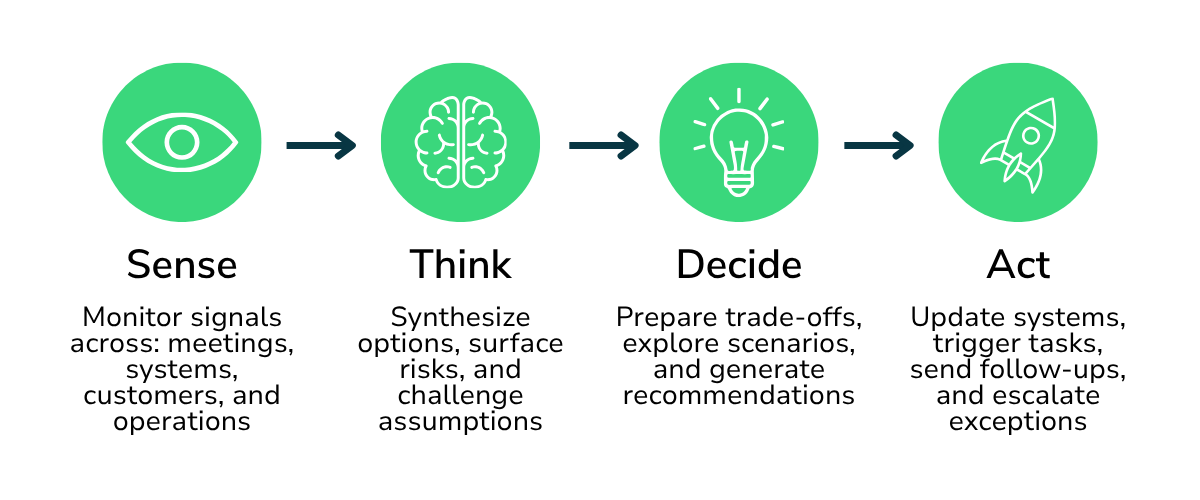
Agents can help sense what is changing across meetings, systems, customers, and operations. They can help think by synthesizing options, surfacing risks, and challenging assumptions. They can support decisions by preparing trade-offs and recommendations. They can act by updating systems, triggering tasks, sending follow-ups, or escalating exceptions.
But the human role must be explicit.
Agents can recommend, prepare, coordinate and execute within boundaries. Leaders remain accountable for what matters, what gets decided, and what trade-offs are acceptable. That is the line.
The companies that win with agents will not be the ones with the most advanced demos. They will be the ones who redesign how work flows so AI increases decision velocity without sacrificing decision advantage.
That is what I mean by judgment infrastructure.
Lesson 4: AI creates value when it is integrated into how work gets done, and increases headcount!
The latest Ramp research adds an important challenge to the dominant AI jobs narrative—that AI replaces workers.
The leading data continues to show something way more interesting.
Ramp Economics Lab, using firm-level AI spending data, joined with Revelio Labs workforce records, studied more than 21,000 U.S. firms. The headline finding: companies that invest heavily in AI grew headcount by 10.2% over the two years following adoption. Entry-level headcount grew 12%. Low-intensity adopters saw no statistically significant change.
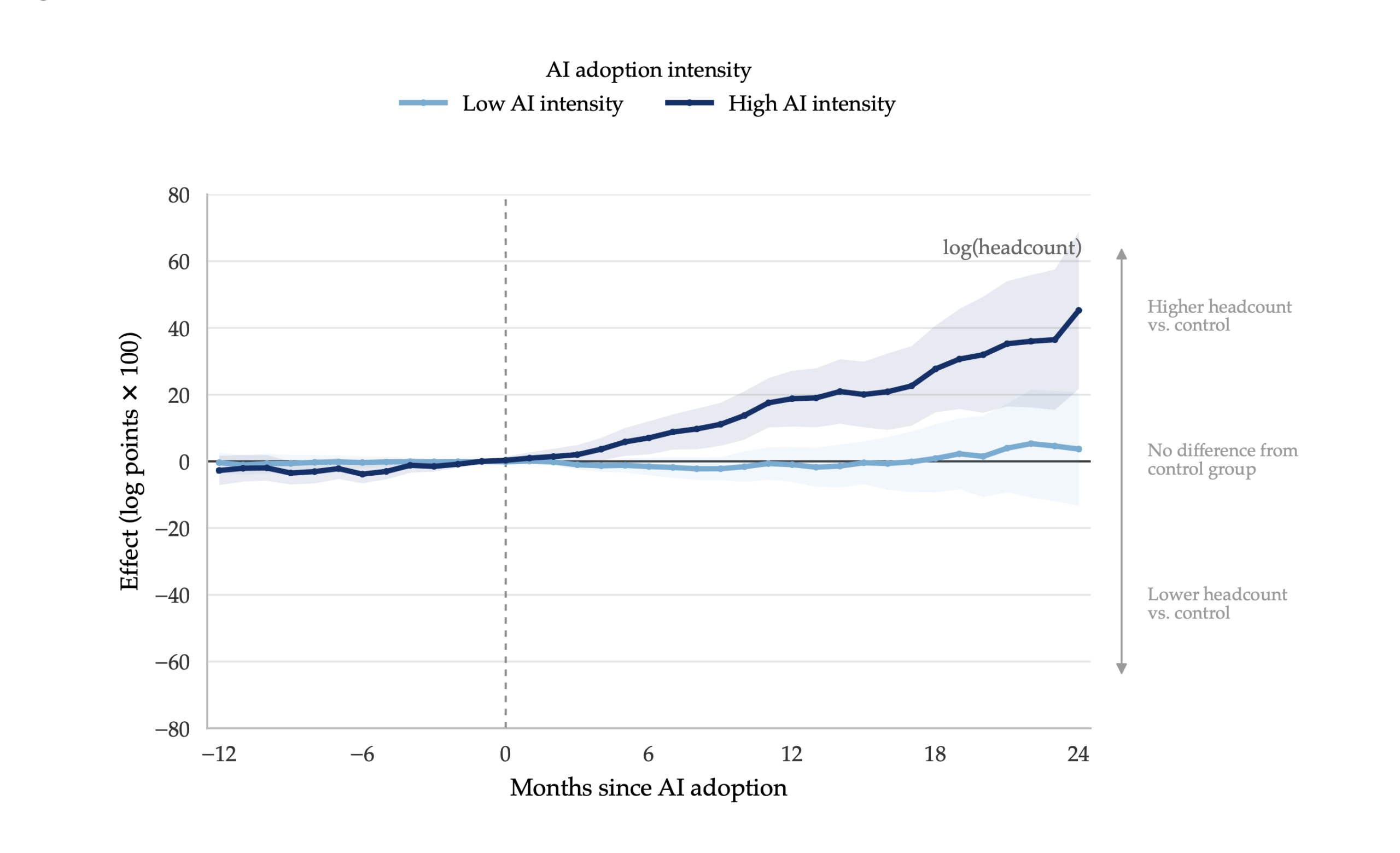
Ramp Economics Lab, Heavy AI Adopters Hire More (2026).
That does not mean AI automatically creates jobs. The researchers are careful about the caveats. AI adopters were already larger, more engineering-intensive, more likely to be venture-backed, and faster-growing than non-adopters.
But the pattern matters.
The gains came from high-intensity adoption, not casual experimentation. They also emerged gradually, after a 6 to 12 month learning curve, as best practices spread through teams, workflows, and operations.
That is the lesson.
AI creates value when organizations integrate it into how work gets done.
Not when they buy access, run scattered pilots or encourage people to “try AI” on the side. Certainly not when they measure prompts, licenses, or tool usage!
The value appears when teams redesign workflows, build new habits, and use AI to expand capacity for better work.
Ramp’s finding that high-intensity AI adopters grow headcount is especially important because it reframes the opportunity. The best companies are not simply using AI to cut. They are using AI to do more.
More products, reach more customer segments, increase speed, learning and growth.
That aligns with what I see inside organizations I’m working with, or taking part in our AI coaching programs. When AI removes friction from routine work, the best leaders do not just ask, “How many people can we take out?”
They ask, “What can our people now do that we could not do before?”
That is a very different leadership question.
At Progyny, CEO Pete Anevski put it clearly: “We’re not using AI to reduce headcount. We’re using it to amplify your human skills. To elevate, not eliminate you and your work.”
That statement matters because people need to know the purpose of the change. If AI is framed only as efficiency, employees protect themselves. They hide learning. They resist experimentation. They assume every workflow redesign is a workforce reduction plan.
But if AI is framed as amplification, with clear boundaries and better outcomes, people lean in. That is how AI becomes a growth system rather than a cost-cutting tool.
What leaders should do now
The lesson from this month is not that AI matters. Everyone knows that.
The lesson is that AI changes the standard for organizational design.
Weak systems will be exposed. Judgment will matter more. Operating models will need to evolve. Value will come from integration, not isolated adoption.
So where should leaders begin? By thinking big, and starting small. Start with one workflow that matters. Not the flashiest AI use case. Not the most impressive demo. Pick a recurring workflow where context, coordination, and decision quality matter.
A weekly business review. A customer escalation process. A sales pipeline review.
Then ask five questions:
- Where is context captured?
- Where is it lost?
- Where do decisions wait?
- Where do humans add judgment?
- Where could AI safely reduce friction?
Once you see the workflow clearly, redesign it.
Capture the work as data. Synthesize the signals. Make the decision points explicit. Define what AI can do and what humans must own. Measure whether the workflow improves.
Do not measure AI activity. Measure operating progress. Time-to-decision. Decision reversal rate. Cycle time. Even the headcount growth where capacity unlocks demand.
That is how you know whether AI is changing the organization or simply adding noise.
The bigger lesson
AI is teaching us that the future of organizations is not human or machine. It is human judgment deliberately paired with machine intelligence.
The best organizations will not automate everything. They will become more intentional about what should be automated, what should be augmented, and what must remain deeply human.
They will use AI to make work visible, strengthen judgment and redesign workflows. They are using AI to expand human capacity, not simply reduce cost.
And for those willing to look honestly, unlearn old operating habits, and redesign how work happens, the upside is enormous.
Better systems, stronger judgment and more adaptable operating models, a better organization overall!
That is what AI is really teaching us.
The question is, are you learning that, or do you need to unlearn it.
FAQs
Q1. What is AI teaching organizations today?
AI is revealing how organizations actually work. It exposes weak systems, unclear decision-making, inefficient workflows, and outdated operating models while creating opportunities to redesign work around better judgment and collaboration.
Q2. Why does AI make good systems more important?
AI accelerates existing workflows. If the underlying systems are poorly designed, AI simply makes those problems happen faster. Organizations with strong systems are better positioned to benefit from AI because they have clear ownership, better coordination, and stronger decision-making.
Q3. How does AI change leadership decision-making?
AI can help leaders evaluate options, challenge assumptions, and surface relevant evidence, but it cannot replace human judgment. Leaders remain responsible for defining priorities, making trade-offs, and determining acceptable levels of risk.
Q4. Why are AI agents considered an operating model shift?
Unlike copilots that primarily assist individuals, AI agents can coordinate work across teams, systems, and workflows. This changes how organizations assign accountability, design workflows, and integrate human judgment into everyday operations.
Q5. What does the Ramp research suggest about AI adoption?
Ramp Economics Lab found that companies with high-intensity AI adoption experienced approximately 10.2% headcount growth over two years, while low-intensity adopters showed no statistically significant employment change. The strongest gains emerged after organizations integrated AI into workflows and operating practices over a 6–12 month period.
Q6. Where should leaders begin with AI transformation?
Rather than starting with the latest AI tool, leaders should begin by selecting an important workflow, making decision points explicit, identifying where context is lost, and determining where AI can safely reduce friction while preserving human judgment.
References
- Barry O’Reilly. Artificial Organizations: Build Better Judgment, Speed, and Results with Human and Machine Intelligence.
- Barry O’Reilly. “AI Agents Are Moving From Experiments to Operating Models.” BarryOReilly.com. Accessed July 2026.
- Barry O’Reilly. “AI as Thinking Partner: Leadership Decision Making.” Unlearn Podcast. Accessed July 2026.
- Barry O’Reilly. “Judgment in the Age of AI with John Cutler.” Unlearn Podcast. Accessed July 2026.
- Barry O’Reilly. “Why AI Makes Great Systems Matter with Eric Baxley.” Unlearn Podcast. Accessed July 2026.
- Boston Consulting Group. AI at Work 2025: Momentum Builds, but Gaps Remain. June 26, 2025.
- McKinsey & Company. The State of AI: How Organizations Are Rewiring to Capture Value. March 12, 2025.
- Ramp Economics Lab. “Heavy AI Adopters Hire More.” June 30, 2026.