
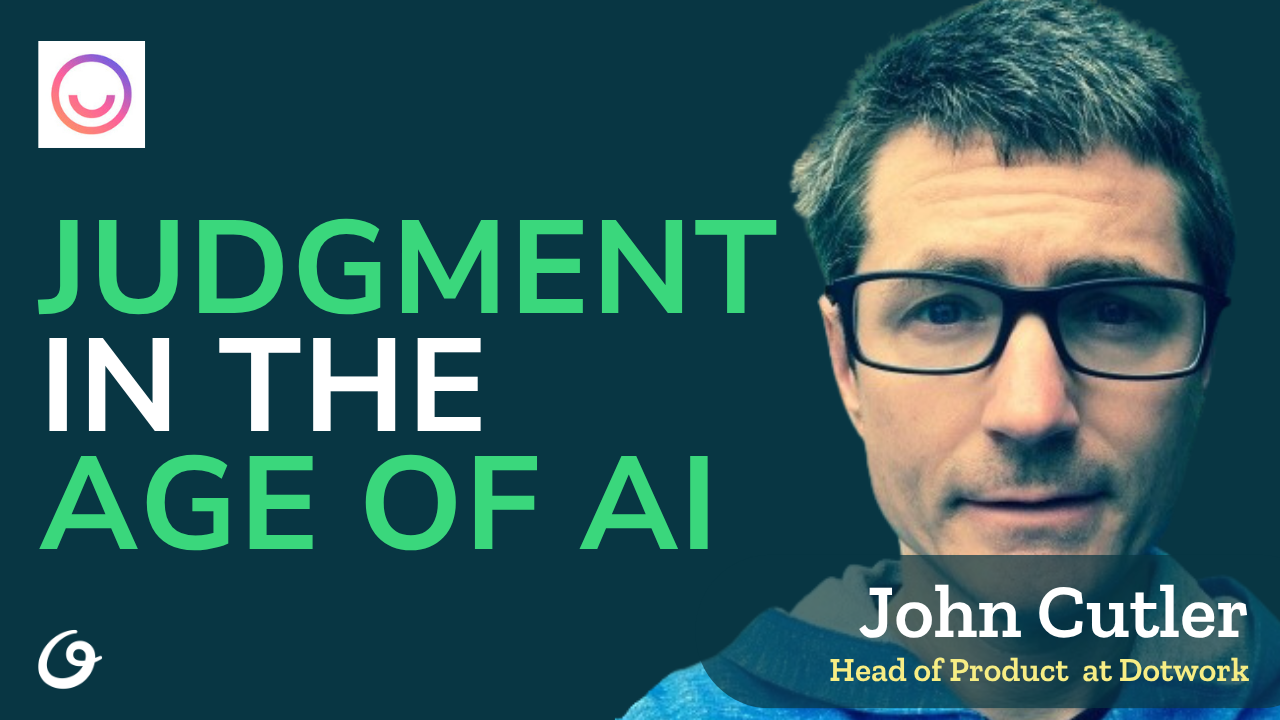
AI is changing how leaders think, decide, and work with their teams. But as John Cutler points out in this conversation, the real shift is not simply about faster answers or more productivity. It is about becoming more aware of the judgment systems we already use, often without noticing.
In this episode of the Unlearn Podcast, I’m joined again by John Cutler, product thinker, systems explorer, and Head of Product at Dotwork. We explore how AI can help leaders expose their thinking, pressure test decisions, and build stronger team judgment, while also making it easier to accelerate poor habits, shallow work, and false confidence.
Subscribe


John shares practical examples from product prioritization, survey design, objection handling, and team collaboration to show where AI can genuinely improve decision quality. We also get into the tradeoffs: why AI can make work feel like “hard mode,” why downtime still matters, and why intentionality is becoming one of the most important leadership skills in this moment.
Key Takeaways
- AI exposes how leaders make decisions: AI tends to amplify the decision system already there. When a leader’s thinking is clear, AI can help make it visible and reusable; when it is vague, AI can make that vagueness move faster.
- Judgment is built differently depending on the situation: John explains that some judgment comes from repetition and tacit pattern recognition, while other judgment develops through coaching, discussion, and working alongside people with more experience.
- AI can help turn intuition into something teams can use: John’s example of documenting his product prioritization heuristic shows how AI can help make internal judgment concrete. The value comes from helping others understand why certain decisions matter, not just what the decision is.
- Better AI use starts with knowing what you know: John contrasts product prioritization, where he has deep experience, with survey design, where he knows there is established expertise to draw from. The skill is recognizing whether AI should extend your own judgment or help you borrow from a domain expert.
- Teams using AI well can raise decision quality: Barry shares how AI can help teams pressure test assumptions, run scenarios, and ask disconfirming questions without losing momentum. The real advantage comes when AI strengthens collaboration rather than replacing it.
- AI can also accelerate bad instincts: John warns that AI can make poor thinking look polished. A team can paste AI onto an existing process and call it transformation without changing how decisions are actually made.
- Intentionality matters more than productivity: AI can reduce friction, but it can also remove the pauses where judgment forms. Leaders need to design space for reflection, not just optimize for more output.
Additional Insights
- Individual metacognition: This is understanding how you think and make decisions. John’s examples show that leaders get more value from AI when they can first make their own judgment system visible.
- Social metacognition: This is understanding that other people think, perceive, and engage differently. AI becomes more useful when it supports the conversation between people instead of flattening everyone into the same process.
- Computational metacognition: This is understanding what LLMs are good at, where they fail, and how to work with them responsibly. John argues that leaders need this skill so they know when to trust AI, when to challenge it, and when to bring in human expertise.
- Objection handling as a repeatable system: John’s team did not ask AI to create a generic sales guide. They role-played real objections, captured the discussion, compared their responses against best practices, and turned that into a system that could review future calls.
- The deeper lesson: AI becomes more useful when it is connected to real work, real context, and a team’s actual judgment. Without that grounding, it risks creating more output without improving the quality of decisions.
Episode Highlights
00:00 – Episode Recap
John Cutler opens with a story about how judgment often comes from repetition and tacit signals, not neat frameworks. The episode explores what happens when AI starts making those hidden decision systems visible.
02:02 – Guest Introduction: John Cutler
Barry welcomes back John Cutler, product thinker, systems explorer, and Head of Product at Dotwork, for a conversation about judgment, decision making, and collaboration in the age of AI.
04:59 – How Judgment Gets Built
John explains that judgment develops differently depending on the context: through individual practice, repeated exposure, mentorship, team discussion, and comparison against examples of quality.
08:58 – Making Prioritization Thinking Visible
John shares how he used AI to document his own scoring heuristic for product prioritization, giving a teammate deeper insight into why certain ideas mattered more than others.
12:11 – Knowing When to Borrow Expertise
Using survey design as an example, John explains how AI can help access existing expert knowledge when you are not the expert yourself. The key is being honest about the limits of your own judgment.
13:56 – From Answers to Better Questions
Barry reflects on the shift from using AI to get answers toward using it to challenge thinking, improve decisions, and bring stronger questions to colleagues.
18:04 – Why Better Surveys Lead to Better Decisions
John explains how improving a survey from average to strong can materially change the quality of insight a team gets back, which then affects the quality of product decisions.
23:04 – Teams, AI, and Decision Advantage
Barry shares how AI can help teams maintain momentum during ideation by quickly pressure testing scenarios, asking disconfirming questions, and bringing outside information into the room.
27:48 – Turning Objection Handling into a System
John describes how his team recorded a live objection-handling exercise, analyzed it against best practices, and turned the team’s collective knowledge into a reusable system.
31:32 – The Three Forms of Metacognition
John introduces individual, social, and computational metacognition as three skills leaders need to work effectively with AI and with each other.
35:19 – AI Exposes Leadership Systems
Barry and John discuss why AI can feel uncomfortable for leaders: it reveals whether there is a real decision-making system underneath the confidence.
37:34 – When AI Makes Every Decision Feel Hard
John raises an important limitation: AI can remove small pauses in the workday, leaving people constantly operating at high cognitive load.
41:58 – Productivity Fatigue and Agent Overload
Barry and John discuss the temptation to run too many AI-assisted tasks at once, and why that can create more noise rather than better outcomes.
44:23 – Designing Time to Think
Barry shares how he intentionally creates time for walking, exercise, and reflection to avoid over-optimizing for fast, reactive decisions.
46:38 – Intentionality Over Process Theater
John explains why intentionality is different from rigid process. The opportunity is to design better systems without flattening the richness of how teams actually work.
50:11 – Closing Reflections
Barry wraps the conversation by reflecting on the opportunity for leaders to use AI not just to move faster, but to become more aware of how they think, decide, and scale judgment across teams.
FAQs
Q1: How can AI help leaders make better decisions?
AI can help leaders make better decisions by forcing them to make their thinking more explicit. Instead of relying only on gut instinct, leaders can document their assumptions, create rubrics, pressure test options, and invite teammates to challenge the logic behind a decision.
Q2: What is the risk of using AI for decision making?
The risk is that AI can make weak thinking move faster. If a leader uses AI only to confirm what they already believe, the output may look polished but still be flawed. AI can also create productivity fatigue when people try to run too many tasks without enough time to think.
Q3: What does John Cutler mean by judgment in the age of AI?
John describes judgment as something built through different kinds of experience: repetition, tacit pattern recognition, coaching, comparison, and collaboration. In the age of AI, the challenge is to understand which kind of judgment is needed and how AI can support it without replacing human responsibility.
Q4: How should teams use AI without losing human collaboration?
Teams should use AI to strengthen the conversation, not avoid it. In the episode, Barry describes using AI during team ideation to pressure test assumptions, run scenarios, and ask disconfirming questions while the team is still together. That keeps human energy and judgment in the loop.
Q5: What is computational metacognition?
Computational metacognition is understanding how AI systems, especially LLMs, work well and where they are likely to fail. John pairs this with individual metacognition, knowing how you think, and social metacognition, understanding how other people think.