
Every organization is perfectly designed for the technology that existed when it was built.
Industrial organizations were designed for a world where information moved slowly, expertise was scarce, and coordination depended on hierarchy. Meetings became the primary mechanism for alignment. Reports moved information from one layer of management to another. Knowledge lived inside people, documents, and systems. When people left, much of that knowledge left with them.
That operating model served organizations remarkably well for decades. Today, artificial intelligence is changing those assumptions, and the economics of information, coordination, decision-making, and organizational learning.
And while technology has changed, most operating models haven’t.
The consequences are becoming increasingly visible. Deloitte’s October 2026 research found that 70% of surveyed leaders said their latest transformation failed to deliver its intended business value. Among leaders overseeing AI implementations, 61% felt AI transformation was moving faster than employees could handle.
Organizations are trying to run twenty-first-century technology inside management systems designed for a very different world.
This is the fourth article in The Adaptive Enterprise, our five-part article and podcast series exploring how AI is reshaping work, governance, and leadership. Here, we examine how leaders can redesign their operating models as AI changes how information moves, decisions are made, people coordinate, and organizations learn.
The Operating Model Challenge
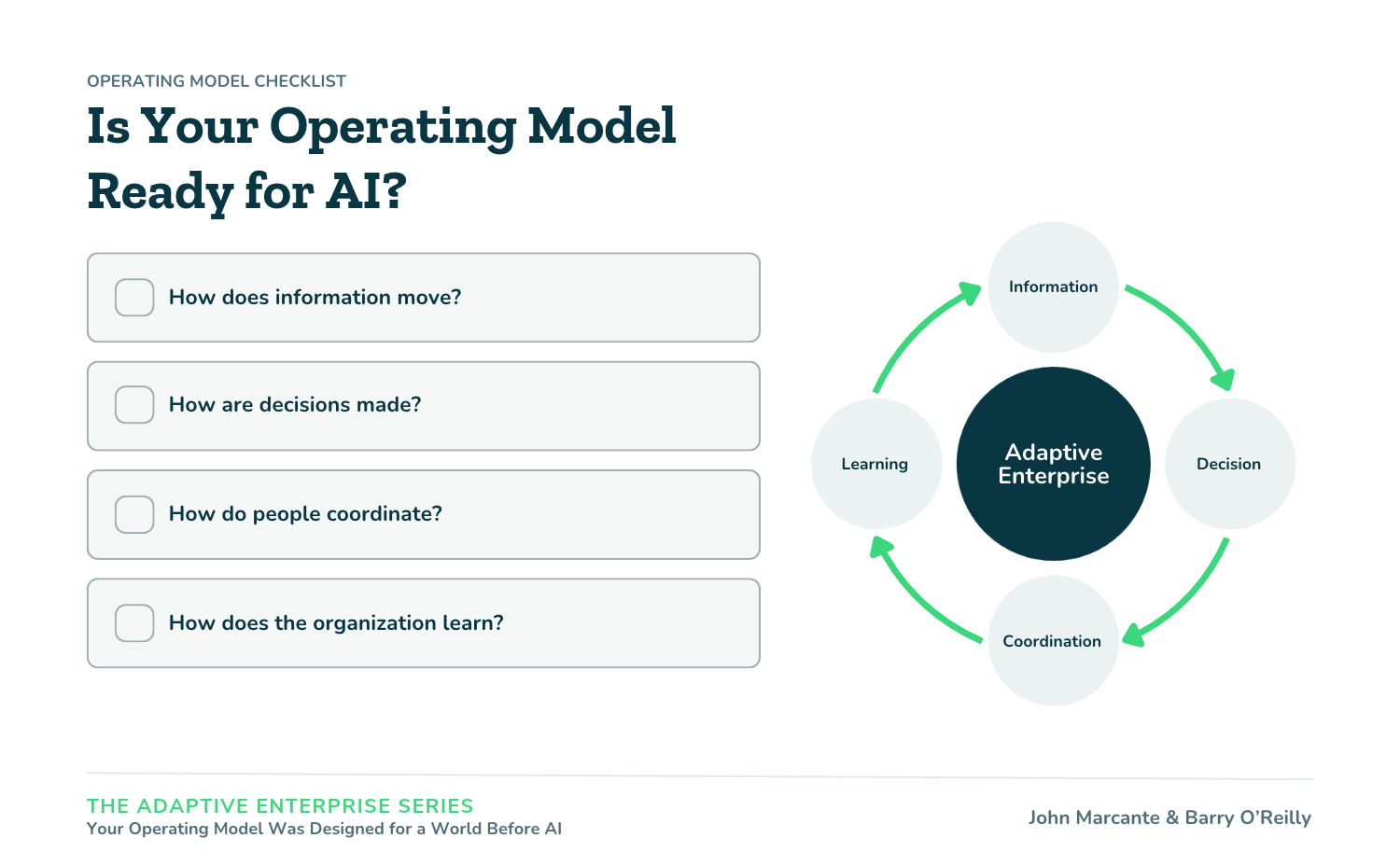
Every operating model, whether deliberately designed or inherited over time, answers four fundamental questions.
- How does information move?
- How are decisions made?
- How do people coordinate?
- How does the organization learn?
Operating Model Checklist
Every organization has answers to these questions. AI changes what’s possible for everyone.
1. How Does Information Move?
For decades, information was scarce. The challenge was getting access to it.
Today, information is abundant. The challenge is deciding what matters.
That changes the role of leadership.
Leaders create less advantage by possessing information others don’t have. Increasingly, the advantage comes from interpreting information well, recognizing what matters, and making good judgments under pressure.
This is something we’ve seen repeatedly in our work with senior executives.
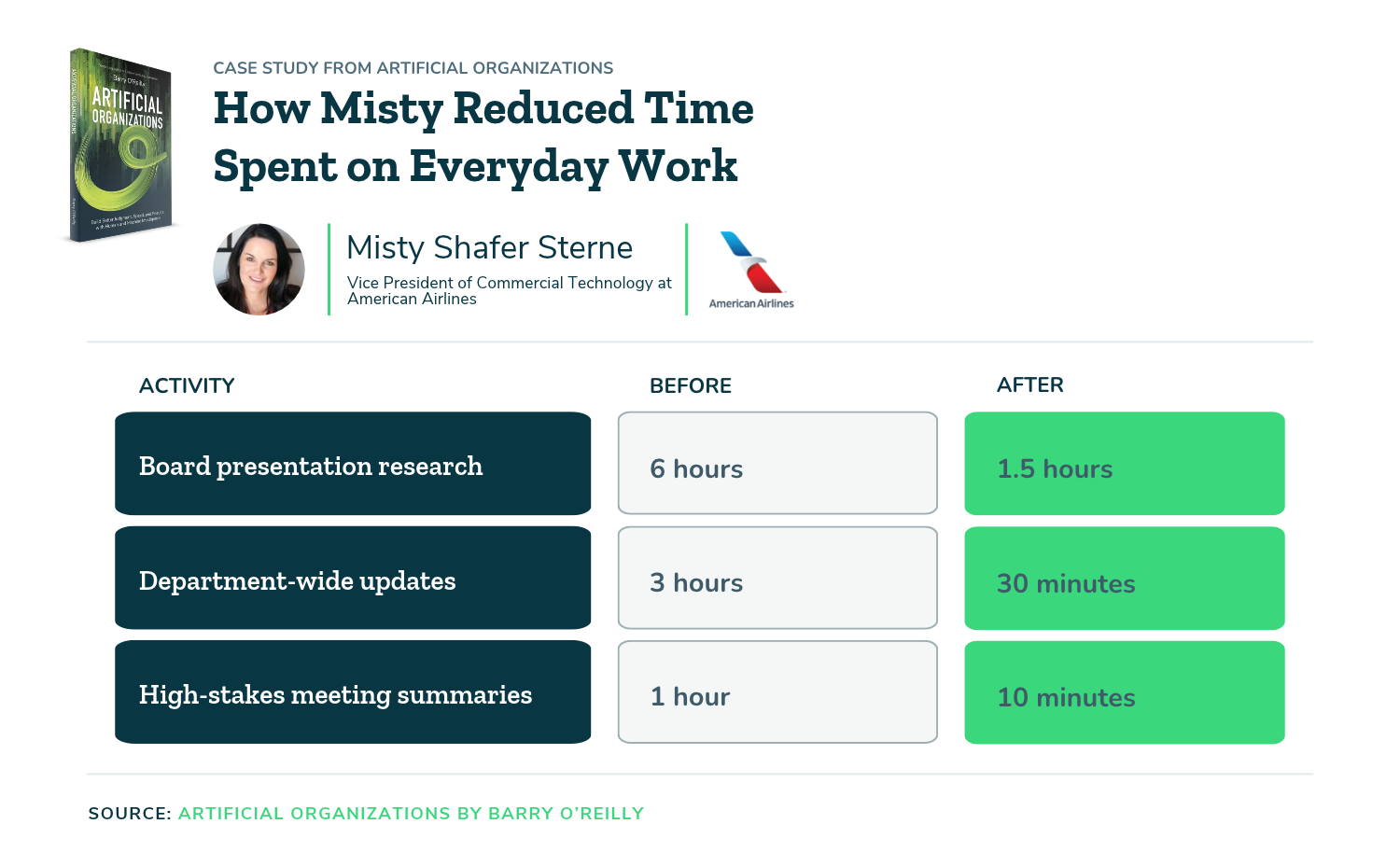
One of the key case studies in Artificial Organizations is at American Airlines, Misty Shafer Sterne began using AI to support how she prepared for complex leadership conversations and strategic decisions.
Artificial Organizations Case Study
The real improvement was performance, not simply faster preparation.
She could bring together more context, explore ideas before socializing them, pressure-test her assumptions, and create stronger dialogue and debate with a clear view of the choices in front of her.
The information already existed. What changed was her ability to turn it into better judgment.
That’s a very different operating model from one where executives spend hours reconstructing context before every important meeting.
Information moves at your pace. Preparation improves. Decision quality follows.
2. How Are Decisions Made?
Most large organizations inherited a simple assumption: people at the top had access to information others did not.
That naturally concentrated decision-making upward. Information moved through the hierarchy. Decisions came back down. Approvals accumulated along the way.
AI changes that equation.
People closest to customers, operations, and emerging problems can increasingly access sophisticated analysis, organizational context, and decision support without waiting for information to travel through multiple management layers.
That doesn’t make hierarchy irrelevant. It changes what hierarchy is for.
Leadership becomes less about personally making every important decision and more about designing the conditions for good decisions to happen at the appropriate level.
Clear decision rights. Shared context. Defined guardrails. Strong judgment. Fast escalation when needed.
John saw the power of this firsthand when Vanguard launched one of its first product teams.
The business goal was straightforward: improve prospective-client conversion. Rather than fund another fixed-scope technology project, leadership invested in a persistent team, gave it the authority to investigate the problem, and measured progress against the business outcome.
What the team discovered challenged everyone’s assumptions. Many prospective clients weren’t lost. They were stuck.
Vanguard’s language was too complex. There were too many choices. People needed more personal guidance to move forward.
The solutions were surprisingly simple: clearer language, fewer choices, and a more supportive experience. Very little new technology was required.
Contrast that with the traditional top-down approach, which had previously spent more than $1 million building a new prospect website.
The product team improved conversion rates in a business where more than 95% of client interactions were digital. The lesson stayed with John.
Give teams a clear outcome, the authority to act, and the freedom to discover how best to achieve it.
The people closest to the problem often find better answers than those furthest from it.
And as AI makes information and analytical capabilities more widely available, that leadership principle becomes even more important.
One of AI’s greatest opportunities is reducing the distance between a problem and the person capable of making a sound decision about it.
3. How Do People Coordinate?
For decades, meetings became the default coordination mechanism of the enterprise.
Need context? Schedule a meeting.
Need alignment? Meeting.
Need an update? Meeting.
Need approval? Meeting.
Need to remember what happened in the last meeting? Another meeting. (Sorry, we couldn’t help ourselves.)
The cost of this approach has been building for decades. Research published in Harvard Business Review found that executives were spending nearly 23 hours a week in meetings, compared with fewer than 10 hours in the 1960s.
The problem isn’t meetings themselves. Important conversations will always matter.
The problem is how much organizational context disappears when those conversations end.
People take their own notes. Actions get interpreted differently. Important rationale disappears. Teams return weeks later and spend the first part of the next meeting reconstructing what they previously discussed.
AI allows organizations to treat those interactions differently.
Conversations can be captured. Meetings can be transcribed. Signals can be synthesized. Decisions, assumptions, actions, and rationale can become persistent organizational assets.
In Artificial Organizations, Barry describes a simple workflow called CTSA.
Capture → Transcribe → Synthesize → Act
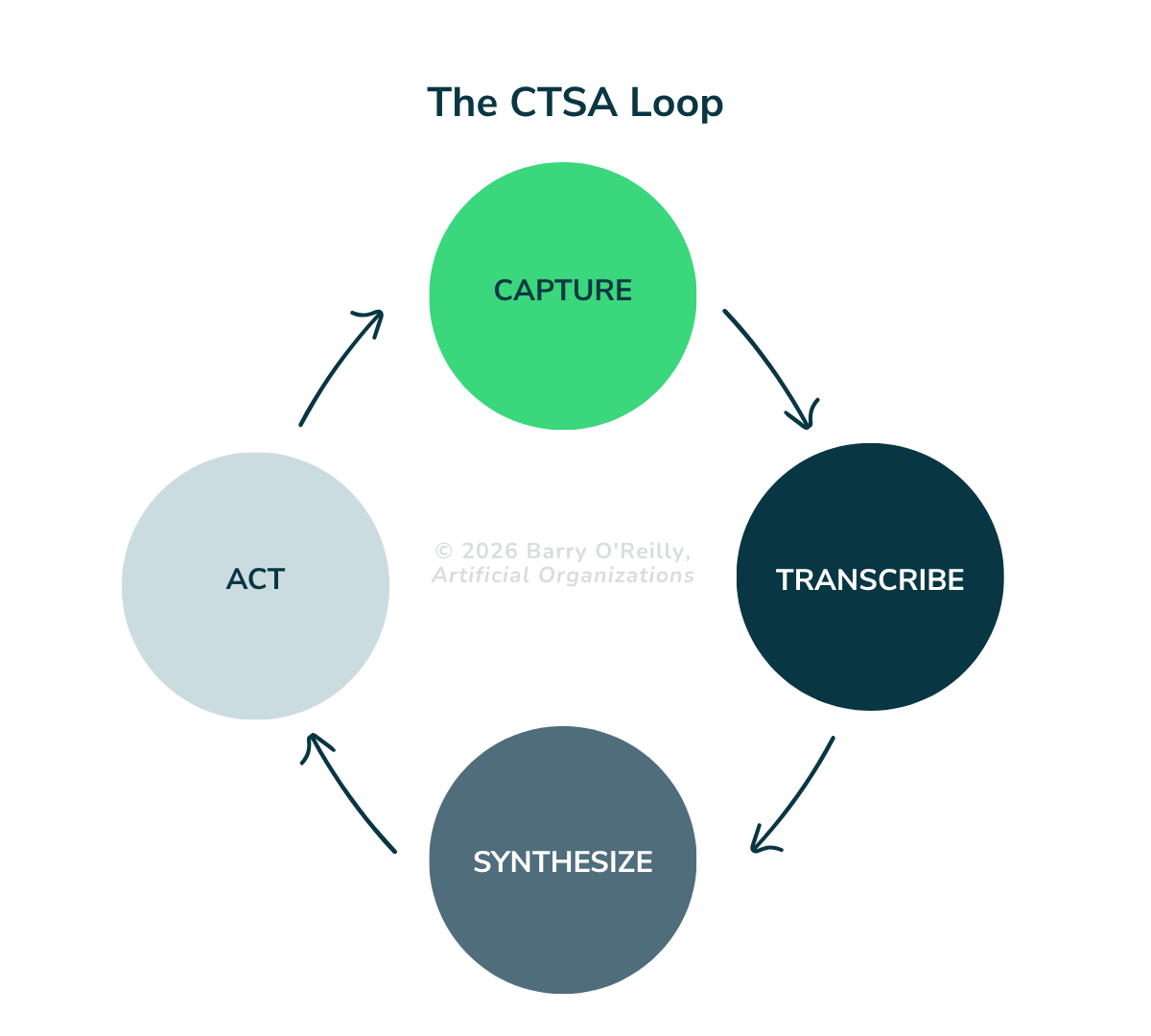
The CTSA Loop
CTSA began as a personal leadership workflow. However, its organizational implications are much bigger.
When work is consistently captured and synthesized, context starts following the work rather than the people.
Teams enter conversations better prepared, spend less time reconstructing the past, and can revisit decisions with a clearer understanding of why they were made.
This becomes especially important when leadership changes.
We’ve all seen what happens when a new leader arrives without the history behind previous decisions. Priorities shift. Strategies are revisited. Sometimes organizations reverse direction without understanding why those choices were made in the first place.
The result is organizational whiplash. Teams spend time and resources revisiting decisions, repeating mistakes, and adjusting to yet another direction.
And organizations have limited capacity to absorb constant change.
Deloitte’s 2026 research found that 73% of surveyed leaders reported employee change fatigue. Those at organizations running four or more major initiatives simultaneously were 6.4 times more likely to report high change fatigue than those running just one.
Preserving organizational context doesn’t mean new leaders should be bound by past decisions, it’s quite the opposite.
It gives them the history, reasoning, and lessons learned to make better decisions about what to continue, what to change, and what to leave behind.
Fresh leadership should bring fresh thinking, without forcing the organization to start learning all over again.
That’s a significant shift in how organizations can coordinate, make decisions, and maintain momentum.
4. How Does the Organization Learn?
This may be the biggest opportunity of all.
Organizations forget, constantly. Meetings end. Projects finish. Customer conversations disappear into different systems. People move roles or employees leave. Teams solve problems that another team solved six months earlier!
A remarkable amount of organizational learning simply evaporates. AI creates the possibility of persistent organizational memory.
Every experiment can produce reusable evidence. Every customer interaction can strengthen the organization’s understanding of its market. Every decision can preserve the assumptions and reasoning that produced it.
The opportunity is to make learning available to the next person, team, or decision.
At Nobody Studios, our aim is to help the studio itself become better at building ventures every time we run an experiment.
When a founder tests a customer problem, explores a business model, discovers why an assumption was wrong, or learns which signal actually predicted demand, that learning should improve the next decision.
Then the next company. Then the studio itself, because venture creation is ultimately a race to learn. The advantage compounds when learning moves from individual memory into organizational memory.
That’s the operating model shift, an organization that gets better at working because it gets better at learning.
Redesigning a Successful Business Before It Needed Saving
One of John’s most important leadership lessons came long before AI, during his first P&L leadership role at Vanguard.
When he accepted responsibility for Vanguard’s High Net Worth business, colleagues joked that he’d won the lottery.
It was one of the strongest-performing businesses in Retail. Client loyalty was exceptionally high, financial performance was excellent, and the advice was simple, “Don’t screw it up.”
Most leaders would have taken exactly that approach. John didn’t.
He started with a listening tour, speaking with Vanguard crew, clients, prospects, former leaders, and industry experts.
What he discovered challenged the financial results.
Relationship managers no longer felt like trusted advisors. Clients rarely spoke with their assigned relationship manager. Internal handoffs frustrated employees and customers. Net Promoter Scores had begun to decline.
Competitors were evolving faster than Vanguard’s service model.
The business was performing well, but its operating model was becoming obsolete.
The team redesigned the experience.
Relationship managers developed deeper investment expertise. Certified Financial Planners worked alongside advisory teams. Technology reduced internal handoffs, while Risk and Compliance helped establish guardrails for more personalized service.
They also changed how success was measured.
Client advocacy, crew engagement, share of wallet, proactive outreach, and single-touch service became important measures of performance alongside financial results.
But the hardest challenge was convincing a successful organization that it needed to change. John didn’t begin with recommendations. He started with evidence. What employees were experiencing. What clients were saying. How competitors were changing.
Once leaders shared the same understanding of reality, they could begin designing a different future. Looking back, that lesson feels even more relevant today.
The best time to redesign your operating model is while you’re still winning.
By the time today’s operating model becomes the problem, tomorrow’s competitors may have already built the next one.
Leadership’s Role Is Continuous Redesign
Leaders don’t redesign organizations because AI exists. They redesign organizations because every new capability changes where value is created.
Technology creates new capabilities. Leadership turns those capabilities into better ways of working.
That means continually asking better questions.
- Where is information getting trapped?
- Which decisions are waiting for unnecessary approvals?
- Where are teams rebuilding context that already exists?
- What knowledge disappears every week?
- Which workflows survive simply because nobody has challenged them?
These are leadership questions.
And they require leaders to examine the systems they have built, the behaviors they reward, and the decisions they expect others to make.
The evidence increasingly points toward work redesign as a differentiator.
McKinsey’s 2026 State of AI research found that nearly three-quarters of AI high performers reported fundamentally redesigning workflows because of AI, compared with only one-quarter of other respondents. Those high performers were organizations reporting significant AI value and attributing at least 5% of their EBIT to AI.
Organizations that continually redesign how work gets done can turn each new capability into an opportunity to improve performance, and that requires a different management rhythm, evidence we’re already seeing by Measuring AI Outcomes with the market. You can do it yourself in 10-minutes, give it a try.
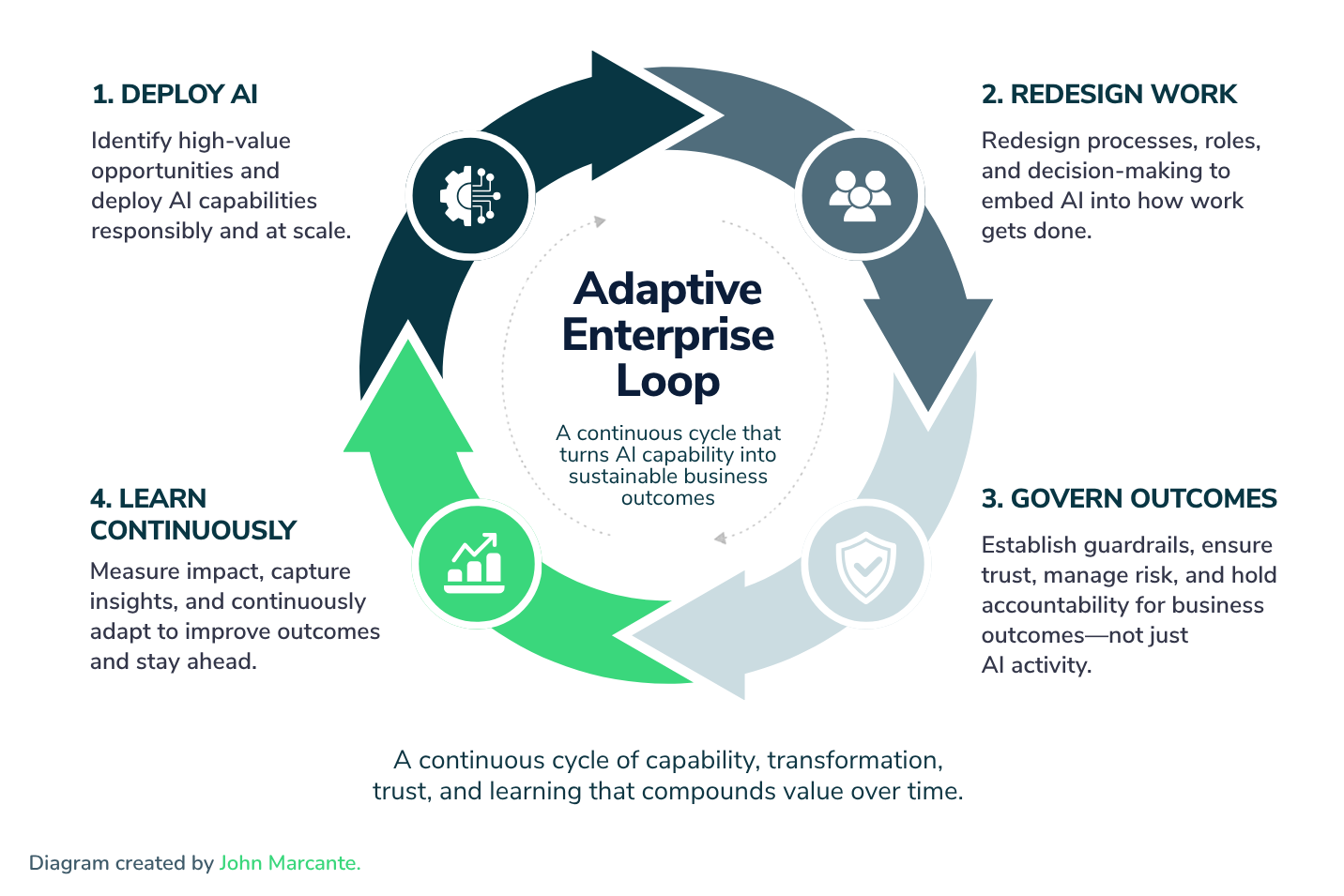
At the core of our series, remember the Adaptive Enterprise Loop brings discipline together:
Deploy AI → Redesign Work → Govern Outcomes → Learn Continuously → Repeat
Adaptive Enterprise Loop
Identify opportunities where AI can create value. Redesign workflows, roles, and decision-making. Establish guardrails and accountability for outcomes. Capture what works, learn from what doesn’t, and improve the system again.
Each cycle should leave the organization better equipped for the next.
The Leadership Shift
For more than a century, organizations optimized for efficiency. This generation will optimize for learning.
Efficiency helps organizations scale what they already know. Learning helps organizations discover what they need to know next. AI accelerates both.
The organizations that outperform will continually redesign:
- How information moves and what deserves attention.
- How decisions are made and who has the authority to act.
- How people coordinate and share context.
- How organizational learning is captured, reused, and improved.
That requires leaders to challenge some of the very practices that made their organizations successful.
Where should decisions move closer to the customer? Which approvals no longer add value? What work could disappear entirely? How should teams measure whether new ways of working are actually better?
These questions should become part of the regular leadership conversation, supported by evidence of what’s changing and the outcomes it produces, because an adaptive enterprise is never finished.
The capability that matters most is the ability to continually redesign how work gets done as new possibilities emerge.
That’s the operating model challenge.
And that’s why every operating model designed before AI will eventually need to be redesigned for a world with it.
– An article by John Marcante and Barry O’Reilly
What needs to change in how your organization works?
Spend 15 minutes with me to explore where AI could improve business performance and what changes to your operating model could help.
FAQs
1. Why do organizations need to redesign their operating models for AI?
Most operating models were designed when information was scarce, coordination depended on meetings, and decisions flowed through management hierarchies. AI changes those assumptions by making information, analysis and organizational knowledge more accessible. Leaders need to rethink how information moves, decisions are made, teams coordinate and learning is captured. The opportunity is to redesign work so AI capabilities translate into better decisions, customer experiences and business outcomes.
2. How does AI change decision-making and organizational hierarchy?
AI allows people closer to customers and operational problems to access sophisticated analysis and decision support without waiting for information to move through multiple management layers. Leaders can distribute more decisions to the people best positioned to make them, supported by clear decision rights, shared context, appropriate guardrails and accountability. Hierarchy still matters, but its role increasingly shifts toward enabling better decisions rather than controlling every decision.
3. Can AI reduce meetings and improve organizational memory?
Yes, when organizations redesign how they capture and use information. The CTSA workflow from Artificial Organizations provides a practical starting point: Capture → Transcribe → Synthesize → Act. AI can help preserve conversations, decisions, assumptions and actions so teams spend less time reconstructing information. This creates persistent organizational memory, improves coordination and helps new leaders understand why previous decisions were made.
4. Why should leaders redesign an operating model that’s already performing well?
Strong financial performance can hide an operating model that’s becoming obsolete. At Vanguard, John Marcante discovered that its successful High Net Worth business was experiencing declining client advocacy, frustrating handoffs and changing customer expectations. Redesigning the service model, decision-making and performance measures helped address those challenges before financial results deteriorated. The best time to redesign your operating model is while you’re still winning.
5. How can leaders measure whether their AI operating model is actually improving performance?
Start with observable business outcomes rather than AI activity. Measure changes in decision speed and quality, customer satisfaction, conversion rates, workflow cycle times and organizational learning. Establish a baseline, redesign the work, monitor what improves and use the evidence to adapt again. This is the foundation of the Adaptive Enterprise Loop: Deploy AI → Redesign Work → Govern Outcomes → Learn Continuously → Repeat. The goal is an organization that continually improves how it works as new capabilities emerge.
References
- Dake, Allyson, Chloe Domergue, Jenny Ahn, and Sue Cantrell. “The 4:1 Change Management Return Most Organizations Are Leaving on the Table.” Deloitte Insights, October 19, 2026. Read the research.
- McKinsey & Company. “The State of AI in 2026: On the Road to ROI.” McKinsey, 2026. Read the research.
- Perlow, Leslie A., Constance Noonan Hadley, and Eunice Eun. “Stop the Meeting Madness.” Harvard Business Review, July–August 2017. Read the article.
- O’Reilly, Barry. Artificial Organizations. 2026. Explore the book.
- Measure AI Outcomes, benchmark your AI capabilities against the market in 10 minutes.