
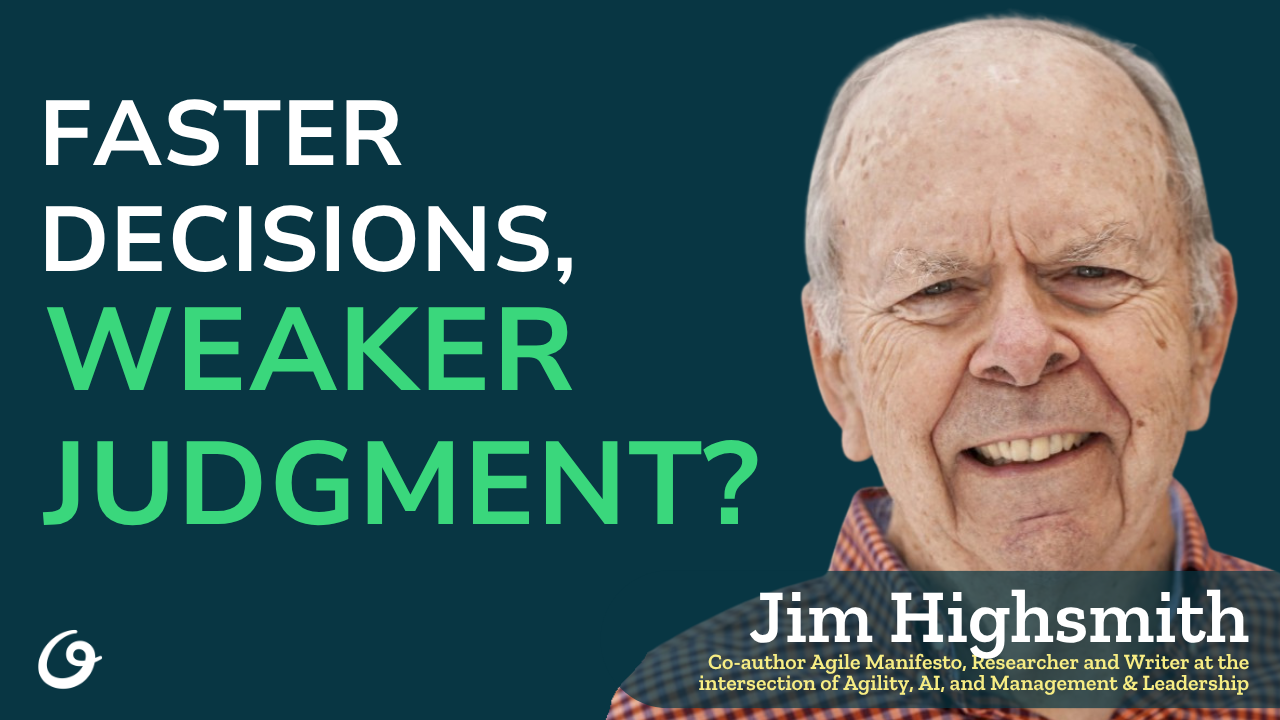
Jim Highsmith has been thinking about decision-making for a long time. When he wrote Agile Project Management in 2004, he went looking for practical guidance on decision-making in the project management literature and found very little. That gap matters even more now.
In this episode, Jim and I talk about why AI raises the stakes for executive judgment. AI can remove friction, speed up work, and take on repeatable tasks, but it can also make it easier for leaders to stop practicing the very capabilities they are paid to use. Jim brings this to life through John Boyd’s OODA loop, the risk of judgment atrophy, mountaineering decisions, Rob Hall’s Everest threshold, Phil Knight’s pattern recognition at Nike, and a personal story from Jim’s own time leading a collaborative project team at Nike.
Subscribe


This conversation is really about how leaders build judgment deliberately: by making consequence-bearing decisions, setting thresholds before pressure arrives, creating space for slow thinking, and reflecting honestly on how decisions were made.
Key Takeaways
- AI can weaken judgment when leaders stop practicing it: Jim compares the risk to driving an autonomous car: the more the system takes over, the less sharp the driver becomes. AI can remove low-value effort, but leaders still need to practice making consequence-bearing decisions.
- The OODA loop is mostly about orientation: Jim explains that John Boyd’s edge was not just speed, but his ability to update his mental model quickly. For leaders, the real work is noticing when old assumptions no longer fit the situation.
- Capability is knowledge plus experience plus judgment: AI can make knowledge easier to access, but it cannot replace the experience of carrying consequences. Judgment develops when people make real decisions, reflect on the outcome, and adjust how they think.
- Thresholds only work when enforced under pressure: Jim uses Rob Hall’s Everest story to show why decision thresholds matter before emotion, ambition, or sunk cost take over. In business, those thresholds might be cost, risk, customer impact, or reversibility.
- Leaders need to separate fast decisions from slow judgment: Some repeatable, data-heavy decisions can be automated with guardrails. Higher-context decisions still need human orientation, pattern matching, and time to think.
- Reflection turns experience into better pattern matching: Barry shares his practice of documenting decisions, what was known at the time, and why the call was made. That kind of review helps leaders improve the decision process, not just judge the outcome.
Additional Insights
- Role modeling beats mandates: Jim describes how Boyd taught by showing the mechanics of his performance. Barry connects this to AI adoption: leaders create more movement by sharing how they are using the tools in real work.
- Productivity fatigue is a real AI-era risk: Barry reflects on how AI can increase output while shrinking the space to think. That matters because senior leadership work often depends on judgment, not just throughput.
- AI transformation is still a people problem: Jim returns to Jerry Weinberg’s reminder that “no matter what they tell you, it’s a people problem.” Tools help, but organizations still need to redesign the work, behaviors, and decisions around them.
- Pattern matching is different from gut feel: Jim uses Phil Knight’s Nike decisions to show how instinct can come from years of context. What looks intuitive on the surface is often pattern recognition built through experience.
Episode Highlights
00:00 – Episode Recap
Jim Highsmith frames the core tension of the episode: AI can accelerate work, but it can also expose whether leaders have a real decision-making system or are quietly handing judgment to the machine.
01:45 – Guest Introduction
Barry introduces Jim Highsmith, a pioneer of adaptive leadership and original Agile Manifesto signatory whose work has shaped how organizations navigate uncertainty and make high-stakes decisions.
04:27 – Decision-Making Was Missing from the Playbook
Jim explains that when he wrote his first Agile Project Management book in 2004, he found surprisingly little practical guidance on decision-making in standard project management sources.
05:47 – The Real Power of the OODA Loop
Jim revisits John Boyd’s observe, orient, decide, act model and argues that orientation, the ability to update mental models under pressure, is the part leaders often underdevelop.
07:19 – From Process-Centric to Judgment-Centric Management
Jim makes the case that if AI takes over more process improvement work, organizations need decision-making capacity distributed through the system, not concentrated at the top.
09:14 – The Judgment Muscle Can Atrophy
Barry and Jim use the autonomous car example to show how useful automation can quietly weaken a capability when people stop practicing it.
12:33 – Role Modeling Beats Mandates
Jim explains how Boyd taught fighter pilots by showing the mechanics of superior performance, which Barry connects to leaders demonstrating their own AI experiments instead of simply telling others what to do.
15:50 – Capability Is More Than Knowledge
Jim defines capability as knowledge plus experience plus judgment, pointing out that LLMs can provide knowledge but not the consequence-bearing experience that shapes better calls.
18:56 – Thresholds Keep Decisions Honest
Jim shares the Rob Hall Everest story to show why thresholds only matter if leaders are willing to honor them when pressure, ambition, or sunk cost pushes the other way.
20:58 – Automate the Right Decisions
Jim distinguishes fast, data-dependent System One decisions from slower System Two judgments, giving leaders a practical way to decide what to automate and what to protect.
24:31 – From Search Engine to Human-Agent Teams
Jim describes his own progression from using AI as a search engine to working daily with multiple humans and agents, showing that the practice evolves through use.
27:06 – Productivity Fatigue and Constant Execution
Barry reflects on how AI can create more throughput while leaving less space for slow thinking, especially for leaders whose real value is making judgment calls.
31:05 – Relearning the People Problem
Jim returns to Jerry Weinberg’s reminder that “no matter what they tell you, it’s a people problem,” and Barry connects that to companies buying AI tools without redesigning how people work.
33:21 – Pattern Matching Is Not Gut Feel
Jim uses Phil Knight’s early Nike decisions to explain why seasoned executives often seem intuitive because they have built patterns from industry knowledge, relationships, and lived context.
36:09 – Decision Journaling Builds Better Judgment
Barry describes documenting decisions, the information available, and the rationale at the time as a way to learn from both strong and weak outcomes.
37:22 – A Nike Lesson in Collaborative Judgment
Jim recalls a project decision at Nike where the team agreed with the outcome but challenged the process, giving him a lasting lesson about when people need to be part of the call.
38:51 – Closing Reflections
Barry thanks Jim and points listeners toward his writing as these long-standing ideas about judgment, adaptability, and decision-making become even more relevant in the AI era.
FAQs
Q1: Why does AI raise the stakes for executive judgment?
AI raises the stakes because it can speed up work and remove friction, but it can also make it easier for leaders to stop practicing the judgment they need for consequence-bearing decisions.
Q2: What does Jim Highsmith say is the most important part of the OODA loop?
Jim emphasizes orientation, the ability to update mental models under pressure, as the part of the OODA loop leaders often underdevelop.
Q3: Can AI replace leadership judgment?
No. Jim explains that AI can provide knowledge and support repeatable decisions, but judgment develops through real experience, consequences, reflection, and adjustment.
Q4: How should leaders decide what to automate with AI?
Leaders should automate repeatable, data-heavy decisions with guardrails while protecting higher-context decisions that require human orientation, pattern matching, and time to think.
Q5: How can teams build better judgment over time?
Teams can build better judgment by making real decisions, setting thresholds before pressure arrives, reflecting honestly on outcomes, and reviewing the decision process rather than only the result.