
Every executive I work with is surrounded by more intelligence than ever before.
More dashboards, more documents, more meetings, more messages, more AI tools, more data just more everything being generated and flowing through the organization every minute of every day (I’m more exhausted just writing that!).
Yet the experience inside most leadership teams is not more clarity. It is more pressure.
Decisions are getting heavier. Context is harder to reconstruct. Teams are moving faster, but not always in the right direction. Leaders are being asked to make bigger calls with incomplete information, compressed timelines, and constant visibility.
This is the paradox of the AI era.
Information is abundant. Judgment is scarce.
Machines can process, store, summarize, and compute at a scale no human can match. They can recall years of conversations, synthesize thousands of documents, detect patterns, and generate options in seconds. But they still do not know what matters in your company, with your customers, at this moment, given your strategy, constraints, values, and risk appetite.
That responsibility still sits with leaders.
The constraint in modern organizations is no longer access to information. It is judgment under pressure.
That is why leading organizations are not simply installing AI tools. They are building two connected capabilities: Human Judgment Systems and Technology Judgment Infrastructure.
You need both. One without the other fails.
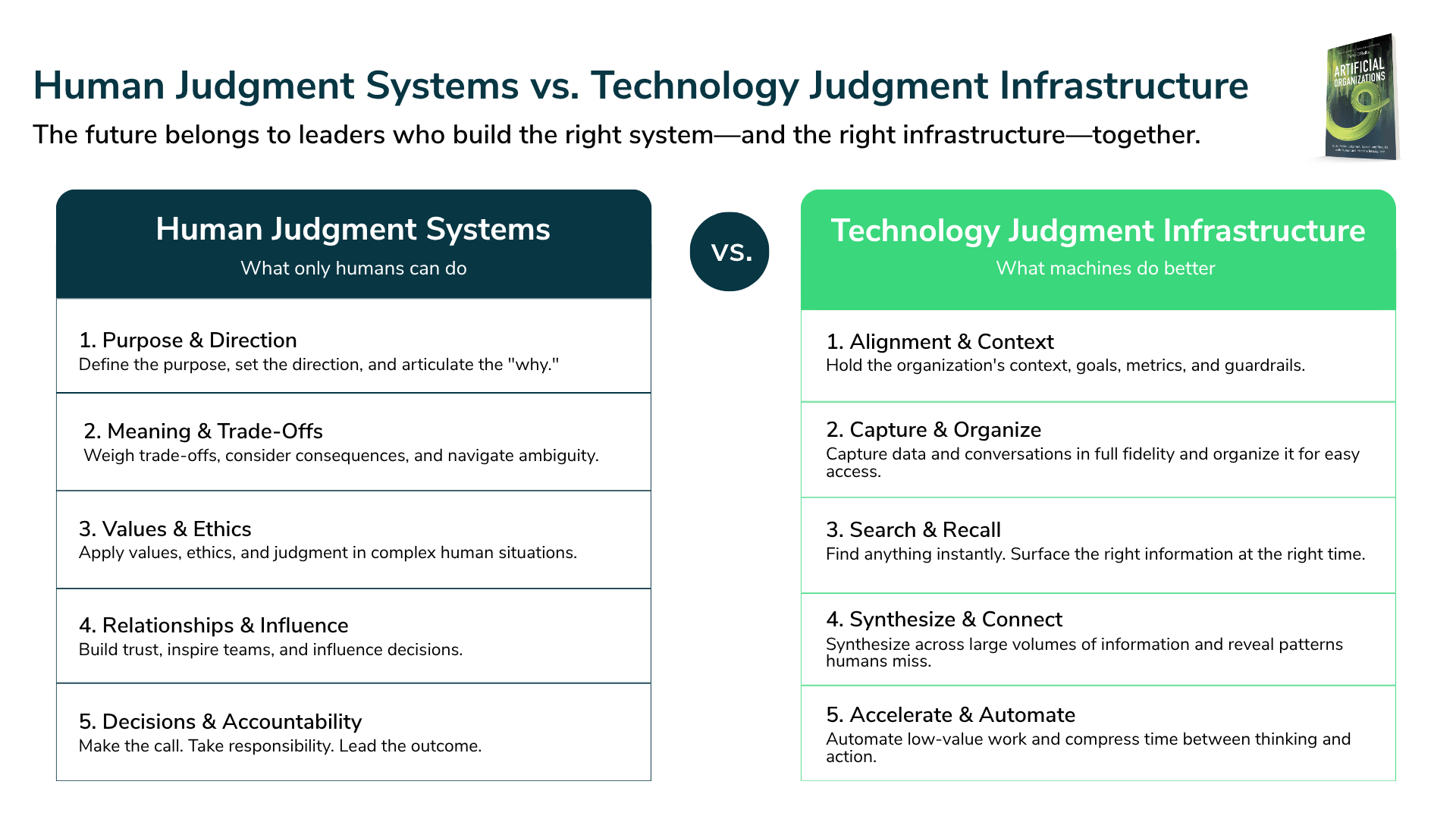
Human Judgment Systems vs. Technology Judgment Infrastructure.
A Human Judgment System without technology infrastructure stays trapped in one person’s head. It cannot scale.
Technology Judgment Infrastructure without a human judgment system creates speed without wisdom. It produces more output, more noise, and more confident wrong answers.
The opportunity is to deliberately combine both, so your organization can make better decisions, faster, with greater clarity and confidence.
And how we define Artificial Organizations, those that deliberately combine human and machine intelligence to redesign how judgment flows through a company.

The Architecture of an Artificial Organization
What Is a Human Judgment System?
A Human Judgment System is the repeatable way a leader makes decisions.
It is the pattern you use to capture information, interpret it, weigh trade-offs, challenge assumptions, decide, act, and learn from the outcome.
Most executives have one. Few have made it visible.
When I ask leaders, “Show me your judgment system,” most pause. They can describe their experience. They can talk about their instincts. They can tell stories about good calls they made in the past. But they struggle to write down the actual system they use to make decisions.
For many leaders, judgment lives as a private algorithm. It is hidden in their head, shaped by years of experience, scars, pattern recognition, preferences, biases, and beliefs.
Sometimes that algorithm is strong.
Sometimes it is outdated.
Sometimes it was built for a different market, a different operating model, and a different pace of change.
That is the danger.
Past success can become the very piece that limits future performance.
A Human Judgment System makes that invisible algorithm visible. It exposes how you decide, so you and others can inspect it, refine it, codify it, and improve it.
For example, when I started using AI more deliberately in my own work, the breakthrough was not that I became more productive. The breakthrough was that I stopped carrying every decision in my head.
I started capturing my meetings. I had transcripts. I could synthesize themes, actions, concerns, and decisions. I could prepare for conversations with the context already assembled. I could ask AI to challenge my thinking before I entered a room.
The machine did not replace my judgment. It gave my judgment more space.
That changed how I showed up. I was calmer. More prepared. More present. More decisive.
That is what a good Human Judgment System does. It helps leaders do the work only they can do.
What Is Technology Judgment Infrastructure?
Technology Judgment Infrastructure is the organizational architecture that helps judgment scale.
It is the systems, workflows, data assets, prompts, AI assistants, decision engines, meeting capture tools, knowledge bases, escalation rules, and operating rhythms that allow teams to capture work as data, synthesize signal from noise, and move from insight to action faster.
This is not about buying an enterprise AI license and hoping value appears.
Most companies are still bolting AI onto the edges of old workflows. They use it to write emails faster, summarize documents, create meeting notes, or draft presentations. Useful, yes. Transformational, no.
Leading organizations redesign the core.
They ask:
- How does judgment flow through this company?
- Where does context get lost?
- Where are decisions waiting on information?
- Where are leaders reconstructing the same conversation every week?
- Where are teams escalating decisions because the right context is not available at the edge?
- Where are we moving fast, but with weak assumptions?
Technology Judgment Infrastructure answers those questions structurally.
It turns conversations into assets. It turns meetings into decision engines. It turns scattered signals into usable insight. It creates thresholds that trigger decisions. It makes context reusable. It reduces the need to rebuild understanding every time a group gets together.
In a legacy organization, people carry context in their heads. Information is fragmented across meetings, dashboards, emails, documents, and chat threads. Decisions slow down because people first have to remember what happened, reconstruct what was agreed, and debate what matters.
In an Artificial Organization, every meaningful interaction can become a reusable data asset. Context is captured. Signals are synthesized. Leaders arrive prepared. Decisions are pressure tested. Actions are tracked. Learning compounds.
That is Technology Judgment Infrastructure.
It is not automation for its own sake. It is architecture for better decisions.
Why You Need to Understand Your Judgment System
If you do not understand your judgment system, you cannot improve it.
You also cannot tell whether AI is making your decisions better or simply making your existing habits faster.
This is one of the biggest risks I see right now. Leaders are using AI to accelerate work without examining whether the work should happen in the same way at all.
Bad judgment at higher speed is not transformation. It is risk.
That is why the first step is to expose your judgment system.
Write down how you make a recurring decision. Pick something real, not theoretical. A hiring decision. A product investment. A customer escalation. A budget trade-off. A strategic bet. A decision to continue or kill an initiative.
Ask yourself:
- What is the decision I need to make?
- What information do I use?
- Where does that information come from?
- What signals do I trust most?
- What assumptions do I usually make?
- Who do I involve?
- What trade-offs do I consider?
- What thresholds trigger action?
- What would make me change my mind?
- How do I know whether the decision worked?
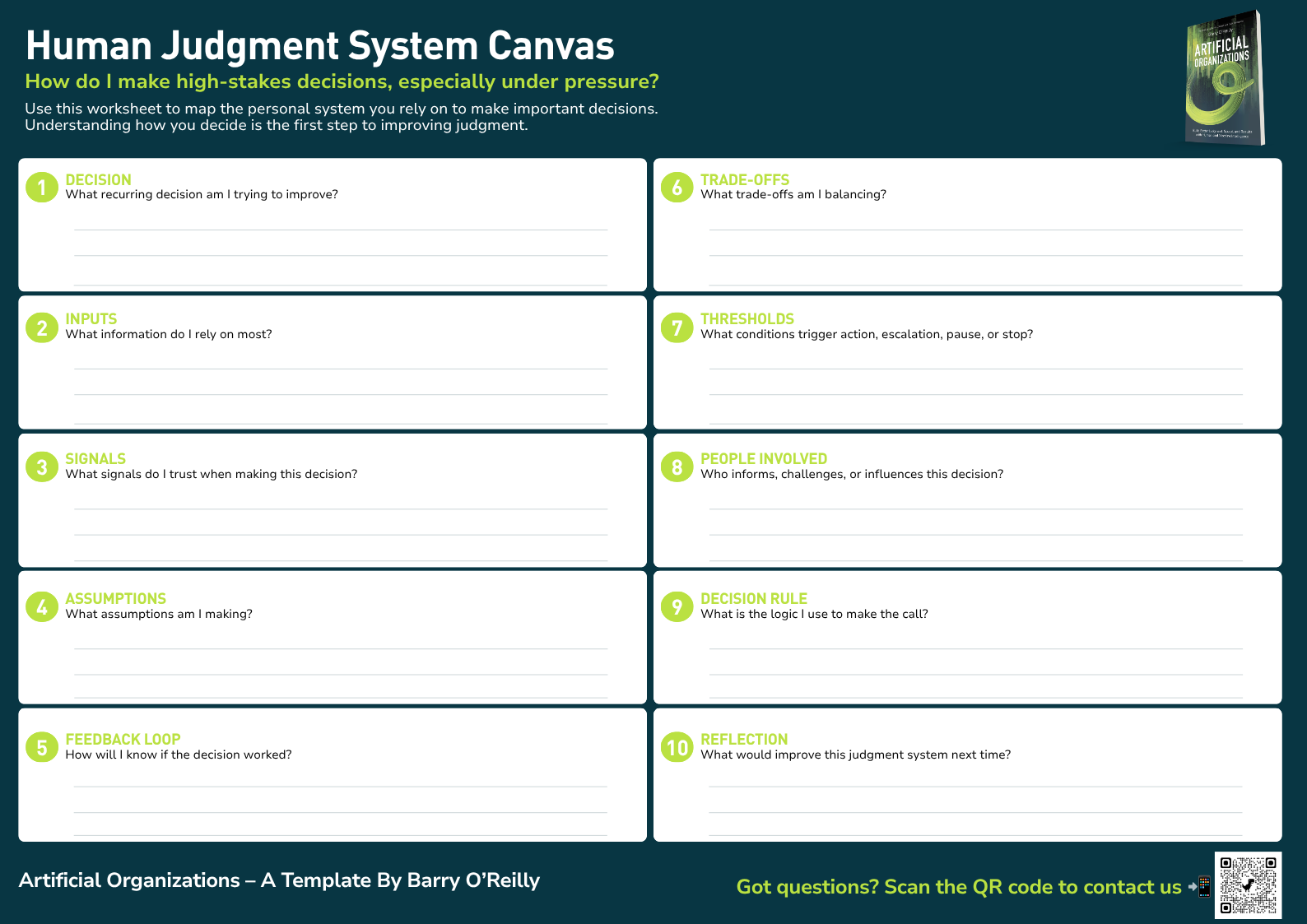
Want a digital copy of this template? Download the Human Judgment System Canvas here
Most leaders have never answered these questions clearly.
Once you do, something powerful happens. Your judgment becomes inspectable. Your team can see how you think. They can challenge weak assumptions. They can identify missing data. They can spot where your experience is helping and where it may be limiting you.
This is not about removing intuition. It is about strengthening it.
The best leaders are not the ones who pretend they have perfect judgment. They are the ones who create systems that help their judgment get better.
Expose It, Refine It, Codify It, Improve It
There are four moves every executive should make.
First, expose it.
“AI isn’t replacing leaders. It’s exposing them.”, that’s the opening statement of Artificial Organizations. Here’s why, You must make your decision logic visible. Stop hiding behind “gut feel” when the stakes are high. Gut feel may be a real signal, but it should not be a black box. Write out the inputs, assumptions, patterns, and principles that shape your call.
Second, refine it.
Once your system is visible, you can improve it. Ask where your logic is weak. Ask what data is missing. Ask what would need to be true for the opposite decision to be better. Ask where you are over-weighting past experience.
This is where AI becomes useful as a thinking partner. You can give it your decision logic and ask it to challenge you. Not agree with you. Challenge you.
Third, codify it.
When you find a better way to make a decision, turn it into a repeatable workflow. Create prompts. Create decision templates. Create escalation rules. Define thresholds. Build checklists for recurring decision types.
Codification does not remove human judgment. It protects it from inconsistency, fatigue, politics, and panic.
Fourth, improve it.
Every decision should create learning. What happened after the call? Did the outcome match the assumption? Did you detect the signal early enough? Did you reverse the decision later? Did the team understand the rationale? Did the decision create momentum or confusion?
This is where judgment compounds.
A judgment system without feedback becomes dogma.
A judgment system with feedback becomes an advantage.
Judgment Infrastructure Creates Decision Triggers
One of the most powerful shifts in the AI era is not only making better decisions. It is knowing when a decision needs to be made.
One of the most sophisticated judgment systems and infrastructure I help set up for a client involved leaders defining thresholds and boundary conditions in advance.
Think about a marketing campaign. You might decide to invest $50,000 over three weeks. You might set a minimum conversion threshold. If conversion stays above the target, keep going. If cost rises above a boundary, review. If the campaign fails to hit a signal by week two, trigger a decision.
The same logic applies to product experiments, sales motions, hiring plans, capital allocation, and strategic bets.
This matters because many organizations do not make bad decisions. They make late decisions. They wait too long to stop initiatives that are not working. They wait too long to double down on signals that are working. They wait too long to escalate risks. They wait too long to align around trade-offs.
The human systems and technology infrastructure we designed for the company helped bring those decisions forward, making them visible and monitored to align with the judgment strategy they defined from the beginning.
It did not make the call for the leaders. It triggers the moment where human judgment must engage. That is the right division of labor. Machines monitor, humans decide. Machines synthesize, humans interpret. Machines surface options, humans own the call.
The company’s decision velocity increased by 250% in a month, and their decision advantage scored 87% in terms of confidence to make uncertain decisions with incomplete information.
Interested in installing our Judgment System and Infrastructure in your company? Get in touch.
The Human Superpower: Judgment Amplified by Machine Intelligence
The future does not belong to humans alone or machines alone. It belongs to leaders and organizations that learn how to combine both.
Human intelligence brings imagination, ethics, courage, empathy, experience, taste, and accountability.
Machine intelligence brings recall, synthesis, pattern detection, scenario exploration, and speed.
Together, they create a new kind of leadership capability.
This is why I push back on the idea that AI is simply about productivity. Productivity is the entry point. Performance is the real goal. Presence is the leadership advantage.
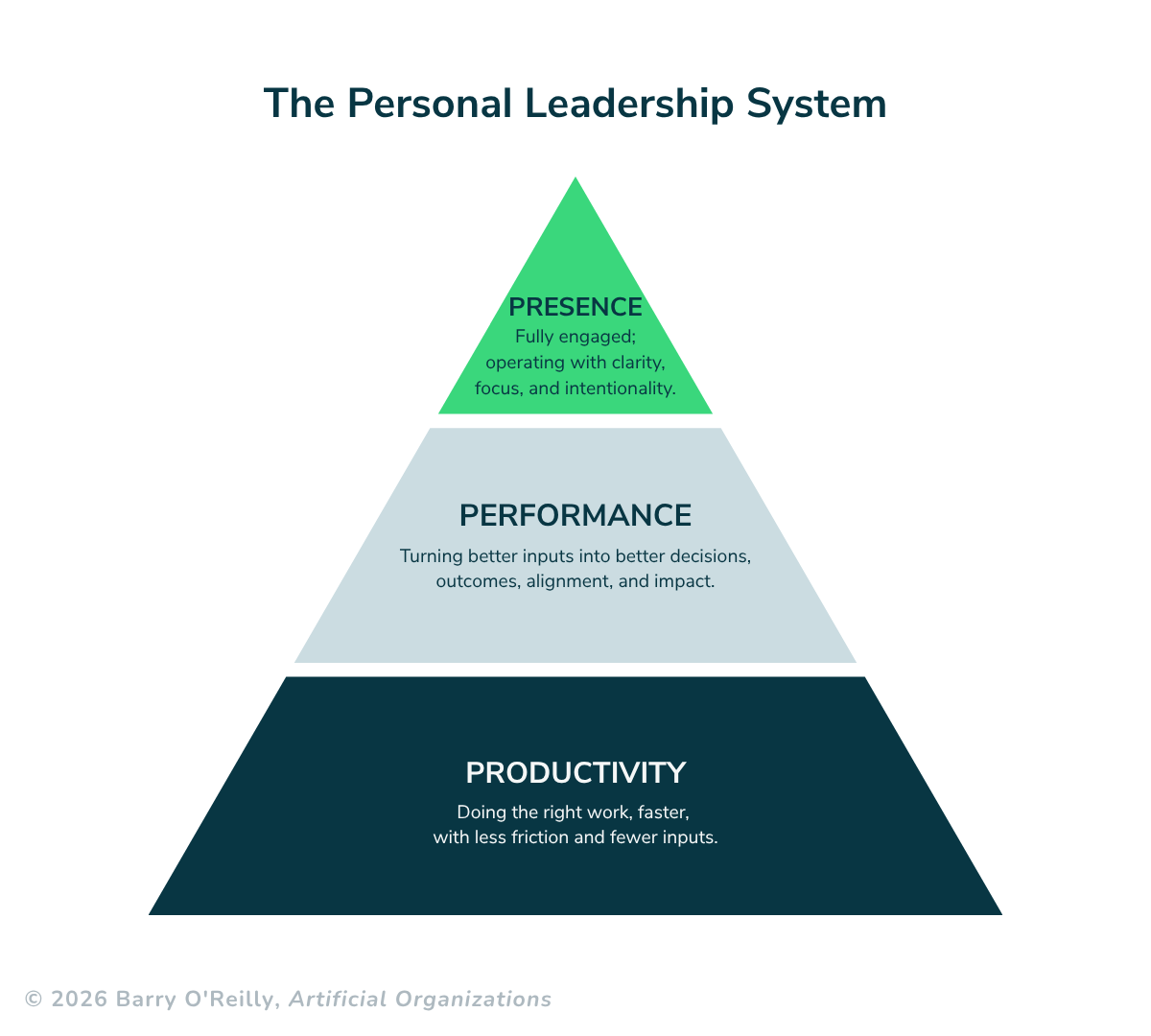
The Personal Leadership System
When AI captures the meeting, you can listen more deeply.
When AI synthesizes the conversation, you can see patterns sooner.
When AI pressure tests your thinking, you can enter the room with more conviction.
When AI tracks decisions and actions, your team can move with less ambiguity.
When AI helps you learn from outcomes, your judgment gets stronger.
That is the human superpower. Not outsourcing thinking, upgrading it.
The Executive Challenge Address
Leading organizations understand that the individual and organizational levels are connected.
At the individual level, leaders build Human Judgment Systems. They become clear about how they think, decide, and learn.
At the organizational level, they build Technology Judgment Infrastructure. They create the systems that allow better judgment to move through the company faster.
That combination changes the operating model, which I’ll write more about soon.
For now, the question for the Board, Executives team, and leaders is no longer, “Do we have AI?” Everyone will have AI.
The better question is, “Is our judgment infrastructure competitive?”
- Can your teams detect signals earlier?
- Can they make decisions closer to the work?
- Can they challenge assumptions before capital is committed?
- Can they stop weak ideas faster?
- Can they move without waiting for hierarchy to reconstruct context?
- Can leaders explain how decisions are made, why they were made, and what would cause them to change?
If the answer is no, then AI will not save you. It will expose you.
The work starts with your own judgment system.
Pick one recurring decision this week. Expose how you make it. Capture the context. Ask AI to synthesize the signals. Ask it to challenge your assumptions. Define the threshold that would trigger action. Make the decision. Track the outcome.
That is how the loop begins.
- Expose it.
- Refine it.
- Codify it.
- Improve it.
The organizations that win will not be the ones with the most tools. They will be the ones that build the clearest judgment systems, the strongest judgment infrastructure, and the courage to keep improving both.
AI will not replace leadership, it will reveal the quality of it.
Because human judgment is the scarcest resource on the planet.
Key source anchors used: Artificial Organizations defines a Judgment System as the repeatable way a leader captures, synthesizes, decides, and acts with AI, and Judgment Infrastructure as the organizational structure that improves decision quality as speed increases. It also frames the core constraint as judgment under pressure, not information access, and argues that machines process information well but humans remain responsible for deciding what matters. The Progyny / Pete Anevski case, CTSA loop, and the “capture work as data” idea also come directly from the book excerpts surfaced above.
FAQs
Q1. What does it mean that human judgment is becoming scarce?
Leaders have access to more information, data, dashboards, meetings, and AI tools than ever before. The challenge is no longer getting information. The challenge is deciding what matters, making sense of complexity, and making high-quality decisions under pressure.
Q2. If AI can analyze so much information, why is human judgment still important?
Machines are excellent at processing, recalling, and synthesizing information. They are far less capable of understanding context, weighing trade-offs, navigating ambiguity, and deciding what matters most. Those responsibilities remain firmly in the hands of leaders.
Q3. Should leaders focus on AI tools or changing how they work?
Most leaders start with tools, but tools are rarely the real constraint. The bigger opportunity is redesigning how work gets done, reducing low-value administrative tasks, and creating more space for strategic thinking, decision-making, and leadership.
Q4. What is the biggest mistake organizations make with AI?
Many organizations treat AI as a technology rollout or efficiency initiative. They focus on automating work rather than improving decision-making. As a result, they accelerate activity without improving judgment, clarity, or outcomes.
Q5. How can leaders use AI without becoming dependent on it?
Use AI as a thinking partner, not a decision-maker. Let machines handle capture, recall, synthesis, and preparation while leaders remain responsible for interpretation, judgment, accountability, and action. The goal is not to replace human thinking but to strengthen it.
References
- O’Reilly, Barry. Artificial Organizations: Build Better Judgment, Speed, and Results with Human and Machine Intelligence. New York: Ideapress Publishing, 2026.
- O’Reilly, Barry. “AI as a Thinking Partner: Leadership and Decision-Making.” Unlearn Podcast.
- O’Reilly, Barry. “Good to Great Decisions: Why Better Judgment Is the New Leadership Advantage.” BarryOReilly.com.
- O’Reilly, Barry. “Human vs AI vs Human + AI: The Leadership Shift No One Is Explaining Properly.” BarryOReilly.com.
- McKinsey & Company. The State of AI in Early 2025: Generative AI’s Breakout Year. New York: McKinsey & Company, 2025.
- Dell’Acqua, Fabrizio, Karim R. Lakhani, Hila Lifshitz-Assaf, Katherine Kellogg, Soroush Vosoughi, and others. “Navigating the Jagged Technological Frontier: Field Experimental Evidence of the Effects of AI on Knowledge Worker Productivity and Quality.” Harvard Business School Working Paper, 2024.
- Burning Glass Institute. The Emerging AI Economy: Implications for Workforce Skills and Jobs. Philadelphia: Burning Glass Institute, 2026.